
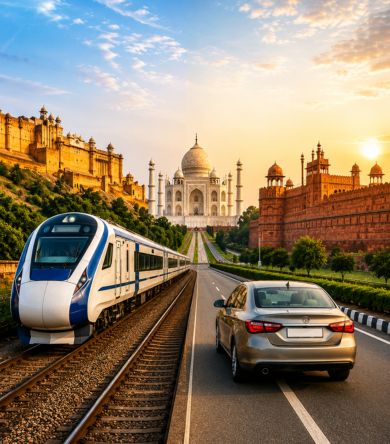
Choosing how you travel between Delhi, Agra, and Jaipur can make or break your trip. The Golden Triangle by train vs car decision isn’t just about logistics — it shapes how much you see, how comfortable you feel, and how much flexibility you have along the way. Both options have real advantages, and the right one depends entirely on your travel style, budget, and what you actually want out of the journey. In this guide, you’ll get a full breakdown of cost, comfort, scenic stops, hidden expenses, and which option fits different types of travelers, so you can plan with confidence. If you’re leaning toward flexibility and door-to-door comfort from the start, our Golden Triangle Tour India by private car is built around exactly that.
In This Guide – Golden Triangle by Train vs Car
| Section | What You’ll Learn |
|---|---|
| What Is the Golden Triangle? | Understand India’s famous Delhi–Agra–Jaipur tourist circuit and why it’s so popular. |
| Train vs Car at a Glance | Get a quick side-by-side comparison before diving into the details. |
| Cost Comparison | Compare train fares, private car costs, and the hidden expenses travelers often overlook. |
| Travel Time Comparison | See how long each journey takes, including Delhi–Agra, Agra–Jaipur, and Jaipur–Delhi. |
| Door-to-Door Experience | Discover the real travel time, including station transfers, waiting time, and hotel pickups. |
| Comfort & Convenience | Compare seating comfort, privacy, flexibility, luggage handling, and rest stops. |
| Scenic Experiences | Explore attractions and roadside experiences only accessible by private car, including Fatehpur Sikri and Chand Baori. |
| Traveler Type Guide | Find the best option for families, couples, solo travelers, photographers, seniors, and luxury travelers. |
| Hidden Costs | Learn about additional expenses like taxis, porter fees, tolls, parking, and travel delays. |
| Hybrid Travel (Train + Car) | Discover how combining train and private car can offer the perfect balance of speed and flexibility. |
| Best Choice by Budget | Compare the best transport option for budget, mid-range, and luxury travelers. |
| Frequently Asked Questions | Get answers to the most common questions about traveling the Golden Triangle by train or car. |
What Is the Golden Triangle Tour?
The Golden Triangle refers to the classic travel circuit connecting Delhi, Agra, and Jaipur — three cities that, when mapped, form a rough triangular route across North India. Delhi offers the political and historic capital experience, Agra is home to the Taj Mahal and Agra Fort, and Jaipur delivers the royal architecture and color of Rajasthan. The full loop covers roughly 720 km, and most travelers complete it in 4 to 6 days. It remains India’s most popular tourist circuit because it packs three completely different experiences — Mughal history, royal heritage, and modern capital life — into a single, manageable route.
Which Option (Golden Triangle by Train vs Car) Is Right for You? (Quick Quiz)
| Question | If Yes, Choose | Why? |
|---|---|---|
| Traveling with children? | Private Car | More space, flexible breaks, and easier luggage handling for families. |
| Traveling alone? | Train | Budget-friendly and efficient for solo travelers following a fixed itinerary. |
| Love photography? | Private Car | Stop at scenic viewpoints, villages, and attractions whenever you like. |
| Budget under ₹20,000? | Train | Lower transportation costs make it ideal for budget-conscious travelers. |
| Want to visit Fatehpur Sikri or Chand Baori? | Private Car | These attractions are easily accessible by road and difficult to include with train travel. |
| Carrying multiple suitcases? | Private Car | No need to move luggage through busy railway stations. |
| Traveling with senior citizens? | Private Car | Fewer transfers, less walking, and a more comfortable journey. |
| Looking for a luxury experience? | Private Car | Personalized service, premium vehicles, and complete itinerary flexibility. |
| Only visiting Delhi and Agra? | Train | Fast, convenient, and cost-effective for a short trip between the two cities. |
| Want complete flexibility during your trip? | Private Car | Change your schedule, stop for meals, sightseeing, or shopping whenever you want. |
| Planning a honeymoon or romantic getaway? | Private Car | Enjoy privacy and the freedom to travel at your own pace. |
| Short on time and want the fastest Delhi–Agra connection? | Train | Premium trains offer the quickest journey between Delhi and Agra. |
Quick Recommendation – Golden Triangle by Train vs Car
| Choose a Private Car If… | Choose a Train If… |
|---|---|
| You want a relaxed, flexible holiday. | You’re traveling on a tight budget. |
| You’re visiting Delhi, Agra, and Jaipur. | You’re only visiting Delhi and Agra. |
| You want to stop at attractions along the route. | You don’t mind fixed schedules and station transfers. |
| You’re traveling with family, seniors, or lots of luggage. | You’re traveling solo with light luggage. |
| You value comfort and convenience over saving money. | Your priority is the lowest travel cost. |
If most of your answers point to one column, that’s your starting point — the sections below will help you confirm it.
Golden Triangle by Train vs Car: Quick Comparison
| Feature | Private Car | Train |
|---|---|---|
| Door-to-Door Convenience | Hotel pickup and drop-off with no transfers | Requires station transfers and local taxis |
| Flexibility | Travel on your own schedule with optional sightseeing stops | Fixed departure and arrival times |
| Privacy | Exclusive vehicle for you or your group | Shared with other passengers |
| Overall Cost | Higher upfront cost but includes convenience and flexibility | Lower ticket cost but additional transfer expenses may apply |
| Scenic Stops | Visit places like Fatehpur Sikri, Chand Baori, and local villages | Limited to destinations served by the rail route |
| Comfort | Spacious seating, climate control, and customizable breaks | Comfortable in premium classes but fixed seating throughout the journey |
| Luggage Handling | Luggage stays securely in the vehicle during the entire trip | Carry luggage through stations and store it onboard |
| Family Friendliness | Ideal for families with children or elderly travelers | Suitable, but transfers can be less convenient |
| Luxury Experience | Personalized service with premium vehicles and private driver | Premium train classes offer comfort but a shared environment |
| Photography Opportunities | Stop whenever you want for landscapes and monuments | Views are limited to what is visible from the train |
| Sightseeing Flexibility | Add attractions and local experiences without changing transport | Separate transport is required for most sightseeing stops |
| Travel Pace | Relaxed and fully customizable | Fixed schedule with limited flexibility |
| Best For | Families, couples, luxury travelers, photographers, and first-time visitors | Budget travelers, solo travelers, and those focused on speed |
Winner Summary
| Category | Winner |
|---|---|
| Lowest Cost | Train |
| Fastest Delhi–Agra Journey | Train |
| Door-to-Door Convenience | Private Car |
| Comfort | Private Car |
| Flexibility | Private Car |
| Scenic Experiences | Private Car |
| Family Travel | Private Car |
| Luxury Experience | Private Car |
| Photography | Private Car |
| Overall Travel Experience | Private Car |
Real Cost Calculator: What You Actually Pay
A simple ticket-price comparison is misleading. Here’s what each option really costs once every expense is included.
Train (Delhi–Agra leg, per person estimate)
Ticket: ₹750–1,500
Taxi to station: ₹250
Taxi from station: ₹250
Food at station/on board: ₹200
Porter charges: ₹100
Waiting time cost (lost touring time, not cash, but worth factoring in)
Actual total: roughly ₹1,300–2,300 per person, plus lost time
Private Car (Delhi–Agra leg, per vehicle, shared across the group)
Package rate (car + driver): ₹3,500–5,500 depending on vehicle class
Driver tip: ₹200–300
Tolls and parking: usually included in package pricing
Actual total: roughly ₹3,700–5,800 per vehicle, which often works out cheaper per person for families or groups of 3 or more
The takeaway: train wins for solo travelers and pairs on a strict budget, but a private car frequently becomes the more economical option once you’re splitting the cost across three or four people, especially when you add in the time and hassle saved.
Hidden Time Calculator: Delhi to Agra
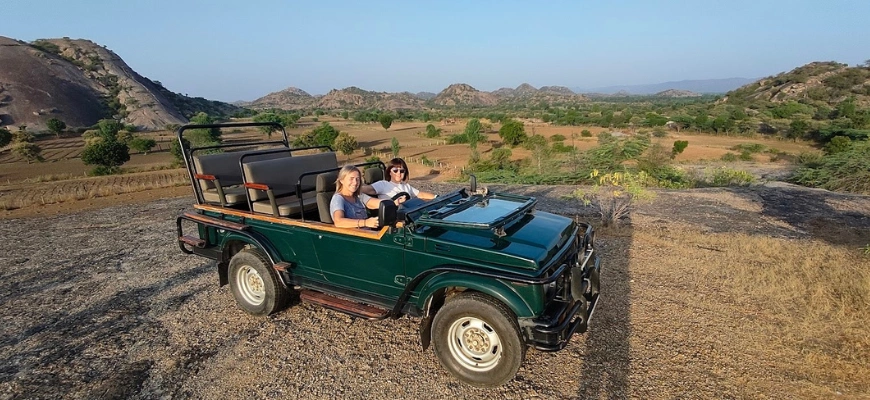
Train (on paper: 2 hours)
Taxi to station: 25 min
Security and boarding: 30 min
Waiting time: 20 min
Train journey: 2 hr
Taxi from station: 20 min
Hotel check-in: 15 min
Actual door-to-door time: approximately 3 hr 50 min
Private Car (on paper: 3.5 hours)
Hotel pickup: 5 min
Drive: 3 hr 30 min
Comfort break: 20 min
Hotel arrival: 5 min
Actual door-to-door time: approximately 4 hr
The gap most travelers expect — train being dramatically faster — barely exists once every step is counted. The train saves roughly 10 minutes door-to-door, while the car skips every transfer, security line, and luggage handoff in between.
Travel Time Comparison (All Three Legs)
Delhi to Agra: car takes 3–3.5 hours via the Yamuna Expressway; the Gatimaan Express covers it in under 2 hours of actual train time.
Agra to Jaipur: car takes 5–5.5 hours on NH21, with the option to stop at Fatehpur Sikri and Abhaneri; direct trains take roughly 4.5–5 hours with limited departure flexibility.
Jaipur to Delhi: car takes approximately 5.5 hours via NH48; train takes around 4.5–5 hours with several daily departures.
Door-to-Door Travel Experience
Traveling by train looks like this: hotel, then a taxi to the railway station, then security screening, then waiting on the platform, then the train itself, then arrival at the destination station, then another taxi, then finally your hotel. Each transfer adds time, effort, and a small amount of uncertainty.
Traveling by private car looks like this: hotel, meet your driver, comfort stops as needed, arrival at your destination, hotel. No transfers, no platform waits, no juggling luggage between vehicles.
Comfort Comparison
Private car: an adjustable schedule that bends around your day, consistent air conditioning, personal space for the whole journey, rest stops whenever you need them, and luggage that stays in the vehicle the entire trip.
Train: Executive Class and AC Chair Car options offer solid comfort, but you’re sharing the environment with other passengers, locked into a fixed schedule, and dealing with station transfers on both ends.
Scenic Experiences You Miss by Train
This is one of the biggest differences between the two options. Traveling by road between Agra and Jaipur opens up stops that simply aren’t accessible by train: Fatehpur Sikri, the abandoned Mughal city sitting directly along the road route; Chand Baori, the stunning stepwell in Abhaneri village; local dhabas for an authentic meal; marble and textile workshops where artisans work in real time; and stretches of rural Rajasthan landscape that make for some of the best highway photography stops on the trip.
Attraction Accessibility: Golden Triangle by Train vs Car
| Attraction / Experience | By Train | By Private Car |
|---|---|---|
| Taj Mahal | Excellent | Excellent |
| Fatehpur Sikri | Limited (requires separate transfer) | Excellent |
| Chand Baori Stepwell | Not Easily Accessible | Excellent |
| Abhaneri Village | Not Easily Accessible | Excellent |
| Local Villages | Not Accessible | Excellent |
| Traditional Dhabas | Not Accessible | Excellent |
| Local Markets | Limited | Excellent |
| Marble Inlay Workshops | Limited | Excellent |
| Handicraft & Textile Workshops | Limited | Excellent |
| Highway Photography Stops | Not Possible | Excellent |
| Rural Rajasthan Landscapes | Limited | Excellent |
| Flexible Sightseeing Stops | Not Available | Excellent |
The Taj Mahal is the one stop both options handle equally well, since it sits in central Agra. Everything else along the route strongly favors the car.
Seasonal Comparison
Winter: fog is the biggest factor here, frequently causing train delays on early-morning departures; road travel is generally more predictable, though early starts should be planned with buffer time. Best departure: mid-morning once fog clears.
Summer: heat makes AC comfort essential either way; train AC coaches are consistently cool, while car AC depends on the operator, so confirm this in advance. Best travel hours: early morning or evening to avoid peak heat.
Monsoon: road safety becomes the main consideration, with occasional waterlogging on highway stretches; trains are less affected by rain but scenic stops lose some appeal in heavy downpours. Travel advice: build extra buffer time into road journeys during peak monsoon weeks.
Which Is Better for Different Travelers?
Families: Private car.
Couples: Private car.
Solo travelers: Train.
Luxury travelers: Private car.
Senior travelers: Private car.
Backpackers: Train.
Photographers: Private car.
Business travelers: Train.
Real Travel Scenarios
Scenario 1 — Family of 4: Winner: Private Car. Why: luggage stays in the vehicle, no platform transfers with kids, and the cost splits favorably across four people.
Scenario 2 — Solo Backpacker: Winner: Train. Why: lowest cost, minimal luggage, and a fixed schedule isn’t a drawback when traveling alone.
Scenario 3 — Luxury Couple: Winner: Private Car. Why: privacy, comfort, and the option to add romantic scenic stops along the way.
Scenario 4 — Senior Couple: Winner: Private Car. Why: fewer transfers, less walking through stations, and a more comfortable overall pace.
Scenario 5 — College Friends: Winner: Train. Why: budget-friendly, social atmosphere, and the group doesn’t mind a fixed schedule.
Tourist Personas: Tailored Advice
First-time India visitors: lean toward private car for ease and fewer logistics to manage while still adjusting to a new country.
Repeat visitors: train is a comfortable, efficient choice once you’re already familiar with the route and stations.
Luxury travelers: private car, for full customization and door-to-door comfort.
Families: private car, for flexibility around children’s schedules and naps.
Couples: private car, for privacy and romantic detours.
Senior travelers: private car, to minimize walking and transfers.
Digital nomads: car, for charging access and flexible work breaks during the journey.
Photographers: car, for unrestricted access to scenic stops along the route.
Train + Car Hybrid Travel: The Best of Both Worlds
This is one of the most underused strategies for the Golden Triangle, and it deserves real attention because it genuinely solves the core tradeoff between speed and flexibility.
When should you combine both? The Delhi to Agra leg is short enough that train speed offers a real advantage, while the Agra to Jaipur leg is where the road truly shines, with Fatehpur Sikri and Chand Baori sitting directly along the route. Combining the two means you get the fastest possible start to your trip and the richest possible middle stretch.
Best train for Delhi to Agra: the Gatimaan Express is the standout choice, covering the distance in under 2 hours with Executive Class seating that’s comfortable enough for a short morning journey.
Private driver from Agra to Jaipur: booking a private car for this specific leg, rather than the full circuit, lets you build in stops at Fatehpur Sikri, Chand Baori, and roadside dhabas without committing to a car for the entire trip.
How much money does it save? For solo travelers and pairs, the hybrid approach can save 15–25% compared to a full private car package, while still delivering the scenic Agra–Jaipur stretch that trains can’t offer.
Who benefits most? Travelers who want to save time on the Delhi–Agra leg specifically, but still want the open-road experience for the more scenic Agra–Jaipur stretch — this is especially well-suited to photographers, couples, and small groups of 2–3 people.
Sample 5-day hybrid itinerary:
1 Day , arrive and explore Delhi.
2 Day, take the Gatimaan Express to Agra, visit the Taj Mahal and Agra Fort.
3 Day, private car from Agra to Jaipur via Fatehpur Sikri and Chand Baori.
4 Day, explore Jaipur’s forts and palaces.
5 Day, train back to Delhi.
Sample 7-day hybrid itinerary:
1–2 Day in Delhi with sightseeing,
3 Day train to Agra,
4 Day full day in Agra including sunrise at the Taj Mahal,
5 Day private car to Jaipur via scenic stops,
Days 6–7 in Jaipur with a relaxed pace before flying out or training back to Delhi.
Booking tips: reserve the Gatimaan Express at least a week in advance since seats sell out quickly, and book your private car for the Agra–Jaipur leg separately so the driver and vehicle are confirmed before you arrive in Agra.
Common mistakes: booking the train too close to departure and missing out on Executive Class seating; not confirming the private car pickup point at the Agra train station in advance; and underestimating how much time the Fatehpur Sikri and Chand Baori stops add, which can push a tight schedule into the evening.
Hidden Costs Most Travelers Forget
Train hidden costs: taxi to the station, taxi from the station, porter charges, waiting time, food at the station, and the awkward timing of early checkouts or late check-ins around train schedules.
Car hidden costs: fuel (often included in package pricing), tolls, driver allowance for overnight stays, and parking at hotels or attractions.
Luggage Comparison
Train: carrying your own bags, relying on porters at busy stations, navigating storage on board, and managing platform changes with luggage in tow.
Car: luggage stays in the vehicle the entire trip, making shopping along the way far more convenient, with everything within easy reach.
Safety Comparison
For solo women travelers, both premium train classes and a licensed private driver offer reasonable safety, though many travelers find a known driver and vehicle more reassuring for night travel. Families generally feel most secure with a private car, since there’s no need to navigate crowded platforms with children. Premium train classes offer solid security measures, and most reputable car services provide emergency support contacts as standard.
Productivity During Travel
Car: charging ports, flexible break timing, light laptop work when road conditions allow, and consistent privacy throughout.
Train: a chance to read, take in scenic views, and enjoy the more social atmosphere of shared travel.
Best Transport Option by Budget
Budget travelers: Train. Mid-range travelers: hybrid approach or shared private car. Luxury travelers: Private car. Honeymoon trips: Private car. Family vacations: Private car. Group tours: Private car.
Decision Flowchart
Choose train if: budget matters most, you’re traveling light, you’re only visiting Delhi and Agra, and you’re comfortable with fixed schedules.
Choose private car if: you want flexibility, you’re carrying multiple bags, you’re traveling with family, you want scenic stops, you love photography, or you simply prefer comfort over cost savings.
Who Should NOT Choose Each Option?
Don’t choose train if: you’re traveling with elderly parents, carrying four or more suitcases, or want real flexibility in your schedule.
Don’t choose car if: you’re only visiting Agra and nothing else, you’re working with a very limited budget, or you specifically want the fastest possible Delhi–Agra connection.
Mistakes by Transport Type
Train mistakes: booking the wrong class for comfort needs, arriving late and missing the departure, carrying heavy luggage that’s difficult to manage on platforms, and getting confused by platform changes at busy stations.
Car mistakes: booking with cheap, unverified operators, ignoring toll and parking costs when budgeting, skipping the sightseeing stops that make the drive worthwhile, and allowing late departures to eat into the day’s schedule.
Best Hotels Based on Transport
Staying near the railway station: ideal if you’re train-hopping between cities, since it minimizes taxi time and makes early departures far less stressful.
Staying near the highway exit: ideal for private car travelers, since it simplifies pickup and drop-off and avoids navigating through dense city traffic at the start and end of each driving day.
Packing Guide by Transport Type
Train: small luggage, a backpack for essentials, and gear that’s easy to carry through stations and onto platforms.
Car: a larger suitcase since space isn’t a constraint, a camera bag for the scenic stops, and room left over for shopping picked up along the way.
Sample 5-Day Itinerary by Train
1 Day : Arrive and explore Delhi.
2 Day : Train to Agra, visit the Taj Mahal and Agra Fort.
3 Day : Train to Jaipur.
4 Day : Explore Jaipur’s forts and palaces.
5 Day : Train back to Delhi for departure.
Sample 5-Day Itinerary by Private Car
1 Day : Arrive in Delhi, comfortable hotel check-in.
2 Day : Drive to Agra with scenic stops, Taj Mahal and Agra Fort.
3 Day : Drive to Jaipur via Fatehpur Sikri and Chand Baori.
4 Day : Full day exploring Jaipur’s Amber Fort and City Palace.
5 Day : Comfortable drive back to Delhi for departure.
If you’re considering a flexible setup that blends both worlds, it’s worth exploring Rajasthan Tour Packages that can be tailored around a combined train-and-car itinerary, getting the efficiency of rail and the open-road experience where it matters most.
Why We Recommend It
| If You Want… | Best Option | Why We Recommend It |
|---|---|---|
| Lowest Overall Cost | Train | Lower ticket prices make it the most budget-friendly option. |
| Maximum Flexibility | Private Car | Travel at your own pace with the freedom to stop whenever you like. |
| Luxury & Comfort | Private Car | Enjoy a personalized journey with premium vehicles and a dedicated driver. |
| Fastest Delhi–Agra Journey | Train | Premium trains like the Gatimaan Express offer the quickest travel time. |
| Photography Stops | Private Car | Stop at scenic viewpoints, villages, and monuments whenever inspiration strikes. |
| Family Holiday | Private Car | More comfortable for children, seniors, and travelers with extra luggage. |
| Scenic Road Trip Experience | Private Car | Visit attractions like Fatehpur Sikri, Chand Baori, and local villages along the route. |
| Solo Budget Travel | Train | Ideal for solo travelers looking to keep transportation costs low. |
| Traveling with Senior Citizens | Private Car | Fewer transfers and a more relaxed, comfortable journey. |
| Honeymoon or Couple’s Trip | Private Car | Greater privacy and the flexibility to create a romantic itinerary. |
| Traveling with Large Luggage | Private Car | No need to carry bags through busy railway stations. |
| Fixed Schedule & Short Trip | Train | Best if you’re following a strict timetable and visiting only major cities. |
| First-Time Visit to India | Private Car | Easier navigation, local assistance, and a stress-free travel experience. |
| Exploring Beyond Major Attractions | Private Car | Easily access hidden gems and off-the-beaten-path destinations. |
Final Verdict
| Travel Style | Recommended Option |
|---|---|
| Budget Traveler | Train |
| Family Traveler | Private Car |
| Couples & Honeymooners | Private Car |
| Photography Enthusiasts | Private Car |
| Senior Travelers | Private Car |
| Solo Backpackers | Train |
| Luxury Travelers | Private Car |
| Travelers Seeking a Complete Golden Triangle Experience | Private Car |
FAQs – Golden Triangle by Train vs Car
Is the Golden Triangle better by train or car?
It depends on priorities — train wins on cost and speed for the Delhi–Agra leg, while car wins on flexibility, comfort, and scenic stops across the full circuit.
Which is cheaper?
Train tickets are cheaper upfront, though the gap narrows for groups of three or more once hidden costs are factored in.
Which is faster?
For Delhi to Agra specifically, the train is marginally faster door-to-door; for the full circuit including stops, a private car is often comparable or faster overall.
Is a private driver worth it?
For families, photographers, and travelers who want scenic stops, yes — the flexibility and comfort generally justify the cost.
Can I combine train and car?
Yes, a hybrid approach using train for Delhi–Agra and car for Agra–Jaipur is a popular and practical option, and often the smartest choice overall.
Is it safe for solo travelers?
Both options are reasonably safe; premium train classes and licensed private drivers each offer solid safety standards.
Which option is best for families?
Private car, due to the flexibility and reduced hassle of managing luggage and schedules with children.
Which option is best for photographers?
Private car, since it allows stops at scenic locations the train route simply bypasses.
How much luggage can I bring?
Private cars comfortably handle multiple large bags; trains require more careful packing, especially in Chair Car classes.
Which train class should I book?
Executive Class or AC Chair Car on routes like the Gatimaan Express offer the best comfort-to-cost ratio.
Is a 5-day itinerary enough?
Yes, 5 days comfortably covers the core Golden Triangle circuit, whether traveling by train, car, or a hybrid of both.
What’s the best way to see Fatehpur Sikri?
By private car, since it sits directly on the Agra–Jaipur road route and isn’t accessible via the train circuit.
Conclusion – Golden Triangle by Train vs Car
When it comes to Golden Triangle by train vs car, there’s no single right answer — it comes down to matching transportation to your travel style, group size, and priorities. Train travel suits budget-conscious or solo travelers who prioritize speed on the Delhi–Agra leg. A Golden Triangle Tour by Car suits families, couples, and photographers who value flexibility and scenic stops. And for travelers who want the best of both, the train-and-car hybrid offers real savings without giving up the road’s most rewarding detours.
If a seamless, customizable journey across Delhi, Agra, and Jaipur sounds like what you’re after, explore our Golden Triangle Tour by Private Car and let the road show you more of India than the rails ever could. For travelers planning a longer Rajasthan circuit, our Private Car Driver India service can also extend comfortably beyond the Golden Triangle into a full Rajasthan itinerary.
