Table of Contents Why Jaipur Needs a Private Taxi Services Offered Vehicle Options Booking Process Best Time to Hire Pricing Private Taxi vs Street Taxi Common Taxi Scams Choosing the Right Operator FAQs Jaipur welcomed a record share of Rajasthan's 25.44 crore tourist visits in 2025, and most of them arrived needing one thing sorted first: a way to get from the airport or station into the city safely. A reliable private taxi service in Jaipur is the difference between starting your trip relaxed or starting it stressed, haggling over fares before you've even seen the Pink City. Whether you need a Jaipur airport taxi, a private cab for city sightseeing, or a full-day Jaipur chauffeur service, this guide covers what to expect, what it costs, and how to avoid the handful of problems that catch first-time visitors off guard. If you're planning a longer trip beyond Jaipur, our India private driver tour service covers pickups and multi-city journeys across the state with the same driver from start to finish. Why Jaipur Needs a Reliable Private Taxi Service Jaipur isn't a small stop-off anymore. It's one of the few cities in the world holding three UNESCO World Heritage recognitions inside its own city limits — the Walled City, Amber Fort, and Jantar Mantar — and it was named among the world's best travel destinations in 2025, a reflection of how fast international interest in the city has grown. Rajasthan's Tourism Department reported that the state's foreign tourist arrivals fell just 6.4% in 2025, far less than the 12.53% national decline recorded across India, meaning Jaipur is holding onto international visitors even as broader travel patterns shift. That growth brings real pressure onto local transport. During peak season, traffic around Amber Fort, MI Road, and the walled city gets heavy fast,
Table of Contents
Why Jaipur Needs a Private Taxi
Services Offered
Vehicle Options
Booking Process
Best Time to Hire
Pricing
Private Taxi vs Street Taxi
Common Taxi Scams
Choosing the Right Operator
FAQs
Jaipur welcomed a record share of Rajasthan’s 25.44 crore tourist visits in 2025, and most of them arrived needing one thing sorted first: a way to get from the airport or station into the city safely. A reliable private taxi service in Jaipur is the difference between starting your trip relaxed or starting it stressed, haggling over fares before you’ve even seen the Pink City. Whether you need a Jaipur airport taxi, a private cab for city sightseeing, or a full-day Jaipur chauffeur service, this guide covers what to expect, what it costs, and how to avoid the handful of problems that catch first-time visitors off guard.
If you’re planning a longer trip beyond Jaipur, our India private driver tour service covers pickups and multi-city journeys across the state with the same driver from start to finish.
Why Jaipur Needs a Reliable Private Taxi Service
Jaipur isn’t a small stop-off anymore. It’s one of the few cities in the world holding three UNESCO World Heritage recognitions inside its own city limits — the Walled City, Amber Fort, and Jantar Mantar — and it was named among the world’s best travel destinations in 2025, a reflection of how fast international interest in the city has grown. Rajasthan’s Tourism Department reported that the state’s foreign tourist arrivals fell just 6.4% in 2025, far less than the 12.53% national decline recorded across India, meaning Jaipur is holding onto international visitors even as broader travel patterns shift.
That growth brings real pressure onto local transport. During peak season, traffic around Amber Fort, MI Road, and the walled city gets heavy fast, and a taxi service in Jaipur that plans routes around this — instead of relying on a shared cab or a last-minute street hail — saves real time on a short trip.
What a Private Taxi Service in Jaipur Actually Covers
This kind of service typically falls into two categories, and it’s worth knowing which one you need before you book:
Airport & Station Transfers
A single pickup or drop between Jaipur International Airport, Jaipur Junction Railway Station, or Sindhi Camp Bus Stand and your hotel — whether you’re staying in C-Scheme, Bani Park, Malviya Nagar, or near MI Road. This is a fixed point-to-point trip, usually taking 20–40 minutes depending on where you’re staying in the city.
Full-Day or Half-Day City Tours
A private car and driver for several hours or a full day, covering Amber Fort, City Palace, Hawa Mahal, Jal Mahal, and Jaipur’s markets at your own pace, with the driver waiting at each stop. This is what most people mean when they search for a Jaipur sightseeing taxi or a private cab for a Jaipur city tour.
Some travelers need both — a Jaipur airport transfer on arrival, then a private cab Jaipur travelers can rely on for sightseeing over the following days. Booking both with the same operator usually works out simpler and often cheaper than arranging them separately.
Planning your Jaipur trip? Book a verified private taxi service in Jaipur with an experienced local driver and get fixed pricing, flexible sightseeing, and comfortable travel across the city.
Choose the Right Vehicle for Your Jaipur Trip
Vehicle choice affects both comfort and price, so it’s worth matching the car to your trip type:
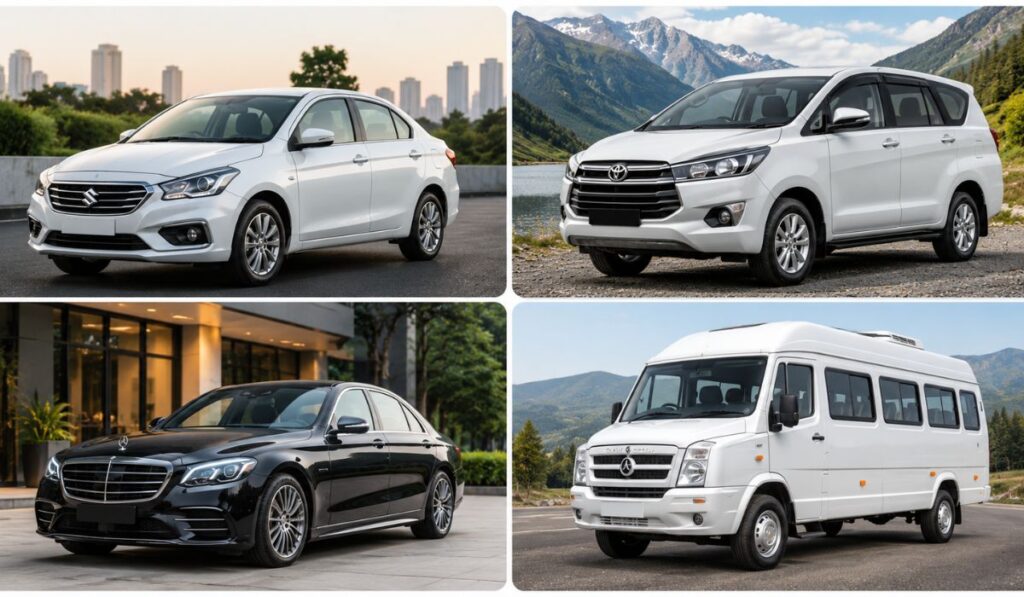
Sedan — Ideal for couples or solo travelers doing an airport transfer or a light sightseeing day
SUV — Best for families or small groups needing more luggage space
Innova Crysta — The most common choice for longer Rajasthan tours and multi-day trips, comfortable over long distances
Tempo Traveller — Suited to larger groups of 8–12, common for family reunions or group bookings
How to Book a Private Taxi in Jaipur
Booking a Jaipur car rental with driver is usually a short process:
Share your pickup location — Jaipur International Airport, Jaipur Junction, or your hotel address
Confirm your itinerary — airport transfer only, a city tour, or a multi-day Rajasthan trip
Receive your vehicle and driver details in advance, not on the day
Meet your driver at the agreed pickup point
Enjoy your journey with fixed, pre-agreed pricing
Best Time to Hire a Private Taxi in Jaipur
Timing your booking around Jaipur’s traffic and tourist patterns makes a real difference:
October to March is peak season — book vehicles a few days ahead, since local taxi services get booked out around Diwali and other festival weeks
Early morning is the best time to start an Amber Fort visit, both to beat the crowds and the heat
Avoid late afternoon rush hour (roughly 5–8 PM) around MI Road and the walled city if your itinerary is time-sensitive, such as a train or flight connection
Typical Pricing for a Private Taxi Service in Jaipur
Fares vary by vehicle type, season, and whether you book an outstation operator or a local one, but as a general guide:
Service
Typical Vehicle
Approximate Price Range (INR)
Airport/station transfer
Sedan
₹700–₹1,200
Full-day city tour (8 hrs/80 km)
Sedan
₹2,000–₹2,800
Full-day city tour (8 hrs/80 km)
SUV/Innova
₹3,500–₹5,000
Outstation (per km, one-way)
Sedan
₹12–₹15/km
These are indicative ranges — always confirm the exact fare, inclusions (tolls, parking, driver allowance), and cancellation terms before you book, since pricing shifts with fuel costs and festival-season demand.
Private Taxi vs Street Taxi: What Actually Changes
Factor
Street Taxi
Private Taxi Service
Fixed price agreed upfront
Rarely
Yes
Airport pickup with meet-and-greet
Rarely
Yes
Waiting charges
Usually extra
Usually included in the package
English-speaking driver
Uncommon
Common with established operators
Unscheduled shopping stops
Common
Only if you ask for them
The Real Difficulties Tourists Face With Jaipur Taxis
This is worth being direct about, because it’s the single biggest complaint from first-time visitors to Jaipur, and it’s well documented by travel safety guides and Rajasthan’s own tourism authorities:
Meter refusal and inflated fares. Street taxis and autos sometimes refuse to use a meter and quote a fixed price well above the going rate, particularly near Hawa Mahal and other tourist hotspots.
Fake ticket agents at monuments. Unofficial agents outside Amber Fort sell counterfeit or already-used entry tickets to tourists, who only discover the problem at the checkpoint.
Commission-driven detours. Some drivers steer visitors toward specific gem or handicraft shops that pay a commission, adding unplanned stops and pressure to buy.
“Your hotel is closed” scam. A driver claims a pre-booked hotel is full or shut and redirects the traveler to a different property that pays the driver a cut.
Unregulated touts (“lapkas”). Rajasthan authorities have acknowledged that touts posing as guides are a persistent problem in Jaipur and Udaipur specifically, and the state has moved to make misbehaviour toward tourists a cognisable offence to address it.
None of this means Jaipur is unsafe — most visits are trouble-free in the main tourist areas — but it’s exactly why booking verified, upfront-priced private transport removes most of the risk before it starts, rather than trying to negotiate your way out of it on the street. Our guide on hiring a chauffeur driver safely in India covers this in more depth for first-time and foreign travelers.
What to Look for in a Private Taxi Service in Jaipur
Upfront, written pricing — no “discuss on arrival” fares
Verified drivers with commercial plates and ID, not informal street operators
No unscheduled shopping stops unless you ask for them
Confirmed vehicle and driver details before pickup, not on the day
A single point of contact for support if plans change mid-trip
Our drivers work Jaipur’s airport, station, and city routes daily, so pricing, timing, and route decisions are based on what actually works on the ground — not a generic quote. If you’re combining Jaipur with the wider region, our Rajasthan private taxi service extends the same private car and driver across Jodhpur, Udaipur, and Jaisalmer. For a single day trip within the city, our same day Jaipur tour package is a ready-made option, and our post on private drivers in Jaipur covers route-by-route detail if you want to plan it yourself first.
Frequently Asked Questions
How much does a private taxi cost from Jaipur airport to the city?
Expect roughly ₹700–₹1,200 for a sedan, depending on your exact drop location, time of day, and whether you book in advance or on arrival.
Is it safe to hire a private taxi in Jaipur?
Yes, for the vast majority of travelers, especially when booking through a verified operator rather than an unregulated street taxi. The main risks are overcharging and touts, not violent crime.
Should I use a metered taxi or book a private car in advance?
For a single short trip, a metered taxi can work if the driver agrees to use it. For airport transfers, multi-stop sightseeing, or if you’re traveling with family, a pre-booked private taxi service in Jaipur avoids the meter dispute altogether.
What’s the biggest scam to watch for with Jaipur taxis?
Meter refusal combined with inflated flat-rate quotes, and drivers redirecting you to commission-paying shops mid-trip. Agreeing on the fare and itinerary in writing before you start avoids both.
Can I book a private taxi for a full day of Jaipur sightseeing?
Yes — full-day and half-day city tour packages are the most common way to see Amber Fort, City Palace, Hawa Mahal, and Jal Mahal in one trip without switching transport between stops.
Do Jaipur taxi drivers speak English?
Drivers working with established tour operators generally speak conversational English; drivers picked up informally on the street may not, which can make negotiating fares and directions harder.
Can I hire a private taxi in Jaipur for two days or more?
Yes, multi-day bookings are common, especially for travelers combining Jaipur with Pushkar, Ajmer, or onward Rajasthan destinations. Confirm the daily kilometer limit and overnight driver allowance when booking.
Is fuel included in the price?
Most local and outstation packages quote an all-inclusive per-day or per-km rate that covers fuel, but this varies by operator — always confirm what’s included before you book rather than assuming.
Do drivers help with luggage?
Most private drivers assist with loading and unloading luggage as a standard courtesy, though it’s worth confirming in advance if you’re traveling with a large amount of luggage or heavy bags.
Are child seats available?
Some operators can arrange child seats on request, but it’s not universal — mention this when booking so the operator can confirm availability rather than assuming it’s included by default.
Can I visit Pushkar from Jaipur with a private taxi?
Yes, Pushkar is a popular day-trip or one-way outstation route from Jaipur, roughly 2.5–3 hours each way. Our Rajasthan tour planning guide covers how to fit this into a wider itinerary.
Can I travel from Jaipur to Delhi by private taxi?
Yes, this is a common outstation route, typically 5–6 hours by road depending on traffic, and can be booked one-way or as part of a Golden Triangle circuit.
Booking Your Private Taxi Service in Jaipur
Whether you need a single airport transfer or a multi-day private car and driver booking, arranging it ahead with verified pricing is the simplest way to avoid the common pitfalls above. For trips that extend beyond Jaipur, browse our Rajasthan tour packages covering Jodhpur, Udaipur, and Jaisalmer with the same private car and driver throughout.
Sources: Rajasthan Tourism Department (via Business Standard, January 2026); Ministry of Tourism, Government of India; Jaipur Metro tourist attractions data; Deccan Herald reporting on Rajasthan tourist-safety legislation; MICE Travel Advisor.
Choosing how you travel between Delhi, Agra, and Jaipur can make or break your trip. The Golden Triangle by train vs car decision isn't just about logistics — it shapes how much you see, how comfortable you feel, and how much flexibility you have along the way. Both options have real advantages, and the right one depends entirely on your travel style, budget, and what you actually want out of the journey. In this guide, you'll get a full breakdown of cost, comfort, scenic stops, hidden expenses, and which option fits different types of travelers, so you can plan with confidence. If you're leaning toward flexibility and door-to-door comfort from the start, our Golden Triangle Tour India by private car is built around exactly that. In This Guide - Golden Triangle by Train vs Car SectionWhat You'll LearnWhat Is the Golden Triangle?Understand India's famous Delhi–Agra–Jaipur tourist circuit and why it's so popular.Train vs Car at a GlanceGet a quick side-by-side comparison before diving into the details.Cost ComparisonCompare train fares, private car costs, and the hidden expenses travelers often overlook.Travel Time ComparisonSee how long each journey takes, including Delhi–Agra, Agra–Jaipur, and Jaipur–Delhi.Door-to-Door ExperienceDiscover the real travel time, including station transfers, waiting time, and hotel pickups.Comfort & ConvenienceCompare seating comfort, privacy, flexibility, luggage handling, and rest stops.Scenic ExperiencesExplore attractions and roadside experiences only accessible by private car, including Fatehpur Sikri and Chand Baori.Traveler Type GuideFind the best option for families, couples, solo travelers, photographers, seniors, and luxury travelers.Hidden CostsLearn about additional expenses like taxis, porter fees, tolls, parking, and travel delays.Hybrid Travel (Train + Car)Discover how combining train and private car can offer the perfect balance of speed and flexibility.Best Choice by BudgetCompare the best transport option for budget, mid-range, and luxury travelers.Frequently Asked QuestionsGet answers to the most common questions about
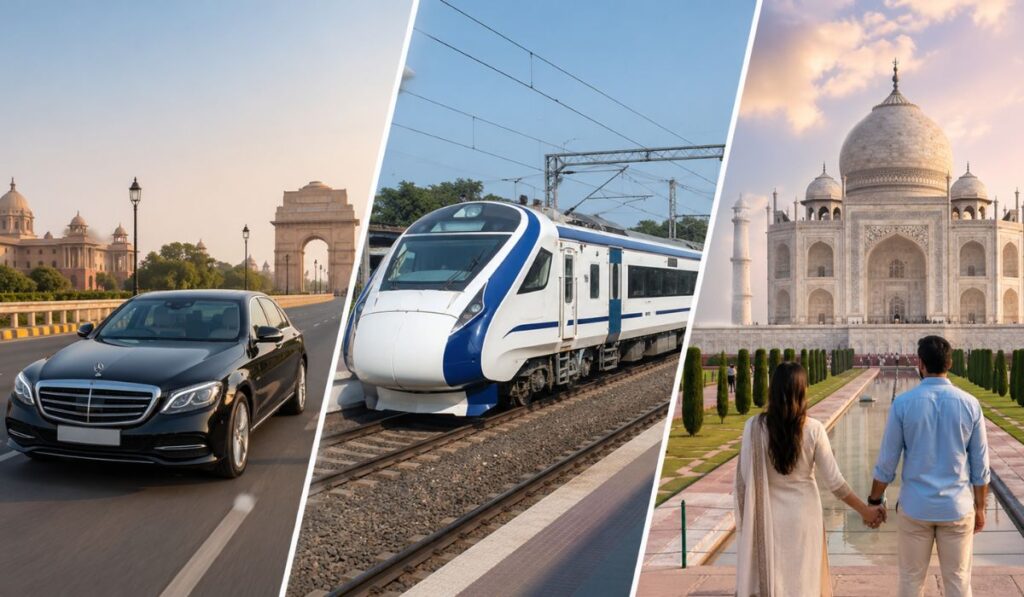
Choosing how you travel between Delhi, Agra, and Jaipur can make or break your trip. The Golden Triangle by train vs car decision isn’t just about logistics — it shapes how much you see, how comfortable you feel, and how much flexibility you have along the way. Both options have real advantages, and the right one depends entirely on your travel style, budget, and what you actually want out of the journey. In this guide, you’ll get a full breakdown of cost, comfort, scenic stops, hidden expenses, and which option fits different types of travelers, so you can plan with confidence. If you’re leaning toward flexibility and door-to-door comfort from the start, ourGolden Triangle Tour India by private car is built around exactly that.
In This Guide – Golden Triangle by Train vs Car
Section
What You’ll Learn
What Is the Golden Triangle?
Understand India’s famous Delhi–Agra–Jaipur tourist circuit and why it’s so popular.
Train vs Car at a Glance
Get a quick side-by-side comparison before diving into the details.
Cost Comparison
Compare train fares, private car costs, and the hidden expenses travelers often overlook.
Travel Time Comparison
See how long each journey takes, including Delhi–Agra, Agra–Jaipur, and Jaipur–Delhi.
Door-to-Door Experience
Discover the real travel time, including station transfers, waiting time, and hotel pickups.
Comfort & Convenience
Compare seating comfort, privacy, flexibility, luggage handling, and rest stops.
Scenic Experiences
Explore attractions and roadside experiences only accessible by private car, including Fatehpur Sikri and Chand Baori.
Traveler Type Guide
Find the best option for families, couples, solo travelers, photographers, seniors, and luxury travelers.
Hidden Costs
Learn about additional expenses like taxis, porter fees, tolls, parking, and travel delays.
Hybrid Travel (Train + Car)
Discover how combining train and private car can offer the perfect balance of speed and flexibility.
Best Choice by Budget
Compare the best transport option for budget, mid-range, and luxury travelers.
Frequently Asked Questions
Get answers to the most common questions about traveling the Golden Triangle by train or car.
What Is the Golden Triangle Tour?
The Golden Triangle refers to the classic travel circuit connecting Delhi, Agra, and Jaipur — three cities that, when mapped, form a rough triangular route across North India. Delhi offers the political and historic capital experience, Agra is home to the Taj Mahal and Agra Fort, and Jaipur delivers the royal architecture and color of Rajasthan. The full loop covers roughly 720 km, and most travelers complete it in 4 to 6 days. It remains India’s most popular tourist circuit because it packs three completely different experiences — Mughal history, royal heritage, and modern capital life — into a single, manageable route.
Which Option (Golden Triangle by Train vs Car) Is Right for You? (Quick Quiz)
Question
If Yes, Choose
Why?
Traveling with children?
Private Car
More space, flexible breaks, and easier luggage handling for families.
Traveling alone?
Train
Budget-friendly and efficient for solo travelers following a fixed itinerary.
Love photography?
Private Car
Stop at scenic viewpoints, villages, and attractions whenever you like.
Budget under ₹20,000?
Train
Lower transportation costs make it ideal for budget-conscious travelers.
Want to visit Fatehpur Sikri or Chand Baori?
Private Car
These attractions are easily accessible by road and difficult to include with train travel.
Carrying multiple suitcases?
Private Car
No need to move luggage through busy railway stations.
Traveling with senior citizens?
Private Car
Fewer transfers, less walking, and a more comfortable journey.
Looking for a luxury experience?
Private Car
Personalized service, premium vehicles, and complete itinerary flexibility.
Only visiting Delhi and Agra?
Train
Fast, convenient, and cost-effective for a short trip between the two cities.
Want complete flexibility during your trip?
Private Car
Change your schedule, stop for meals, sightseeing, or shopping whenever you want.
Planning a honeymoon or romantic getaway?
Private Car
Enjoy privacy and the freedom to travel at your own pace.
Short on time and want the fastest Delhi–Agra connection?
Train
Premium trains offer the quickest journey between Delhi and Agra.
Quick Recommendation – Golden Triangle by Train vs Car
Choose a Private Car If…
Choose a Train If…
You want a relaxed, flexible holiday.
You’re traveling on a tight budget.
You’re visiting Delhi, Agra, and Jaipur.
You’re only visiting Delhi and Agra.
You want to stop at attractions along the route.
You don’t mind fixed schedules and station transfers.
You’re traveling with family, seniors, or lots of luggage.
You’re traveling solo with light luggage.
You value comfort and convenience over saving money.
Your priority is the lowest travel cost.
If most of your answers point to one column, that’s your starting point — the sections below will help you confirm it.
Golden Triangle by Train vs Car: Quick Comparison
Feature
Private Car
Train
Door-to-Door Convenience
Hotel pickup and drop-off with no transfers
Requires station transfers and local taxis
Flexibility
Travel on your own schedule with optional sightseeing stops
Fixed departure and arrival times
Privacy
Exclusive vehicle for you or your group
Shared with other passengers
Overall Cost
Higher upfront cost but includes convenience and flexibility
Lower ticket cost but additional transfer expenses may apply
Scenic Stops
Visit places like Fatehpur Sikri, Chand Baori, and local villages
Limited to destinations served by the rail route
Comfort
Spacious seating, climate control, and customizable breaks
Comfortable in premium classes but fixed seating throughout the journey
Luggage Handling
Luggage stays securely in the vehicle during the entire trip
Carry luggage through stations and store it onboard
Family Friendliness
Ideal for families with children or elderly travelers
Suitable, but transfers can be less convenient
Luxury Experience
Personalized service with premium vehicles and private driver
Premium train classes offer comfort but a shared environment
Photography Opportunities
Stop whenever you want for landscapes and monuments
Views are limited to what is visible from the train
Sightseeing Flexibility
Add attractions and local experiences without changing transport
Separate transport is required for most sightseeing stops
Travel Pace
Relaxed and fully customizable
Fixed schedule with limited flexibility
Best For
Families, couples, luxury travelers, photographers, and first-time visitors
Budget travelers, solo travelers, and those focused on speed
Winner Summary
Category
Winner
Lowest Cost
Train
Fastest Delhi–Agra Journey
Train
Door-to-Door Convenience
Private Car
Comfort
Private Car
Flexibility
Private Car
Scenic Experiences
Private Car
Family Travel
Private Car
Luxury Experience
Private Car
Photography
Private Car
Overall Travel Experience
Private Car
Real Cost Calculator: What You Actually Pay
A simple ticket-price comparison is misleading. Here’s what each option really costs once every expense is included.
Train (Delhi–Agra leg, per person estimate) Ticket: ₹750–1,500 Taxi to station: ₹250 Taxi from station: ₹250 Food at station/on board: ₹200 Porter charges: ₹100 Waiting time cost (lost touring time, not cash, but worth factoring in) Actual total: roughly ₹1,300–2,300 per person, plus lost time
Private Car (Delhi–Agra leg, per vehicle, shared across the group) Package rate (car + driver): ₹3,500–5,500 depending on vehicle class Driver tip: ₹200–300 Tolls and parking: usually included in package pricing Actual total: roughly ₹3,700–5,800 per vehicle, which often works out cheaper per person for families or groups of 3 or more
The takeaway: train wins for solo travelers and pairs on a strict budget, but a private car frequently becomes the more economical option once you’re splitting the cost across three or four people, especially when you add in the time and hassle saved.
Hidden Time Calculator: Delhi to Agra
Train (on paper: 2 hours) Taxi to station: 25 min Security and boarding: 30 min Waiting time: 20 min Train journey: 2 hr Taxi from station: 20 min Hotel check-in: 15 min Actual door-to-door time: approximately 3 hr 50 min
Private Car (on paper: 3.5 hours) Hotel pickup: 5 min Drive: 3 hr 30 min Comfort break: 20 min Hotel arrival: 5 min Actual door-to-door time: approximately 4 hr
The gap most travelers expect — train being dramatically faster — barely exists once every step is counted. The train saves roughly 10 minutes door-to-door, while the car skips every transfer, security line, and luggage handoff in between.
Travel Time Comparison (All Three Legs)
Delhi to Agra: car takes 3–3.5 hours via the Yamuna Expressway; the Gatimaan Express covers it in under 2 hours of actual train time.
Agra to Jaipur: car takes 5–5.5 hours on NH21, with the option to stop at Fatehpur Sikri and Abhaneri; direct trains take roughly 4.5–5 hours with limited departure flexibility.
Jaipur to Delhi: car takes approximately 5.5 hours via NH48; train takes around 4.5–5 hours with several daily departures.
Door-to-Door Travel Experience
Traveling by train looks like this: hotel, then a taxi to the railway station, then security screening, then waiting on the platform, then the train itself, then arrival at the destination station, then another taxi, then finally your hotel. Each transfer adds time, effort, and a small amount of uncertainty.
Traveling by private car looks like this: hotel, meet your driver, comfort stops as needed, arrival at your destination, hotel. No transfers, no platform waits, no juggling luggage between vehicles.
Comfort Comparison
Private car: an adjustable schedule that bends around your day, consistent air conditioning, personal space for the whole journey, rest stops whenever you need them, and luggage that stays in the vehicle the entire trip.
Train: Executive Class and AC Chair Car options offer solid comfort, but you’re sharing the environment with other passengers, locked into a fixed schedule, and dealing with station transfers on both ends.
Scenic Experiences You Miss by Train
This is one of the biggest differences between the two options. Traveling by road between Agra and Jaipur opens up stops that simply aren’t accessible by train: Fatehpur Sikri, the abandoned Mughal city sitting directly along the road route; Chand Baori, the stunning stepwell in Abhaneri village; local dhabas for an authentic meal; marble and textile workshops where artisans work in real time; and stretches of rural Rajasthan landscape that make for some of the best highway photography stops on the trip.
Attraction Accessibility: Golden Triangle by Train vs Car
Attraction / Experience
By Train
By Private Car
Taj Mahal
Excellent
Excellent
Fatehpur Sikri
Limited (requires separate transfer)
Excellent
Chand Baori Stepwell
Not Easily Accessible
Excellent
Abhaneri Village
Not Easily Accessible
Excellent
Local Villages
Not Accessible
Excellent
Traditional Dhabas
Not Accessible
Excellent
Local Markets
Limited
Excellent
Marble Inlay Workshops
Limited
Excellent
Handicraft & Textile Workshops
Limited
Excellent
Highway Photography Stops
Not Possible
Excellent
Rural Rajasthan Landscapes
Limited
Excellent
Flexible Sightseeing Stops
Not Available
Excellent
The Taj Mahal is the one stop both options handle equally well, since it sits in central Agra. Everything else along the route strongly favors the car.
Seasonal Comparison
Winter: fog is the biggest factor here, frequently causing train delays on early-morning departures; road travel is generally more predictable, though early starts should be planned with buffer time. Best departure: mid-morning once fog clears.
Summer: heat makes AC comfort essential either way; train AC coaches are consistently cool, while car AC depends on the operator, so confirm this in advance. Best travel hours: early morning or evening to avoid peak heat.
Monsoon: road safety becomes the main consideration, with occasional waterlogging on highway stretches; trains are less affected by rain but scenic stops lose some appeal in heavy downpours. Travel advice: build extra buffer time into road journeys during peak monsoon weeks.
Scenario 1 — Family of 4: Winner: Private Car. Why: luggage stays in the vehicle, no platform transfers with kids, and the cost splits favorably across four people.
Scenario 2 — Solo Backpacker: Winner: Train. Why: lowest cost, minimal luggage, and a fixed schedule isn’t a drawback when traveling alone.
Scenario 3 — Luxury Couple: Winner: Private Car. Why: privacy, comfort, and the option to add romantic scenic stops along the way.
Scenario 4 — Senior Couple: Winner: Private Car. Why: fewer transfers, less walking through stations, and a more comfortable overall pace.
Scenario 5 — College Friends: Winner: Train. Why: budget-friendly, social atmosphere, and the group doesn’t mind a fixed schedule.
Tourist Personas: Tailored Advice
First-time India visitors: lean toward private car for ease and fewer logistics to manage while still adjusting to a new country.
Repeat visitors: train is a comfortable, efficient choice once you’re already familiar with the route and stations.
Luxury travelers: private car, for full customization and door-to-door comfort.
Families: private car, for flexibility around children’s schedules and naps.
Couples: private car, for privacy and romantic detours.
Senior travelers: private car, to minimize walking and transfers.
Digital nomads: car, for charging access and flexible work breaks during the journey.
Photographers: car, for unrestricted access to scenic stops along the route.
Train + Car Hybrid Travel: The Best of Both Worlds
This is one of the most underused strategies for the Golden Triangle, and it deserves real attention because it genuinely solves the core tradeoff between speed and flexibility.
When should you combine both? The Delhi to Agra leg is short enough that train speed offers a real advantage, while the Agra to Jaipur leg is where the road truly shines, with Fatehpur Sikri and Chand Baori sitting directly along the route. Combining the two means you get the fastest possible start to your trip and the richest possible middle stretch.
Best train for Delhi to Agra: the Gatimaan Express is the standout choice, covering the distance in under 2 hours with Executive Class seating that’s comfortable enough for a short morning journey.
Private driver from Agra to Jaipur: booking a private car for this specific leg, rather than the full circuit, lets you build in stops at Fatehpur Sikri, Chand Baori, and roadside dhabas without committing to a car for the entire trip.
How much money does it save? For solo travelers and pairs, the hybrid approach can save 15–25% compared to a full private car package, while still delivering the scenic Agra–Jaipur stretch that trains can’t offer.
Who benefits most? Travelers who want to save time on the Delhi–Agra leg specifically, but still want the open-road experience for the more scenic Agra–Jaipur stretch — this is especially well-suited to photographers, couples, and small groups of 2–3 people.
Sample 5-day hybrid itinerary:
1 Day , arrive and explore Delhi. 2 Day, take the Gatimaan Express to Agra, visit the Taj Mahal and Agra Fort. 3 Day, private car from Agra to Jaipur via Fatehpur Sikri and Chand Baori. 4 Day, explore Jaipur’s forts and palaces. 5 Day, train back to Delhi.
Sample 7-day hybrid itinerary:
1–2 Day in Delhi with sightseeing, 3 Day train to Agra, 4 Day full day in Agra including sunrise at the Taj Mahal, 5 Day private car to Jaipur via scenic stops,
Days 6–7 in Jaipur with a relaxed pace before flying out or training back to Delhi.
Booking tips: reserve the Gatimaan Express at least a week in advance since seats sell out quickly, and book your private car for the Agra–Jaipur leg separately so the driver and vehicle are confirmed before you arrive in Agra.
Common mistakes: booking the train too close to departure and missing out on Executive Class seating; not confirming the private car pickup point at the Agra train station in advance; and underestimating how much time the Fatehpur Sikri and Chand Baori stops add, which can push a tight schedule into the evening.
Hidden Costs Most Travelers Forget
Train hidden costs: taxi to the station, taxi from the station, porter charges, waiting time, food at the station, and the awkward timing of early checkouts or late check-ins around train schedules.
Car hidden costs: fuel (often included in package pricing), tolls, driver allowance for overnight stays, and parking at hotels or attractions.
Luggage Comparison
Train: carrying your own bags, relying on porters at busy stations, navigating storage on board, and managing platform changes with luggage in tow.
Car: luggage stays in the vehicle the entire trip, making shopping along the way far more convenient, with everything within easy reach.
Safety Comparison
For solo women travelers, both premium train classes and a licensed private driver offer reasonable safety, though many travelers find a known driver and vehicle more reassuring for night travel. Families generally feel most secure with a private car, since there’s no need to navigate crowded platforms with children. Premium train classes offer solid security measures, and most reputable car services provide emergency support contacts as standard.
Productivity During Travel
Car: charging ports, flexible break timing, light laptop work when road conditions allow, and consistent privacy throughout.
Train: a chance to read, take in scenic views, and enjoy the more social atmosphere of shared travel.
Best Transport Option by Budget
Budget travelers: Train. Mid-range travelers: hybrid approach or shared private car. Luxury travelers: Private car. Honeymoon trips: Private car. Family vacations: Private car. Group tours: Private car.
Decision Flowchart
Choose train if: budget matters most, you’re traveling light, you’re only visiting Delhi and Agra, and you’re comfortable with fixed schedules.
Choose private car if: you want flexibility, you’re carrying multiple bags, you’re traveling with family, you want scenic stops, you love photography, or you simply prefer comfort over cost savings.
Who Should NOT Choose Each Option?
Don’t choose train if: you’re traveling with elderly parents, carrying four or more suitcases, or want real flexibility in your schedule.
Don’t choose car if: you’re only visiting Agra and nothing else, you’re working with a very limited budget, or you specifically want the fastest possible Delhi–Agra connection.
Mistakes by Transport Type
Train mistakes: booking the wrong class for comfort needs, arriving late and missing the departure, carrying heavy luggage that’s difficult to manage on platforms, and getting confused by platform changes at busy stations.
Car mistakes: booking with cheap, unverified operators, ignoring toll and parking costs when budgeting, skipping the sightseeing stops that make the drive worthwhile, and allowing late departures to eat into the day’s schedule.
Best Hotels Based on Transport
Staying near the railway station: ideal if you’re train-hopping between cities, since it minimizes taxi time and makes early departures far less stressful.
Staying near the highway exit: ideal for private car travelers, since it simplifies pickup and drop-off and avoids navigating through dense city traffic at the start and end of each driving day.
Packing Guide by Transport Type
Train: small luggage, a backpack for essentials, and gear that’s easy to carry through stations and onto platforms.
Car: a larger suitcase since space isn’t a constraint, a camera bag for the scenic stops, and room left over for shopping picked up along the way.
Sample 5-Day Itinerary by Train
1 Day : Arrive and explore Delhi. 2 Day : Train to Agra, visit the Taj Mahal and Agra Fort. 3 Day : Train to Jaipur. 4 Day : Explore Jaipur’s forts and palaces. 5 Day : Train back to Delhi for departure.
Sample 5-Day Itinerary by Private Car
1 Day : Arrive in Delhi, comfortable hotel check-in. 2 Day : Drive to Agra with scenic stops, Taj Mahal and Agra Fort. 3 Day : Drive to Jaipur via Fatehpur Sikri and Chand Baori. 4 Day : Full day exploring Jaipur’s Amber Fort and City Palace. 5 Day : Comfortable drive back to Delhi for departure.
If you’re considering a flexible setup that blends both worlds, it’s worth exploring Rajasthan Tour Packages that can be tailored around a combined train-and-car itinerary, getting the efficiency of rail and the open-road experience where it matters most.
Why We Recommend It
If You Want…
Best Option
Why We Recommend It
Lowest Overall Cost
Train
Lower ticket prices make it the most budget-friendly option.
Maximum Flexibility
Private Car
Travel at your own pace with the freedom to stop whenever you like.
Luxury & Comfort
Private Car
Enjoy a personalized journey with premium vehicles and a dedicated driver.
Fastest Delhi–Agra Journey
Train
Premium trains like the Gatimaan Express offer the quickest travel time.
Photography Stops
Private Car
Stop at scenic viewpoints, villages, and monuments whenever inspiration strikes.
Family Holiday
Private Car
More comfortable for children, seniors, and travelers with extra luggage.
Scenic Road Trip Experience
Private Car
Visit attractions like Fatehpur Sikri, Chand Baori, and local villages along the route.
Solo Budget Travel
Train
Ideal for solo travelers looking to keep transportation costs low.
Traveling with Senior Citizens
Private Car
Fewer transfers and a more relaxed, comfortable journey.
Honeymoon or Couple’s Trip
Private Car
Greater privacy and the flexibility to create a romantic itinerary.
Traveling with Large Luggage
Private Car
No need to carry bags through busy railway stations.
Fixed Schedule & Short Trip
Train
Best if you’re following a strict timetable and visiting only major cities.
First-Time Visit to India
Private Car
Easier navigation, local assistance, and a stress-free travel experience.
Exploring Beyond Major Attractions
Private Car
Easily access hidden gems and off-the-beaten-path destinations.
Final Verdict
Travel Style
Recommended Option
Budget Traveler
Train
Family Traveler
Private Car
Couples & Honeymooners
Private Car
Photography Enthusiasts
Private Car
Senior Travelers
Private Car
Solo Backpackers
Train
Luxury Travelers
Private Car
Travelers Seeking a Complete Golden Triangle Experience
Private Car
FAQs – Golden Triangle by Train vs Car
Is the Golden Triangle better by train or car?
It depends on priorities — train wins on cost and speed for the Delhi–Agra leg, while car wins on flexibility, comfort, and scenic stops across the full circuit.
Which is cheaper?
Train tickets are cheaper upfront, though the gap narrows for groups of three or more once hidden costs are factored in.
Which is faster?
For Delhi to Agra specifically, the train is marginally faster door-to-door; for the full circuit including stops, a private car is often comparable or faster overall.
Is a private driver worth it?
For families, photographers, and travelers who want scenic stops, yes — the flexibility and comfort generally justify the cost.
Can I combine train and car?
Yes, a hybrid approach using train for Delhi–Agra and car for Agra–Jaipur is a popular and practical option, and often the smartest choice overall.
Is it safe for solo travelers?
Both options are reasonably safe; premium train classes and licensed private drivers each offer solid safety standards.
Which option is best for families?
Private car, due to the flexibility and reduced hassle of managing luggage and schedules with children.
Which option is best for photographers?
Private car, since it allows stops at scenic locations the train route simply bypasses.
How much luggage can I bring?
Private cars comfortably handle multiple large bags; trains require more careful packing, especially in Chair Car classes.
Which train class should I book?
Executive Class or AC Chair Car on routes like the Gatimaan Express offer the best comfort-to-cost ratio.
Is a 5-day itinerary enough?
Yes, 5 days comfortably covers the core Golden Triangle circuit, whether traveling by train, car, or a hybrid of both.
What’s the best way to see Fatehpur Sikri?
By private car, since it sits directly on the Agra–Jaipur road route and isn’t accessible via the train circuit.
Conclusion – Golden Triangle by Train vs Car
When it comes to Golden Triangle by train vs car, there’s no single right answer — it comes down to matching transportation to your travel style, group size, and priorities. Train travel suits budget-conscious or solo travelers who prioritize speed on the Delhi–Agra leg. A Golden Triangle Tour by Car suits families, couples, and photographers who value flexibility and scenic stops. And for travelers who want the best of both, the train-and-car hybrid offers real savings without giving up the road’s most rewarding detours.
If a seamless, customizable journey across Delhi, Agra, and Jaipur sounds like what you’re after, explore our Golden Triangle Tour by Private Car and let the road show you more of India than the rails ever could. For travelers planning a longer Rajasthan circuit, our Private Car Driver India service can also extend comfortably beyond the Golden Triangle into a full Rajasthan itinerary.
Best Time to Visit the Golden Triangle in India—this is the question every first-time traveler asks before booking their trip. The Golden Triangle is India's most iconic travel circuit. Three cities—Delhi, Agra, and Jaipur—form a triangle on the map and a perfect introduction to the country on the ground. But here is what most visitors do not realize: when you go matters just as much as where you go. Weather in North India swings between extremes. A summer afternoon in Agra can hit 47°C. A winter morning in Jaipur can dip below 5°C. Monsoon rains transform dusty landscapes into lush greenery but close rural roads and cloud monument views. The season you choose shapes everything—your comfort, your photographs, the crowds you fight, and the prices you pay. This guide breaks down each season month by month so you can pick the perfect window for your trip. Whether you are planning a quick getaway or a deep cultural dive, understanding the Golden Triangle weather patterns Before visiting Golden Triangle will save you from sweat, shivers, and disappointment. Whether you're planning your first Golden Triangle Tour India itinerary or looking for the ideal season to visit Delhi, Agra, and Jaipur, this guide will help you choose the perfect time based on weather, festivals, crowds, and travel style. Best Time to Visit the Golden Triangle in India SeasonMonthsWeatherRatingWinterOctober–MarchCool, dry, clear⭐⭐⭐⭐⭐SummerApril–JuneVery hot, dry, hazy⭐⭐☆☆☆MonsoonJuly–SeptemberWarm, humid, rainy⭐⭐⭐⭐☆ Quick Verdict: Winter wins across almost every category. But summer and monsoon have their own advantages for specific traveler types. Read on to see which season matches your priorities. What Is the Golden Triangle in India? The Golden Triangle connects three of India's most historically significant cities: Delhi: The capital. A collision of ancient empires and modern India. You will explore Mughal forts, British-era boulevards, chaotic bazaars, and
Best Time to Visit the Golden Triangle in India—this is the question every first-time traveler asks before booking their trip. The Golden Triangle is India’s most iconic travel circuit. Three cities—Delhi, Agra, and Jaipur—form a triangle on the map and a perfect introduction to the country on the ground. But here is what most visitors do not realize: when you go matters just as much as where you go.
Weather in North India swings between extremes. A summer afternoon in Agra can hit 47°C. A winter morning in Jaipur can dip below 5°C. Monsoon rains transform dusty landscapes into lush greenery but close rural roads and cloud monument views. The season you choose shapes everything—your comfort, your photographs, the crowds you fight, and the prices you pay.
This guide breaks down each season month by month so you can pick the perfect window for your trip. Whether you are planning a quick getaway or a deep cultural dive, understanding the Golden Triangle weather patterns Before visiting Golden Triangle will save you from sweat, shivers, and disappointment.
Whether you’re planning your first Golden Triangle Tour India itinerary or looking for the ideal season to visit Delhi, Agra, and Jaipur, this guide will help you choose the perfect time based on weather, festivals, crowds, and travel style.
Best Time to Visit the Golden Triangle in India
Season
Months
Weather
Rating
Winter
October–March
Cool, dry, clear
⭐⭐⭐⭐⭐
Summer
April–June
Very hot, dry, hazy
⭐⭐☆☆☆
Monsoon
July–September
Warm, humid, rainy
⭐⭐⭐⭐☆
Quick Verdict: Winter wins across almost every category. But summer and monsoon have their own advantages for specific traveler types. Read on to see which season matches your priorities.
What Is the Golden Triangle in India?
The Golden Triangle connects three of India’s most historically significant cities:
Delhi: The capital. A collision of ancient empires and modern India. You will explore Mughal forts, British-era boulevards, chaotic bazaars, and some of the best food on the subcontinent.
Agra: Home to the Taj Mahal. But also Agra Fort, Itimad-ud-Daulah, and a legacy of marble craftsmanship that continues today.
Jaipur: The Pink City. Rajasthan’s capital delivers palaces, forts, pink-hued architecture, and a desert culture distinct from the Gangetic plains.
Route Overview: The standard route runs Delhi → Agra → Jaipur → Delhi, though some travelers reverse it. Total driving distance is roughly 720–800 km depending on the exact stops.
Why It Is Popular: These three cities pack UNESCO World Heritage sites, world-class museums, vibrant markets, and architectural wonders into a compact, drivable circuit. No domestic flights needed. No complicated logistics. Just a private car and three of India’s greatest hits.
Daytime temperatures hover between 15°C and 25°C. Nights can drop to 5–10°C, especially in Delhi and Jaipur. The air is dry, the sky is blue, and visibility is at its peak. This is the best season for Golden Triangle Tour travel, hands down.
Festivals
Winter catches Diwali (October/November), Republic Day (January 26), and the Jaipur Literature Festival (January). The cultural calendar is packed.
Photography
Crisp light, minimal haze, and golden hour tones that make the Taj Mahal glow. Winter delivers the sharpest, most saturated images of the entire year.
Comfortable Sightseeing
You can walk Agra Fort without sweating through your shirt. You can explore Jaipur’s Amber Fort without seeking shade every ten minutes. The physical comfort factor is enormous.
Advantages
Best Delhi Agra Jaipur weather combination
Ideal for outdoor monuments and walking tours
Peak festival season
Cleanest air for photography
Things to Know
This is peak tourist season. Book hotels and trains 2–3 months ahead.
December and January mornings can be foggy, occasionally delaying trains or obscuring sunrise views.
Prices are highest October through February.
Summer (April–June)
Pros
Lowest prices of the year
Fewer tourists at major monuments
Longer daylight hours for extended sightseeing
Mango season (May–June)
Cons
Daytime temperatures regularly exceed 40°C
Intense sun and UV exposure
Heat haze reduces visibility for photography
Physical exhaustion limits how much you can see daily
Who Should Visit
Budget travelers who can tolerate heat, or those specifically chasing lower rates. Not recommended for families with young children or senior travelers.
Travel Tips
Schedule all outdoor sightseeing before 10:00 AM and after 4:00 PM.
Carry electrolyte packets and drink constantly.
Book air-conditioned transport. Non-AC travel is miserable in peak summer.
Monsoon (July–September)
Rain
Intermittent but heavy downpours. Not constant drizzle—more like dramatic afternoon thunderstorms. Roads can flood temporarily, but major highways between Delhi, Agra, and Jaipur generally stay passable.
Green Landscapes
The arid Rajasthan landscape transforms. Jaipur’s surrounding hills turn green. The Yamuna River swells. It is the most photogenic season for landscape shots, even if monument clarity suffers.
Lower Prices
Hotels drop rates 30–50% from winter peaks. You get better value for money across the board.
Photography
Overcast skies create soft, diffused light—excellent for portraits and detail shots. But the Taj Mahal may disappear behind clouds. It is a trade-off.
Pros & Cons
Table
Pros
Cons
Lush scenery
Unpredictable rain
Lower prices
Humidity
Fewer crowds
Potential flight delays
Soft light
Cloudy skies at monuments
Best Time to Visit the Golden Triangle in India – Month-by-Month Travel Guide
January: Cold mornings, clear afternoons. Possible fog delays. Excellent for photography once the sun burns through. Pack warm layers.
February: The sweet spot. Clear skies, mild temperatures, minimal fog. Arguably the best single month for the Golden Triangle.
March: Warming up. Comfortable days, pleasant evenings. Holi often falls in March—a spectacular but messy festival to experience.
April: The last decent month before heat takes over. Mornings are still manageable. Afternoons become oppressive.
May: Brutal heat. Only recommended if you have a high tolerance or are chasing extreme budget deals.
June: Pre-monsoon humidity builds. Occasional dust storms. Wait for the rains if you can.
July: Monsoon arrives. Dramatic skies, green landscapes, but unpredictable downpours. Good for experienced travelers.
August: Peak rainfall. Lush scenery, lowest crowds, best hotel deals. Risk-reward month.
September: Monsoon retreats. Clearer days return. A hidden gem month with green landscapes and thinning crowds.
October: Post-monsoon clarity. Comfortable temperatures return. Diwali often falls in October. One of the best months overall.
November: Peak season begins. Perfect weather, festival atmosphere, but book everything early.
December: Cold, atmospheric, occasionally foggy. When clear, the light is extraordinary. Pack winter clothing.
Best Time for Different Types of Travelers
Couples: October–February. Pleasant weather for romantic walks, outdoor dining, and the Taj Mahal at sunrise. Avoid summer heat.
Families: November–February. Comfortable for children, school holiday alignment, and safe outdoor exploration.
Solo Travelers: September–October or February–March. Good weather with thinner crowds and lower accommodation costs.
Senior Travelers: November–February only. Summer heat is a genuine health risk for older travelers unaccustomed to extreme temperatures.
Luxury Travelers: October–March. Palace hotels in Jaipur and premium properties across the circuit operate at full service during peak season.
Best Time for Photography
Delhi: Winter mornings at India Gate and Humayun’s Tomb deliver soft golden light with minimal haze. Avoid summer afternoons—flat, harsh light and heat distortion.
Agra: The Taj Mahal at sunrise in November or February is the single best photography opportunity in the Golden Triangle. Summer haze kills contrast. Monsoon clouds add drama but obscure the dome.
Jaipur: Amber Fort at sunrise in winter. Hawa Mahal in late afternoon light. The pink city glows in low-angle sun.
Golden Hour: Winter golden hours are longer and cleaner. Summer golden hours are brief and hazy. Monsoon golden hours are unpredictable but occasionally spectacular.
Sunrise vs. Sunset: Sunrise wins in Agra (Taj Mahal faces east). Sunset wins in Jaipur (west-facing fort views). Delhi offers strong options for both.
Festivals Worth Planning Around
Diwali: October/November. Lights, fireworks, family atmosphere. Delhi and Jaipur are spectacular. Book months ahead.
Holi: March. The festival of colors. Joyful, chaotic, and photogenic. Wear clothes you can throw away.
Pushkar Fair: November. Near Jaipur (Ajmer district). A massive camel and livestock fair with cultural performances. Unique but crowded.
Jaipur Literature Festival: January. The world’s largest free literary festival. A different side of Rajasthan.
Republic Day: January 26. Delhi’s parade and celebrations are iconic but security is extreme and crowds are massive.
Weather Tips for Each City
Delhi: The widest temperature swing. Winter nights are cold. Summer days are scorching. Always check the specific forecast.
Agra: Slightly hotter than Delhi in summer. The Yamuna River adds humidity. Winter fog is more common here than in Jaipur.
Jaipur: The driest of the three. Desert climate means cold winter nights and very hot summer days. Monsoon is lighter than Delhi or Agra.
Packing: Layers for winter (morning cold, afternoon warm). Breathable cotton for summer. Waterproof jacket and quick-dry clothing for monsoon. Comfortable walking shoes year-round.
Suggested 3-Day Golden Triangle Itinerary
1 Day: Delhi
Morning: India Gate, Humayun’s Tomb
Afternoon: Qutub Minar, Lotus Temple
Evening: Connaught Place dinner
2 Day: Agra
Early morning: Taj Mahal at sunrise
Mid-morning: Agra Fort
Afternoon: Itimad-ud-Daulah (Baby Taj)
Evening: Drive to Jaipur or overnight in Agra
3 Day: Jaipur
Morning: Amber Fort
Afternoon: City Palace, Jantar Mantar
Evening: Hawa Mahal, local bazaar shopping
Travelers looking for a hassle-free experience can choose our 3 Day Golden Triangle Tour, which includes private transportation, sightseeing, and a carefully planned itinerary.
Travel Tips
Packing: Travel light but prepare for temperature swings. A warm layer for winter mornings, sun protection year-round, and rain gear for monsoon.
Clothing: Conservative dress is appreciated at religious sites. Lightweight long pants and breathable long-sleeve shirts work in all seasons.
Booking Hotels: Winter requires 2–3 month advance booking for good properties. Summer and monsoon offer last-minute deals.
Entry Tickets: Buy Taj Mahal tickets online in advance. The daily visitor cap fills quickly in peak season.
Private Driver: A private car with driver is the most efficient way to cover the circuit. It eliminates navigation stress, handles luggage, and lets you rest between cities.
FAQs – Best Time to Visit the Golden Triangle in India
Which month is best? February and November are the single best months for weather, clarity, and manageable crowds.
Is summer too hot? For most travelers, yes. April through June sees temperatures above 40°C regularly. Only visit in summer if you are experienced with extreme heat or are chasing deep discounts.
Is monsoon a good time? Yes, for budget travelers and landscape photographers. Expect rain, humidity, and occasional monument closures, but enjoy lower prices and lush scenery.
How many days are enough? Three days is the classic minimum. Four to five days allows a more relaxed pace and deeper exploration.
Which season has fewer crowds? Summer (April–June) and monsoon (July–September). Winter is packed.
Is winter expensive? Yes. Winter is peak season. Hotels, guides, and transport cost 30–100% more than off-season. Book early for better rates.
Final Thoughts – Best Time to Visit the Golden Triangle in India
Here is the bottom line: Winter is the best overall season to visit the Golden Triangle. The combination of cool temperatures, clear skies, festival energy, and comfortable sightseeing creates conditions that simply do not exist in other months.
Monsoon is the hidden gem for budget travelers and photographers who love dramatic skies and green landscapes. Summer suits those looking for fewer crowds and lower prices, provided they can handle extreme heat.
No matter when you go, the Golden Triangle delivers. The Taj Mahal at dawn, the forts of Jaipur at sunset, and the chaotic energy of Old Delhi are unforgettable in any season. The trick is matching your travel style to the right window—and packing accordingly.
Written by Rajasthan Road Trip Specialists Our team has planned and operated hundreds of private car tours across Rajasthan since 2012. Every price, route, and recommendation in this guide is drawn from real booking data, seasonal experience, and first-hand knowledge of Rajasthan roads — not third-party estimates. ⚠ Rates shown are indicative for 2026. Final pricing depends on your exact route, vehicle choice, and travel dates. Request a custom quote for a precise figure. Rajasthan is one of India's largest states — and one of its most rewarding road trip destinations. From the pink streets of Jaipur to the golden dunes of Jaisalmer and the lake palaces of Udaipur, distances between highlights can stretch 300–600 km. That is exactly why a private car and driver remains the most popular, flexible, and practical way to explore the state. But how much does a Rajasthan tour by car and driver cost in 2026? This guide gives you real prices, per-km rates, route-wise estimates, and a full budget breakdown — no vague ranges. How Much Does a Rajasthan Tour by Car and Driver Cost? The Rajasthan tour by car and driver cost depends primarily on your vehicle choice, total kilometres covered, and trip duration. Here are indicative package prices based on our 2026 booking data: Rajasthan Tour by Car and Driver Cost — 2026 Package EstimatesTour LengthSedan (up to 4 pax)Innova Crysta (up to 6 pax)SUV / Luxury (up to 6 pax)5 Days₹22,000 – ₹30,000₹35,000 – ₹45,000₹45,000 – ₹60,0007 Days₹30,000 – ₹45,000₹45,000 – ₹65,000₹60,000 – ₹85,00010 Days₹45,000 – ₹60,000₹60,000 – ₹90,000₹80,000 – ₹1,20,000 These figures cover car hire and driver charges only. Hotels, meals, monument entry tickets, and personal expenses are separate. Prices apply for tours originating from Jaipur or Delhi. Rajasthan Car Rental Rates Per Kilometre If you prefer to calculate your
Written by Rajasthan Road Trip Specialists Our team has planned and operated hundreds of private car tours across Rajasthan since 2012. Every price, route, and recommendation in this guide is drawn from real booking data, seasonal experience, and first-hand knowledge of Rajasthan roads — not third-party estimates. ⚠ Rates shown are indicative for 2026. Final pricing depends on your exact route, vehicle choice, and travel dates. Request a custom quote for a precise figure.
Rajasthan is one of India’s largest states — and one of its most rewarding road trip destinations. From the pink streets of Jaipur to the golden dunes of Jaisalmer and the lake palaces of Udaipur, distances between highlights can stretch 300–600 km. That is exactly why a private car and driver remains the most popular, flexible, and practical way to explore the state. But how much does a Rajasthan tour by car and driver cost in 2026? This guide gives you real prices, per-km rates, route-wise estimates, and a full budget breakdown — no vague ranges.
How Much Does a Rajasthan Tour by Car and Driver Cost?
The Rajasthan tour by car and driver cost depends primarily on your vehicle choice, total kilometres covered, and trip duration. Here are indicative package prices based on our 2026 booking data:
Rajasthan Tour by Car and Driver Cost — 2026 Package Estimates
Tour Length
Sedan (up to 4 pax)
Innova Crysta (up to 6 pax)
SUV / Luxury (up to 6 pax)
5 Days
₹22,000 – ₹30,000
₹35,000 – ₹45,000
₹45,000 – ₹60,000
7 Days
₹30,000 – ₹45,000
₹45,000 – ₹65,000
₹60,000 – ₹85,000
10 Days
₹45,000 – ₹60,000
₹60,000 – ₹90,000
₹80,000 – ₹1,20,000
These figures cover car hire and driver charges only. Hotels, meals, monument entry tickets, and personal expenses are separate. Prices apply for tours originating from Jaipur or Delhi.
Rajasthan Car Rental Rates Per Kilometre
If you prefer to calculate your Rajasthan road trip cost based on distance rather than package duration, here are our 2026 per-kilometre rates:
Car Rental Per KM Rates — Rajasthan 2026
Vehicle
Best For
Capacity
Rate Per KM
Toyota Etios / Swift Dzire (Sedan)
Couples, solo travellers
Up to 4 passengers
₹15 per km
Ertiga (MUV)
Small families
Up to 6 passengers
₹18 per km
Toyota Innova Crysta (SUV)
Families, comfortable long drives
Up to 6 passengers
₹23 per km
Tempo Traveller
Groups, corporate tours
9–18 passengers
₹25–₹32 per km
Most standard Rajasthan tours cover 1,800–3,200 km depending on route. At ₹23/km for an Innova Crysta, a 2,500 km Rajasthan road trip cost works out to approximately ₹57,500 for vehicle and driver alone — consistent with our 10-day package estimates above.
Factors That Affect Rajasthan Tour by Car and Driver Cost
Understanding what drives the final price helps you budget accurately and avoid surprises when planning a Rajasthan road trip. Whether you are booking a short city tour or a multi-day Rajasthan Private Taxi Service, these factors have the biggest impact on the final cost:
Vehicle Type
The biggest cost variable. An Innova Crysta costs roughly 50–55% more per km than a sedan but offers significantly greater comfort, luggage space, and highway performance for long-distance Rajasthan journeys.
Trip Duration
Longer tours generally result in lower per-day costs. A 10-day Rajasthan itinerary often provides better value than two separate 5-day bookings because fixed expenses are spread across more travel days.
Season
Peak tourist season (October–February) typically sees rates increase by 10–20% compared to the summer off-season (April–June). Major holidays such as Diwali, Christmas, and New Year can command premium pricing due to higher demand.
Driver Allowance
A daily driver bata (allowance) of ₹300–500 per day is standard across Rajasthan and is usually included in comprehensive tour quotations.
Toll Taxes and State Permits
Rajasthan has multiple toll roads and interstate checkpoints. Most professional Rajasthan Private Taxi Service providers include these charges in package pricing, but it is always wise to confirm what is covered before booking.
Hotel Category
Accommodation is separate from transportation costs but significantly affects your overall travel budget. Mid-range hotels in Jaipur, Jodhpur, and Udaipur typically cost ₹2,500–4,000 per night, while luxury heritage hotels can range from ₹6,000–12,000+ per night.
Airport and Railway Station Transfers
Pickups and drop-offs may add ₹300–600 per transfer if they are not already included in your itinerary. Many Rajasthan tour packages include one complimentary pickup and drop-off service.
If you prefer a hassle-free experience with transparent pricing, experienced local drivers, and customized itineraries, our Rajasthan Private Taxi Service offers flexible vehicle options for couples, families, and groups travelling across Jaipur, Jodhpur, Udaipur, Jaisalmer, and beyond.
Popular Rajasthan Tour Routes and Their Cost
Route 1: Jaipur – Jodhpur – Udaipur (6 Days)
One of Rajasthan’s most popular circuits covers the three iconic cities of the Golden Triangle extension. Key highlights include Amber Fort and Hawa Mahal in Jaipur, Mehrangarh Fort and the blue city in Jodhpur, and City Palace with Lake Pichola in Udaipur. Total driving distance: approximately 1,100–1,300 km.
The complete Golden Desert Circuit adds Bikaner’s Junagarh Fort and the Jaisalmer sand dunes to the classic route. This is Rajasthan road travel at its most immersive. Total driving distance: approximately 2,200–2,600 km.
The most popular route for international travellers flying into Delhi. This self-contained loop eliminates the need for inter-city trains and gives complete flexibility. Total driving distance: approximately 2,800–3,200 km including Delhi–Agra if added.
Innova Crysta: ₹75,000 – ₹95,000
Luxury SUV / Toyota Fortuner: ₹1,00,000 – ₹1,20,000
Plan Your Rajasthan Route with Real Costs Tell us your travel dates, number of passengers, and cities — we’ll send a detailed Rajasthan tour by car and driver cost estimate with day-by-day route and vehicle recommendation within 30 minutes. → Get a Free Custom Quote
What’s Included in a Rajasthan Car and Driver Package?
Package Inclusions vs Exclusions
Typically Included
Usually Not Included
Private AC vehicle throughout
Hotel accommodation
Professional, licensed driver
Meals and restaurant bills
Fuel for all travel
Monument entry tickets
Parking charges
Personal expenses / shopping
Toll taxes and state entry taxes
Optional activities (camel safari, boat ride)
Driver allowance (bata)
Airport taxes or flight costs
Always read your package agreement carefully. Some budget operators exclude toll taxes and driver bata — these can add ₹3,000–6,000 to a 10-day trip. Reputable operators include these as standard.
Rajasthan Tour Cost by Traveller Type
Couples (2 Persons)
A sedan (Swift Dzire or Toyota Etios) is ideal and the most economical option for two people. For a 7-day Jaipur–Jodhpur–Udaipur circuit, expect to pay ₹30,000–₹40,000 for car and driver. Split between two people, that is ₹15,000–₹20,000 per person — very competitive with train and taxi combinations.
Families (4–6 Persons)
For families, the Toyota Innova Crysta is the benchmark vehicle for Rajasthan road trips. It offers seven seats, strong AC, generous luggage space, and excellent performance on Rajasthan’s varied roads. A 7-day family tour costs ₹45,000–₹65,000 for car and driver — roughly ₹8,000–₹10,000 per person for six travellers.
Groups (8–18 Persons)
A Tempo Traveller at ₹25–32/km is the most cost-effective option for larger groups. A 10-day Rajasthan tour covering 2,500 km costs approximately ₹65,000–₹80,000 for vehicle and driver — divided among 12 travellers, that is under ₹7,000 per person.
Car with Driver vs Self-Drive in Rajasthan
Private Driver vs Self-Drive — Rajasthan Comparison
Self-drive rental in Rajasthan is technically available but comes with significant risks — highway driving between cities like Jaipur to Jaisalmer (560 km) involves long stretches of poorly lit road. Most international and domestic travellers choose a private driver for safety and peace of mind.
Sample Budget for a 7-Day Rajasthan Tour (Family of 4)
7-Day Rajasthan Tour — Complete Budget Breakdown (Innova Crysta)
Expense Category
Estimated Cost
Notes
Car + Driver (7 days, Innova)
₹45,000 – ₹55,000
All tolls, fuel, parking included
Hotels (3-star, 6 nights, 2 rooms)
₹18,000 – ₹28,000
₹1,500–₹2,300 per room per night
Food & Meals
₹8,000 – ₹12,000
₹700–₹1,000 per person per day
Monument Entry Tickets
₹3,000 – ₹5,000
Amber Fort, Mehrangarh, City Palace etc.
Optional Activities
₹3,000 – ₹6,000
Camel safari, boat ride, folk show
Total (4 persons, 7 days)
₹77,000 – ₹1,06,000
₹19,000–₹26,500 per person
Upgrading to heritage hotels (havelis, palace hotels) adds ₹15,000–₹25,000 to the accommodation line. Luxury SUV upgrades add ₹15,000–₹25,000 to the vehicle line. The car and driver cost remains the most controllable — and often the best-value — element of a Rajasthan trip.
How to Save Money on a Rajasthan Road Trip
Travel shoulder season (March or September): Rates drop 10–20% versus peak winter season. Weather is warmer but manageable in the mornings and evenings.
Travel as a group: The tour by car and driver cost per person drops dramatically with 5–6 passengers sharing an Innova versus 2 in a sedan.
Book longer itineraries: A 10-day booking is cheaper per day than two 5-day bookings with the same operator.
Choose Innova over luxury SUV: The Innova Crysta offers 90% of the comfort at 70–75% of the price of a Toyota Fortuner or Mahindra Alturas.
Book direct with operators: Aggregator platforms add 15–25% commission. Direct booking with a licensed Rajasthan tour operator gives better rates and accountability.
Why Choose a Private Driver for Your Rajasthan Tour?
A private driver is not just a convenience — it fundamentally changes your Rajasthan experience. Here is why the Rajasthan tour by car and driver model works so well:
Local knowledge: An experienced Rajasthan driver knows the fastest roads, the best dhabas for lunch, the quieter temple entrances, and the photo spots that guidebooks miss.
Flexible sightseeing: Stop for a roadside chai, double back to a camel fair, add an unplanned village — a private rants car gives you control that trains and group tours cannot.
Safe long-distance driving: Rajasthan highways between cities like Jaisalmer and Bikaner are long and require confidence. Professional drivers handle fatigue, livestock on roads, and night driving safely.
English-speaking drivers: Our drivers communicate in English and act as informal guides — sharing local history, restaurant recommendations, and cultural context at each stop.
Fully customised itinerary: No fixed departure times, no group schedules. Your car waits for you at every monument and hotel.
Frequently Asked Questions
Q: How much does a private driver cost in Rajasthan?
A private driver for a Rajasthan tour typically costs ₹700–₹1,200 per day as part of a package, with fuel and vehicle charges on top. Most operators quote a combined car-and-driver rate — for an Innova Crysta, expect ₹6,000–₹9,500 per day all-inclusive.
Q: Is fuel included in Rajasthan car rental packages?
Yes — reputable operators include all fuel costs in their package rates. This is standard practice. If you see a quote that excludes fuel, request clarification before confirming.
Q: Is the Innova Crysta the best car for a Rajasthan tour?
For most families and groups of 4–6, yes. The Innova Crysta handles Rajasthan’s highway and desert roads confidently, offers strong AC, and has enough boot space for 6 passengers’ luggage. For couples or solo travellers, a sedan is equally comfortable and more economical.
Q: How much should I tip my driver?
A tip of ₹300–₹500 per day is customary for good service. On a 7-day tour, ₹2,000–₹3,500 is a generous and appreciated gesture for an exceptional driver.
Q: Are toll taxes included in the package price?
They should be — always confirm before booking. Rajasthan has multiple national highway tolls between cities. Toll costs on a 10-day circuit can total ₹2,500–₹4,500 depending on the route.
Q: Can I customise my Rajasthan itinerary?
Absolutely. Private car tours are fully flexible. You can add or remove cities, change the order of destinations, extend in a location you love, and adjust daily schedules as you travel. Notify your driver and operator of changes at least 12 hours in advance for smooth logistics.
Get Your Rajasthan Tour Cost Estimate — Free in 30 Minutes
Ready to plan your trip? The Rajasthan tour by car and driver cost depends on your specific dates, group size, preferred cities, and vehicle choice. Share those four details with us and we’ll send a full day-by-day itinerary with exact pricing — no obligation, no hidden fees.
Traveling across India is one of the most rewarding experiences in the world — but getting around comfortably and safely is a challenge most first-time visitors underestimate. Chauffeur-driven car hire services in India have become the go-to solution for international tourists who want flexibility, comfort, and peace of mind without the stress of navigating unfamiliar roads. Whether you are planning a heritage tour through Rajasthan or a spiritual journey to Varanasi, Private Car Driver India offers professional, personalized travel built around you. Chauffeur-Driven Car Hire Services in India: What You Need to Know First Before booking anything, it helps to understand exactly what this type of service involves and how it differs from the alternatives available to foreign tourists. What Does Chauffeur-Driven Car Hire Actually Mean? A chauffeur-driven car hire is not a taxi you hail on the street and share with strangers. It is a dedicated, pre-booked vehicle with a professional driver assigned exclusively to you — for a day, several days, or an entire multi-week tour. Your driver stays with you throughout the trip. They learn your preferences, manage your schedule, handle parking and tolls, and act as a bridge between you and the places you are visiting. How Is It Different From a Regular Taxi? A taxi is transactional — it takes you from one point to another and moves on to the next passenger. Chauffeur-driven car hire services in India are relationship-based. Your driver is invested in your trip from start to finish. FeatureChauffeur-Driven HireTaxiSelf-DriveDedicated to youYesNoNoMulti-day toursYesLimitedYesLocal knowledgeHighMediumNoneTourist-friendlyExcellentModerateLowRoute flexibilityHighModerateHighComfort levelExcellentGoodVariable Who Should Consider This Option? Families traveling with children or elderly members Couples on honeymoon or anniversary trips Solo travelers, particularly women traveling alone Senior tourists needing additional support Business travelers on tight itineraries First-time visitors to India with no local contacts Why International Tourists
Traveling across India is one of the most rewarding experiences in the world — but getting around comfortably and safely is a challenge most first-time visitors underestimate. Chauffeur-driven car hire services in India have become the go-to solution for international tourists who want flexibility, comfort, and peace of mind without the stress of navigating unfamiliar roads. Whether you are planning a heritage tour through Rajasthan or a spiritual journey to Varanasi, Private Car Driver India offers professional, personalized travel built around you.
Chauffeur-Driven Car Hire Services in India: What You Need to Know First
Before booking anything, it helps to understand exactly what this type of service involves and how it differs from the alternatives available to foreign tourists.
What Does Chauffeur-Driven Car Hire Actually Mean?
A chauffeur-driven car hire is not a taxi you hail on the street and share with strangers. It is a dedicated, pre-booked vehicle with a professional driver assigned exclusively to you — for a day, several days, or an entire multi-week tour.
Your driver stays with you throughout the trip. They learn your preferences, manage your schedule, handle parking and tolls, and act as a bridge between you and the places you are visiting.
How Is It Different From a Regular Taxi?
A taxi is transactional — it takes you from one point to another and moves on to the next passenger. Chauffeur-driven car hire services in India are relationship-based. Your driver is invested in your trip from start to finish.
Feature
Chauffeur-Driven Hire
Taxi
Self-Drive
Dedicated to you
Yes
No
No
Multi-day tours
Yes
Limited
Yes
Local knowledge
High
Medium
None
Tourist-friendly
Excellent
Moderate
Low
Route flexibility
High
Moderate
High
Comfort level
Excellent
Good
Variable
Who Should Consider This Option?
Families traveling with children or elderly members
Couples on honeymoon or anniversary trips
Solo travelers, particularly women traveling alone
Senior tourists needing additional support
Business travelers on tight itineraries
First-time visitors to India with no local contacts
Why International Tourists Prefer Chauffeur-Driven Travel in India
India is extraordinary. It is also loud, dense, and navigated by rules that exist more in spirit than on paper. Here is why more foreign tourists are choosing chauffeur-driven car hire services in India over every other option.
You Stop Worrying About the Road
Indian traffic is its own experience. Multiple lanes used simultaneously, unexpected diversions, cattle on highways, and speed breakers that appear without warning. A professional driver who has done this for years handles all of it. You look out the window and enjoy.
Your Driver Becomes a Local Resource
A good chauffeur knows which roadside stop between Delhi and Agra has the best food. They know the quietest entry point into a crowded market. They help you communicate with locals when language becomes a barrier and alert you to things worth slowing down for.
Your Itinerary Stays Flexible
Want to stop at a village you spotted from the car window? Want to arrive at the Taj Mahal before sunrise? Chauffeur-driven car hire services in India give you that control. No fixed bus schedule, no group compromises, no pre-set timings you have to work around.
Long-Distance Travel Becomes Comfortable
The Golden Triangle alone covers roughly 700 kilometres. Doing that in a clean, air-conditioned vehicle with a professional at the wheel is a completely different experience from self-driving it or sitting in a crowded overnight bus.
Benefits of Chauffeur-Driven Car Hire Over Self-Driving in India
Self-driving in India sounds adventurous. For most foreign tourists, it quickly becomes one of the most stressful decisions of the trip.
No Navigation Stress
Most Indian cities were not designed for GPS-guided navigation. Roads split without warning, addresses are imprecise, and popular tourist areas have traffic patterns that change by the hour. Your chauffeur already knows all of this.
Parking Is Not Your Problem
Near the Amber Fort in Jaipur or the ghats in Varanasi, parking is a genuine ordeal. Your driver drops you at the entrance and handles everything while you go in and experience the place.
You Arrive With Energy
When someone else is managing the road, you arrive at each destination rested. You actually enjoy Fatehpur Sikri instead of recovering from a three-hour drive that took every ounce of concentration.
Added Safety Layer for Solo Female Travelers
Professional chauffeur-driven car hire services in India use verified, commercially licensed drivers. Reputable providers like Private Car Driver India maintain driver records, vehicle registrations, and 24-hour emergency support — giving solo female travelers a meaningful safety net that taxis and self-drive options simply do not offer.
Popular Routes Covered by Chauffeur-Driven Services
A professional chauffeur service can cover virtually any route across the country. These are the most traveled ones among international tourists.
Golden Triangle — Delhi, Agra, Jaipur
The most booked route in India for foreign tourists is with a dout is Delhi, Agra, Jaipur of Golden Triangle. That include Three iconic destinations, Mughal architecture, Rajput forts, and street culture — typically covered over four to six days. The Toyota Innova Crysta is the most popular vehicle choice for this route.
Rajasthan Heritage Circuit
Jaipur, Jodhpur, Udaipur, and Jaisalmer. Each city is architecturally and culturally distinct. The distances between them cross desert terrain, making a reliable and experienced driver essential.
North India — Hills and Holy Cities
Delhi to Rishikesh, Haridwar, and Shimla. Mountain roads on this route require a driver with specific hill-driving experience. Do not underestimate this when selecting your service.
Spiritual India Tour
Delhi, Varanasi, and Bodhgaya. The narrow lanes of Varanasi especially benefit from a driver who knows the city well. Getting lost here in a hired car without local knowledge is genuinely frustrating.
Fully Custom Multi-City Tours
Your trip does not need to fit a standard template. Good chauffeur-driven car hire services in India build the route around your interests, travel dates, and pace.
Types of Vehicles Available
Sedan — Swift Dzire or Honda City
Best for solo travelers and couples. Fuel-efficient, easy to maneuver through city traffic, and comfortable for drives up to six or seven hours.
SUV — Toyota Innova Crysta
The most recommended option for families and small groups. Spacious, handles highway and semi-rural roads well, and has enough luggage capacity for longer tours.
Luxury Vehicles — Mercedes-Benz, BMW, Audi
For travelers who want a premium experience from arrival to departure. Clean interiors, professional presentation, and maximum comfort across long distances.
Tempo Traveller
Best suited for groups of eight to twelve. Often used for corporate delegations, multi-family trips, or wedding-related travel.
Is It Safe to Use Chauffeur-Driven Car Hire Services in India?
This is the most common question from international travelers considering this option — and the honest answer is yes, provided you book through a verified and established service.
Licensed Professional Drivers
Reputable providers only work with drivers holding a valid commercial vehicle license. Background verification is standard practice, not optional.
Commercially Registered Vehicles
These vehicles carry proper insurance and are legally authorized for passenger transport. This matters significantly if anything goes wrong during the journey.
GPS Navigation and Highway Knowledge
Your driver knows the safest and fastest routes — including which roads to avoid after dark and where highway conditions require extra care during monsoon season.
Emergency Support Availability
Established services maintain round-the-clock customer support. A vehicle breakdown or a sudden change in plans gets handled quickly, not left to you to figure out alone in an unfamiliar state.
How to Choose the Right Service
Read Reviews From International Travelers Specifically
Experiences from other foreign tourists are far more relevant to your situation than domestic reviews. Look for consistent mentions of punctuality, English communication, and flexibility.
Ask About the Driver’s Route Experience
A driver who has done the Delhi-Agra-Jaipur circuit hundreds of times brings knowledge that no app can replicate. Ask directly how long your assigned driver has been on the specific route you are booking.
Confirm the Vehicle Condition
Request photos of the actual vehicle before confirming. A clean, well-maintained car is a reliable indicator of overall service quality.
Get Everything in Writing
Hidden charges are the most common frustration for foreign tourists. Fuel, tolls, driver allowance, parking — all of it should be clearly stated in the booking confirmation.
Prioritize English-Speaking Drivers
For international tourists, this is non-negotiable. Your driver should be able to communicate clearly about route changes, timing, local context, and anything that comes up during the journey.
Why Private Car Driver India
If you are looking for chauffeur-driven car hire services in India with a track record among international travelers, Private Car Driver India has built that reputation consistently.
Drivers with genuine touring experience — Not just license holders, but professionals who have traveled these routes with foreign clients and understand what international tourists actually need.
English-speaking team throughout — From first inquiry to final drop-off, communication is clear and responsive at every step.
Well-maintained, clean vehicles — Regular servicing and hygiene standards are maintained. You will not be surprised by a broken air conditioner on a 42-degree afternoon in Rajasthan.
Fully custom itinerary planning — Your trip is built around your preferences and pace. Not pulled from a fixed package that does not quite fit anyone.
Transparent, itemized pricing — Every quote covers fuel, tolls, driver allowance, and parking. No surprises at the end.
Trusted by travelers from the UK, USA, Australia, Germany, Japan, and beyond.
“Ten days across Rajasthan with our driver was genuinely one of the best decisions of the trip. Punctual, knowledgeable, and went out of his way to make the journey special.” — Sarah T., United Kingdom
“We were nervous about getting around India for the first time. By day two, we had completely stopped worrying. The service was that good.” — Mark and Jill, Australia
If you are in the early stages of planning and want to understand what a customized tour might look like for your dates and interests — getting in touch with Private Car Driver India for a no-obligation consultation is a practical first step.
Wrapping Up
India is one of the most rewarding countries in the world to travel through — but how you move between its great places shapes the entire experience.
Chauffeur-driven car hire services in India give you safety, local knowledge, flexibility, and the comfort to actually enjoy the journey rather than just endure it. You spend less energy managing logistics and more time experiencing the country you came to see.
Whether you are planning a classic Golden Triangle circuit, a deep dive into Rajasthan, or a completely custom multi-region journey — Private Car Driver India can help you build something that fits exactly what you are looking for.
Thinking about your India itinerary and want to understand what a chauffeur-driven tour might realistically look like for your budget and travel dates? Reach out to Private Car Driver India for a free, detailed consultation.
Frequently Asked Questions
What are chauffeur-driven car hire services in India?
They are pre-booked, dedicated vehicle-and-driver services for tourists and travelers. Unlike taxis, a chauffeur stays with you for your entire trip — whether that is one day or three weeks.
Is it safe for foreign tourists?
Yes, when booked through a verified provider with commercially registered vehicles and licensed drivers. Established services maintain insurance, driver background checks, and 24-hour support.
How much does it cost?
Day tours in a sedan start around ₹2,500. Multi-day packages vary by distance and vehicle. All reputable services provide itemized quotes upfront.
Can foreigners book these services without an Indian driving license?
Yes. No driving license or local knowledge is required. That is entirely the point of hiring a professional driver.
Do the drivers speak English?
Professional services specifically deploy English-speaking drivers for international clients. Confirm this when booking.
What is the best vehicle for the Golden Triangle Tour?
The Toyota Innova Crysta is the most recommended option for families and groups. Couples and solo travelers are usually comfortable in a sedan.
Are fuel and toll charges included in the price?
With most reputable services, yes. Always confirm in writing before travel begins.
Introduction on why it Is Safe to Hire a Chauffeur Driver in India for Foreign Tourists Planning a trip to India is exciting — but for most foreign tourists, it also comes with a fair share of questions. How do I get around safely? Will I understand the roads? What if I get lost in a city I have never visited before? These are completely valid concerns, especially when you consider India's dense traffic, unfamiliar road signs, and the sheer scale of distances between popular destinations. In fact, one of the most common questions travelers ask is, "Is It Safe to Hire a Chauffeur Driver in India? and the answer is yes with good news, That Hiring a chauffeur driver in India solves most of these problems before your trip even begins. To give you a direct answer right away: yes, hiring a professional chauffeur driver in India is generally very safe — provided you book through a reputable, verified company. Whether you are touring the Golden Triangle, exploring Rajasthan's royal palaces, or flying into Delhi for the first time, a trusted private driver makes every part of your journey smoother, safer, and far more enjoyable. In this guide, you will learn why foreign tourists prefer chauffeur services over self-driving or public transport, what safety factors to look for, how to choose the right provider, and practical tips to keep your journey worry-free from start to finish. Why Foreign Tourists Choose a Chauffeur Driver in India Stress-Free Travel Experience India's roads are a world of their own. Between the honking on Delhi highways, the narrow lanes of Jaipur's old city, and the heavy truck traffic on routes to Agra, navigating as a self-driver is genuinely challenging — even for experienced drivers. When you hire a chauffeur driver in India, you
Introduction on why it Is Safe to Hire a Chauffeur Driver in India for Foreign Tourists
Planning a trip to India is exciting — but for most foreign tourists, it also comes with a fair share of questions. How do I get around safely? Will I understand the roads? What if I get lost in a city I have never visited before? These are completely valid concerns, especially when you consider India’s dense traffic, unfamiliar road signs, and the sheer scale of distances between popular destinations. In fact, one of the most common questions travelers ask is, “Is It Safe to Hire a Chauffeur Driver in India? and the answer is yes with good news, That Hiring a chauffeur driver in India solves most of these problems before your trip even begins.
To give you a direct answer right away: yes, hiring a professional chauffeur driver in India is generally very safe — provided you book through a reputable, verified company. Whether you are touring the Golden Triangle, exploring Rajasthan’s royal palaces, or flying into Delhi for the first time, a trusted private driver makes every part of your journey smoother, safer, and far more enjoyable.
In this guide, you will learn why foreign tourists prefer chauffeur services over self-driving or public transport, what safety factors to look for, how to choose the right provider, and practical tips to keep your journey worry-free from start to finish.
Why Foreign Tourists Choose a Chauffeur Driver in India
Stress-Free Travel Experience
India’s roads are a world of their own. Between the honking on Delhi highways, the narrow lanes of Jaipur’s old city, and the heavy truck traffic on routes to Agra, navigating as a self-driver is genuinely challenging — even for experienced drivers. When you hire a chauffeur driver in India, you hand over all of that responsibility to someone who drives these roads every single day.
There is no need to worry about GPS failures, wrong turns, or finding parking in a crowded bazaar. Your driver handles all of it while you sit back and enjoy the view from a comfortable, air-conditioned vehicle.
Local Knowledge and Assistance
One of the biggest underrated benefits of hiring an English-speaking driver in India is the local knowledge they bring. Your chauffeur is not just a driver — they are often your first point of contact with local culture. They know which entrance to use at the Taj Mahal to save time, which roadside dhabas are safe to eat at, and which roads to avoid during festival seasons.
For first-time visitors especially, this kind of on-the-ground guidance is genuinely priceless.
Flexible Travel Schedule
Unlike group tours that run on strict timetables, a private chauffeur service India gives you complete control over your day. Want to spend an extra hour at Amber Fort? No problem. Decide on the morning of your trip that you would rather visit a village market instead of a popular tourist site? Your driver adapts.
This flexibility is one of the most common reasons international travelers choose a private car with driver in India over bus tours or train travel.
Comfort During Long-Distance Journeys
India’s most popular tourist routes — the Golden Triangle (Delhi–Agra–Jaipur), the Rajasthan Heritage Circuit, and North India cultural tours — cover hundreds of kilometres. Doing these journeys in a well-maintained, comfortable vehicle with an experienced chauffeur at the wheel makes an enormous difference to your overall experience.
Is It Safe to Hire a Chauffeur Driver in India?
The Short Answer
Yes. Hiring a chauffeur driver in India through a reputable company is safe for foreign tourists, including solo travelers and families. Professional chauffeur services operate with licensed drivers, commercially registered vehicles, and transparent pricing — all of which are very different from unregulated taxis or auto-rickshaws you might hail on the street.
Why Most Professional Chauffeur Services Are Safe
Here is what separates a trustworthy chauffeur service from an informal arrangement:
Licensed and verified drivers. Reputable companies employ drivers who hold valid commercial driving licences and go through background checks before being allowed to work with tourists.
Commercially registered vehicles. All vehicles used for tourism purposes in India are required to carry commercial registration and valid insurance. This protects both the driver and the passenger in the event of any road incident.
GPS-enabled transportation. Most established chauffeur companies track their vehicles via GPS, which adds a significant layer of accountability and safety — especially for solo female travelers or those on late-night transfers.
Customer reviews and public reputation. A company with hundreds of verified reviews from international tourists has a proven track record. This social proof is one of the most reliable indicators of safety and service quality.
Tourist-focused services. Companies that specialise in India private driver tours understand the specific needs of foreign visitors — from airport pickups timed to flight arrivals to multi-city itineraries planned well in advance.
Common Concerns Foreign Travelers Have
Road Safety in India
Let us be honest — Indian roads can look chaotic to a first-time visitor. Traffic in cities like Delhi and Mumbai is dense, lane discipline is loose by Western standards, and you will frequently see motorcycles, cows, cycle rickshaws, and trucks sharing the same road.
However, experienced chauffeurs navigate these conditions as a matter of routine. They know when to slow down, which routes to take during rush hour, and how to handle the unexpected. The key is to hire a driver with genuine experience on the specific routes you plan to travel — not just someone with a general driving licence.
Language Barriers
Most international tourists worry about communication. Will my driver understand me? What if there is an emergency?
When you hire an English-speaking driver in India through a professional company, this concern disappears almost entirely. These drivers communicate clearly in English, understand tourist requirements, and can assist you in situations ranging from finding a good restaurant to helping you at a hospital if needed.
Hidden Charges
One common complaint about informal taxi arrangements in India is unexpected charges at the end of a trip — toll fees added without warning, night charges not mentioned upfront, or extra fees for waiting time.
A reputable chauffeur service India will provide a clear, written quote before your journey begins. This should include all tolls, driver allowances, and any applicable taxes. Never book without a confirmed price in writing.
Reliability and Punctuality
Missing a flight or arriving late to a monument because your driver did not show up is every traveler’s nightmare. Established chauffeur companies have systems in place — reservation confirmations, backup drivers, 24/7 customer support — that make no-shows extremely rare. This level of professionalism is simply not available with street taxis or informal arrangements.
Benefits of Hiring a Chauffeur Driver in India Instead of Self-Driving
Many tourists consider renting a self-drive car in India. In most cases, we gently advise against it — not because India is dangerous, but because the driving environment is genuinely very different from most Western countries. Here is why a private driver in India is the smarter choice:
No navigation stress. You can put your phone away and enjoy the journey. Your driver knows every highway, bypass, and shortcut on your route.
Better understanding of local roads. Things like unmarked speed breakers, one-way lanes that appear without warning, and road closures during religious events catch self-drivers off guard constantly. An experienced chauffeur anticipates all of these.
Easier airport transfers. Arrivals in a new country are stressful enough. A pre-booked airport transfer with a named driver holding a sign means you are taken care of the moment you step outside the terminal.
Assistance during emergencies. If you fall ill, lose a belonging, or need urgent help, your driver becomes your most immediate local resource. They know who to call and where to go.
More time to enjoy attractions. When someone else handles the logistics, you are free to be a tourist — fully present at every site, every meal, every sunset.
. Look for recent Google reviews, TripAdvisor listings, or verified testimonials from tourists of similar nationalities. Pay attention to comments about punctuality, communication, and professionalism.
Verify driver experience.
Ask specifically how long your assigned driver has been working with international tourists and whether they have experience on your planned route — for example, the Golden Triangle or a Rajasthan circuit.
Confirm vehicle condition.
Request photos or a description of the vehicle. A well-maintained, air-conditioned sedan or SUV is standard for quality chauffeur services.
Ask about licensing and insurance.
A credible company will confirm without hesitation that their drivers hold commercial licences and that all vehicles carry valid insurance.
Choose a company specialising in foreign tourists.
This is important. A company that primarily serves domestic business travel may not be equipped to handle international tourist needs — airport signage, itinerary flexibility, multi-city planning.
Even when you book through a reputable company, these habits will give you additional peace of mind throughout your trip:
Book before arrival. Do not leave airport transfers or inter-city travel to chance. Book your chauffeur driver in India at least a few days before your flight lands, ideally at the time of itinerary planning.
Share your travel itinerary with family. Before departure, send your full travel plan — including driver name, company contact, and daily routes — to someone you trust back home.
Keep emergency contacts handy. Save the local emergency number (112 in India), your hotel’s front desk number, and your chauffeur company’s 24/7 support line in your phone.
Use reputable travel companies. Avoid booking through unverified third-party apps or accepting informal offers from drivers at airports or train stations.
Confirm pickup details in advance. A day before each transfer, confirm the pickup time, location, and driver’s name directly with the company. This prevents any last-minute confusion.
Why a Chauffeur Driver Is Especially Helpful for First-Time Visitors
If this is your first trip to India, the case for hiring a private driver in India becomes even stronger.
Understanding local culture. India’s customs, etiquette, and social norms can feel overwhelming at first. A good chauffeur often doubles as a cultural bridge — explaining local traditions, suggesting appropriate dress for temple visits, and helping you interact respectfully with communities you encounter.
Avoiding transportation confusion. Train booking systems, prepaid taxi counters, auto-rickshaw fare negotiations — India’s transport ecosystem has a steep learning curve. With a pre-arranged private chauffeur, you bypass all of it entirely.
Easier multi-city travel. An India private driver tour across multiple cities — say Delhi, Agra, Jaipur, Jodhpur, and Udaipur — is dramatically easier when one driver handles the entire journey. You are not rebooking transport at every stop or worrying about luggage between modes.
Personalized travel recommendations. Your driver will often know which restaurant near your hotel is genuinely good, which market has authentic local crafts, and which viewpoint gives the best photographs. These recommendations are hard to find in any guidebook.
Popular Routes Covered by Chauffeur Drivers in India
Golden Triangle Tour (Delhi – Agra – Jaipur)
The most popular tourist circuit in India. Covering roughly 720 kilometres in a loop, this route takes in three of the country’s most iconic destinations. A professional chauffeur driver in India handles the full circuit with ease, including optional day trips to Fatehpur Sikri, Pushkar, or Mathura
Rajasthan Heritage Circuit
From Jaipur to Jodhpur, Udaipur, Jaisalmer, and back — Rajasthan’s royal heritage circuit is best explored by private car. The distances between cities are significant, and travelling with a trusted driver means you never feel rushed or uncertain about your next move.
Delhi to Agra Same-Day Trips
One of the most requested services for short-stay visitors. A same-day Delhi to Agra transfer by a private car with driver in India allows you to see the Taj Mahal and return to Delhi within a single day — comfortably.
North India Cultural Tours
Beyond the main tourist triangle, a private chauffeur opens up destinations like Varanasi, Rishikesh, Amritsar, and the Himalayan foothills — experiences that are genuinely difficult to reach comfortably by public transport.
Customized India Private Driver Tours
Every traveler is different. Custom itineraries of India Private Driver Tours designed around your interests, timeline, and budget are what we do best.
Our Experience Assisting International Travelers
We have been helping foreign tourists explore India safely and comfortably for years. Every driver on our team is handpicked for their experience with international clients, proficiency in English, and familiarity with India’s most popular tourist routes.
Our vehicles are regularly inspected, cleaned, and maintained to a standard that international travelers expect. We provide full journey details before your trip begins — driver name, vehicle registration, and a direct contact number — so you always know exactly who is taking care of you.
From solo female travelers doing a Rajasthan circuit to families on a first-time Golden Triangle tour, our clients consistently highlight three things: punctuality, communication, and the peace of mind that comes from travelling with someone they can genuinely trust.
We do not just drop you at your destination and disappear. Our drivers assist with luggage, help with check-ins at hotels, wait during monument visits, and are available whenever you need them throughout the day.
FAQs – Is It Safe to Hire a Chauffeur Driver in India
Is it safe for solo female travelers to hire a chauffeur driver in India?
Yes. Solo female travelers are among our most frequent clients. We assign experienced drivers who are accustomed to working with international solo travelers and GPS-track all journeys for added security. Booking with a verified company — rather than arranging informal transport — is the most important safety step any solo traveler can take.
How much does a chauffeur driver cost in India?
Costs vary depending on the route, vehicle type, and duration. A full-day private car with driver in India typically ranges from USD 50 to USD 120 per day, depending on distance and vehicle class. Multi-day tours are priced as complete packages. Always confirm the full cost in writing before booking.
Can I hire a driver for multiple cities?
Absolutely. Multi-city itineraries are our speciality. One driver, one vehicle, and a consistent standard of service from your first day to your last.
Do chauffeur drivers speak English?
All drivers in our network communicate in English. This is a non-negotiable requirement for any driver working with international tourists.
Is hiring a chauffeur safer than using public transportation?
For foreign tourists — particularly those unfamiliar with India’s transport systems — yes, a private driver in India is generally safer, more predictable, and far more comfortable than buses or trains for inter-city travel.
Should I book my chauffeur before arriving in India?
Yes, always. Pre-booking ensures your driver is waiting for you on arrival, removes any uncertainty at the airport, and locks in your agreed price. Walk-in arrangements at airports are significantly riskier in terms of pricing, vehicle quality, and driver verification.
Final Verdict: Is It Safe to Hire a Chauffeur Driver in India?
Let us bring it all together. Hiring a chauffeur driver in India is safe, practical, and — for most foreign tourists — the single best decision you can make for your transportation.
The key is choosing wisely. A verified, reputable company with experienced drivers, transparent pricing, and a clear track record of serving international tourists will give you a journey that is comfortable, reliable, and genuinely enjoyable.
India is one of the most rewarding travel destinations in the world. Its history, culture, food, and landscapes are extraordinary. The last thing you want is for transport stress to get in the way of experiencing it fully.
A professional chauffeur service takes all of that stress away — so all you have to do is show up and be present.
Ready to Travel India With Confidence?
Planning a trip to India? Hiring an experienced chauffeur driver in India can make your journey safer, more comfortable, and more enjoyable. Whether you are exploring the Golden Triangle, travelling through Rajasthan, or building a custom itinerary, a professional private driver helps you travel with confidence and convenience.
Planning a trip across Rajasthan is exciting — until you realize how far apart everything actually is. Hiring a private driver in Jaipur is one of the most practical decisions any traveler can make, whether you are arriving from abroad or traveling from another Indian city. The roads between Rajasthan's major destinations are long, and navigating them without reliable transport turns a great trip into a stressful one. Jaipur sits at the geographic and logistical heart of northern India. From here, you can reach Udaipur, Jodhpur, Pushkar, Jaisalmer, Agra, and Delhi without switching between unreliable taxis, confusing train schedules, or overcrowded buses. A dedicated car and driver gives you one consistent travel companion, door-to-door service, and the freedom to move on your own timeline. This guide covers everything you need to know — from popular road-trip routes and what to look for in a driver service, to common traveler mistakes and whether the cost is genuinely worth it. Why Travelers Choose a Private Driver in Jaipur The first thing most international travelers notice about Rajasthan is the scale. Distances between cities are not short. Jaipur to Udaipur is roughly 400 kilometers. Jaipur to Jaisalmer is closer to 575 kilometers. These are not journeys you want to piece together with last-minute taxi bookings. A Jaipur private car hire solves multiple problems at once: No negotiation stress. Fares are agreed in advance. No meter disputes, no surge pricing, no arguments at drop-off. Airport convenience. Whether you land at Jaipur International Airport early in the morning or late at night, your driver is waiting — with your name on a sign, ready to go. Luggage comfort. Traveling with bags, camera equipment, or family luggage is far easier in a private car than on public transport. Flexible stops. Want to photograph a roadside temple,
Planning a trip across Rajasthan is exciting — until you realize how far apart everything actually is. Hiring a private driver in Jaipur is one of the most practical decisions any traveler can make, whether you are arriving from abroad or traveling from another Indian city. The roads between Rajasthan’s major destinations are long, and navigating them without reliable transport turns a great trip into a stressful one.
Jaipur sits at the geographic and logistical heart of northern India. From here, you can reach Udaipur, Jodhpur, Pushkar, Jaisalmer, Agra, and Delhi without switching between unreliable taxis, confusing train schedules, or overcrowded buses. A dedicated car and driver gives you one consistent travel companion, door-to-door service, and the freedom to move on your own timeline.
This guide covers everything you need to know — from popular road-trip routes and what to look for in a driver service, to common traveler mistakes and whether the cost is genuinely worth it.
Why Travelers Choose a Private Driver in Jaipur
The first thing most international travelers notice about Rajasthan is the scale. Distances between cities are not short. Jaipur to Udaipur is roughly 400 kilometers. Jaipur to Jaisalmer is closer to 575 kilometers. These are not journeys you want to piece together with last-minute taxi bookings.
A Jaipur private car hire solves multiple problems at once:
No negotiation stress. Fares are agreed in advance. No meter disputes, no surge pricing, no arguments at drop-off.
Airport convenience. Whether you land at Jaipur International Airport early in the morning or late at night, your driver is waiting — with your name on a sign, ready to go.
Luggage comfort. Traveling with bags, camera equipment, or family luggage is far easier in a private car than on public transport.
Flexible stops. Want to photograph a roadside temple, stop for chai, or extend your time at Amber Fort? A private driver waits. A shared taxi does not.
Local knowledge. Good drivers know which roads get congested in peak season, where to eat on long highway stretches, and how to avoid common tourist traps.
Safety on unfamiliar roads. Rajasthan’s highways are manageable, but some rural roads after dark or during monsoon require experience to navigate safely.
For families, older travelers, or anyone on a tighter schedule, these advantages are not luxuries — they are practical necessities.
Jaipur Is the Perfect Starting Point for Rajasthan Tours
Jaipur’s location makes it the natural base for any Rajasthan road trip. It connects directly to the Golden Triangle (Delhi and Agra), and every major Rajasthan destination is reachable by road from here within a day’s drive.
Popular routes that start from Jaipur:
Jaipur → Pushkar → Jodhpur A classic western Rajasthan route. Pushkar is a two-hour drive and worth an overnight stop. Jodhpur adds another three hours from there. The drive passes through open desert landscapes and smaller towns that feel untouched by mass tourism.
Jaipur → Udaipur Around six hours by road through the Aravalli hills. Many travelers stop at Chittorgarh Fort midway — a 15th-century fort that most tour buses skip entirely. With a private car and driver, this stop costs nothing extra in planning.
Jaipur → Jaisalmer A longer two-day journey, often broken at Jodhpur. This route rewards travelers who want to see the Thar Desert and spend a night in a desert camp near the Sam Sand Dunes.
Jaipur → Agra → Delhi (Golden Triangle) This three-city circuit is one of India’s most popular international itineraries. A private driver in Jaipur makes the Agra leg — about four and a half hours — far more comfortable than the tourist bus alternative, and allows you to time your visit to the Taj Mahal for the golden hour light.
For a complete Rajasthan road trip with a private vehicle, take a look at available Rajasthan private taxi service options that can be customized to your exact route and schedule.
Best Rajasthan Road Trips with a Private Driver
Jaipur to Udaipur
This is the most requested long-distance route for international travelers. The drive takes you through the heart of Rajasthan — past lakes, fort ruins, and small agricultural towns. Travelers who have done this route by train often say the road version gives them a completely different picture of the state.
Key stops worth building in: Ajmer’s Dargah Sharif (a significant Sufi shrine), the Chittorgarh Fort complex, and the Nathdwara temple town. None of these fit neatly into a train schedule, but all are straightforward additions with a private car.
Jaipur to Jodhpur
Around five and a half hours direct. The route passes through the Nagaur district, known for its cattle fairs and one of Rajasthan’s most underrated forts. Jodhpur itself rewards early morning arrivals — the blue city looks extraordinary in early light before the crowds build up.
Golden Triangle with Jaipur Base
Delhi → Agra → Jaipur (or the reverse) is still India’s most visited travel circuit. The advantage of starting or ending in Jaipur is that you can extend naturally into deeper Rajasthan without backtracking. A well-organized Jaipurchauffeur service with Driver can handle the entire circuit — airport pickup in Delhi, overnight in Agra, sightseeing at the Taj Mahal, then onward to Jaipur — as a single continuous booking.
Rajasthan Heritage Circuit
Jaipur → Pushkar → Jodhpur → Jaisalmer → Bikaner → back to Jaipur. This 10–14 day loop covers Rajasthan comprehensively. It only works logistically with private transport, since the distances and timing between these cities make train connections impractical for anything except the main Jaipur–Jodhpur corridor.
Why International Travelers Specifically Choose Private Drivers in India
India’s public transport system is genuinely impressive for domestic travelers who know it well. For international visitors — especially on first or second trips — it creates friction at every point.
Language is one factor. Train booking requires navigating the IRCTC system, understanding quota categories, and managing waitlists. Auto-rickshaws and local taxis in smaller cities often have no English. Shared cabs between cities exist, but departure times are unpredictable.
A private driver in India removes all of this friction. From the moment you land to the moment you leave, your transport is handled by one person who knows your itinerary, understands your pace, and can communicate in English.
Beyond language, there is the question of local knowledge. A driver who has run the Jaipur–Jodhpur route dozens of times knows which dhabas (roadside restaurants) are genuinely good, which fuel stops have clean facilities, and how to time the drive to avoid school-traffic congestion through smaller towns.
For travelers wanting a truly customized experience — where itinerary flexibility is built in from day one — a private driver in India makes that possible in a way that no app-based taxi or train booking can replicate.
What Makes a Quality Private Driver Service in Jaipur
Not all driver services are the same. Here is what separates reliable operators from those that cause problems mid-trip:
Licensed and verified drivers. A legitimate service employs drivers with commercial vehicle licenses and verifiable backgrounds. This matters particularly for women traveling solo or families with children.
Clean, well-maintained vehicles. Air conditioning is non-negotiable in Rajasthan between April and September. A well-maintained car with working AC, comfortable seats, and phone charging points makes long drives manageable rather than exhausting.
Transparent pricing. Reputable services provide a quote before the trip starts — covering tolls, fuel, driver accommodation on multi-day tours, and any additional stop charges. Surprise charges at the end of a trip are a red flag.
Route experience. This is underrated. A driver who has done the Jaipur–Jaisalmer route repeatedly knows where the road narrows, where to refuel in remote stretches, and how to handle a detour if needed.
Tourist-oriented communication. The best drivers for international travelers are not just skilled behind the wheel — they know when to offer information and when to give you silence. Over-eager commentary on every roadside structure gets tiring fast.
Multi-day capability. For Rajasthan tours with Driver lasting more than two days, your driver needs to be equipped for overnight stays, managing their own accommodation (usually factored into the trip cost), and keeping energy levels up for full-day driving schedules.
Common Mistakes Travelers Make When Getting Around Rajasthan
These come up repeatedly and are worth knowing before you finalize any transport plan:
Underestimating distances. Rajasthan looks manageable on a map. It is not. Jaipur to Jaisalmer in a single day is technically possible but leaves you exhausted on arrival. Build proper overnight stops into any route longer than 300 kilometers.
Overbooking trains without backup options. Train travel between Rajasthan’s major cities sounds appealing but trains fill up weeks in advance during peak season (October to March). Travelers who arrive without confirmed seats often find themselves stranded or forced into expensive last-minute alternatives.
Relying on unbooked taxis. Hiring a private taxi in Rajasthan at the last minute from a hotel desk or at a railway station usually costs more and gives you less control over driver quality.
Ignoring seasonal timing. April to June is genuinely hot — 40°C+ is common across Rajasthan. Monsoon (July to September) can flood some roads, particularly in the Ajmer and Pushkar region. Planning a road trip in these windows requires flexible scheduling that only private transport can accommodate.
Trying to fit too much into one day. Amber Fort, City Palace, Jantar Mantar, Nahargarh, and Hawa Mahal in a single Jaipur day is physically possible but leaves no room to actually experience anything. A good Jaipur sightseeing driver will tell you this honestly — the best ones actively help you plan better, not just drive you faster.
Is Hiring a Private Driver in Jaipur Actually Worth It?
For solo travelers on a strict budget, public transport across Rajasthan is doable with planning. For almost everyone else, the answer is yes — and usually by a significant margin.
families: Coordinating airport arrivals, managing children’s energy on long travel days, and keeping luggage together across multiple cities is stressful enough without adding transport uncertainty. A single private vehicle handles all of it.
couples: The cost of a private car split between two people is often comparable to two train tickets, especially when you factor in the flexibility and time savings.
older travelers: Comfort and medical accessibility matter more on long road trips. A private driver can stop whenever needed, carry medications in an accessible cooler, and modify the day’s plan if someone is not feeling well.
itinerary-focused travelers: If you have specific photography goals, are visiting heritage sites on a researcher’s timeline, or want to explore places not on standard tourist routes, private transport is the only realistic option.
The time savings alone — not waiting for shared transport, not managing luggage through station crowds, not adjusting your plans to train schedules — add up to meaningful hours over a week-long trip.
Pricing: What to Expect
Pricing for a private driver in Jaipur varies based on several honest factors, and any service that gives you a one-size-fits-all rate without asking questions is worth approaching carefully.
What pricing typically depends on:
Route length and duration — a single-day Jaipur city tour costs less than a 10-day Rajasthan circuit
Vehicle category — hatchbacks, sedans (like the Swift Dzire or Etios), and premium SUVs (Innova, Crysta) are priced differently
Number of passengers — larger groups may need bigger vehicles
Peak season premium — October to March is Rajasthan’s high season; prices reflect demand
Airport transfer vs. multi-day tour — airport pickups are fixed-route and shorter; multi-day tours include driver accommodation costs
Ask any service to provide an itemized quote covering base fare, tolls, parking, driver batta (daily allowance for overnight trips), and any sightseeing waiting charges. This gives you a clean comparison between providers.
FAQs
Is it safe to hire a private driver in Jaipur?
Yes, with a verified service. Look for operators who provide driver details in advance, use licensed commercial vehicles, and have a clear contact number for the company itself — not just the driver.
Can I book a driver for multiple Rajasthan cities?
Absolutely. Multi-city trips are the most common booking type. Jaipur → Jodhpur → Jaisalmer → Udaipur → back to Jaipur is a standard circuit that most services handle regularly.
Are English-speaking drivers available?
Yes. Services catering to international travelers specifically employ drivers with functional to conversational English. It is worth confirming this at the time of booking.
Can I customize my Rajasthan itinerary?
This is one of the core advantages of private transport. You can add stops, change the order of cities, extend a night somewhere, or skip a destination entirely — without rebooking anything except possibly accommodation.
Which cars are typically available?
Standard options are compact sedans for two to three passengers, Toyota Innova or Crysta for four to six, and Tempo Travellers for larger groups. AC is standard across all categories for tourist bookings.
Is airport pickup included in tour packages?
Most providers include Jaipur International Airport pickup as either part of a package or as an add-on at a fixed rate. Confirm this specifically when booking.
Can I travel from Jaipur to Delhi or Agra by private car?
Yes. Jaipur to Delhi is approximately five hours on the NH48. Jaipur to Agra is around four and a half hours. Both routes are well-maintained and commonly covered.
What is the best Rajasthan road trip route for first-time visitors?
The Golden Triangle extended into Rajasthan — Delhi → Agra → Jaipur → Pushkar → Jodhpur → Udaipur — gives the widest range of experiences in 10–12 days and is logistically the most reliable circuit for first-timers.
Plan Your Rajasthan Trip with Confidence
Rajasthan rewards travelers who move through it slowly, with flexibility, and without constantly battling logistics. A trusted private driver in Jaipur gives you exactly that — a fixed travel base from which the entire state becomes accessible, comfortable, and genuinely enjoyable.
Whether you are planning a quick Golden Triangle extension, a full Rajasthan heritage circuit, or a customized private trip in India built around your own interests, having the right transport partner is the difference between a trip you manage and a trip you actually experience.
A travel guide for visitors planning Taj Mahal tours from Delhi and Agra wondering whether the decision of Sunrise Taj Mahal Tour Worth It It's 4am. The Yamuna Expressway is almost silent — just your headlights and the occasional truck heading south. You're three hours from the Taj Mahal, half asleep, wondering whether the decision of watching Sunrise at Taj Mahal was a reasonable decision or is it Worth It. Then the East Gate opens. The forecourt is nearly empty. In the grey pre-dawn light, the white marble dome is just a shape against the sky. And then the sun comes up — and in about fifteen minutes, that shape turns gold, then pink, then a blinding white that you will not see again for the rest of your life unless you come back at dawn. Is Sunrise Taj Mahal Tour Worth It? In most cases: yes. But the honest answer has conditions — and knowing them before you book makes all the difference. This guide covers what the light actually does to the marble, when winter fog will ruin your morning, which months to go in 2026 and which to avoid, how to time the drive from Delhi, and who should probably skip sunrise entirely. What actually happens at sunrise that make Sunrise Taj Mahal Tour Worth It The Taj Mahal is white marble. That sounds simple, but white marble does something extraordinary in directional light — it absorbs and reflects the colour of the sky around it. In the minutes before sunrise, the dome is a pale grey. Then comes a flush of pale pink, followed by a deep gold as the sun crests the horizon. By 7:30am, as the angle steepens, it bleaches back toward brilliant white. The whole sequence takes about forty minutes, which is why
A travel guide for visitors planning Taj Mahal tours from Delhi and Agra
wondering whether the decision of Sunrise Taj Mahal Tour Worth It
It’s 4am. The Yamuna Expressway is almost silent — just your headlights and the occasional truck heading south. You’re three hours from the Taj Mahal, half asleep, wondering whether the decision of watching Sunrise at Taj Mahal was a reasonable decision or is it Worth It.
Then the East Gate opens. The forecourt is nearly empty. In the grey pre-dawn light, the white marble dome is just a shape against the sky. And then the sun comes up — and in about fifteen minutes, that shape turns gold, then pink, then a blinding white that you will not see again for the rest of your life unless you come back at dawn.
Is Sunrise Taj Mahal Tour Worth It? In most cases: yes. But the honest answer has conditions — and knowing them before you book makes all the difference. This guide covers what the light actually does to the marble, when winter fog will ruin your morning, which months to go in 2026 and which to avoid, how to time the drive from Delhi, and who should probably skip sunrise entirely.
What actually happens at sunrise that make Sunrise Taj Mahal Tour Worth It
The Taj Mahal is white marble. That sounds simple, but white marble does something extraordinary in directional light — it absorbs and reflects the colour of the sky around it. In the minutes before sunrise, the dome is a pale grey. Then comes a flush of pale pink, followed by a deep gold as the sun crests the horizon. By 7:30am, as the angle steepens, it bleaches back toward brilliant white. The whole sequence takes about forty minutes, which is why a Taj Mahal Sunrise Tour feels completely different from a standard daytime visit.
This colour shift is one of the main reasons photographers and serious travelers wake up at 3am for a sunrise experience. It’s not subtle — you notice it happening in real time while standing in the forecourt. Many visitors booking a private Taj Mahal tour by car from Delhi specifically choose early morning departures so they can witness these changing marble tones before the daytime crowds arrive.
The other factor is the reflection pool — the long hauz-e-kausar canal running from the main gate to the mausoleum. In the early morning, before wind picks up, the water is perfectly still. The marble dome appears twice: once in the sky, once in the water. By midday this rarely works because foot traffic and wind break the surface. At 6:30am on a calm October morning, it becomes a near-perfect mirror and one of the defining moments of a well-planned Taj Mahal tours.
Crowd levels are the third element. The Taj Mahal receives millions of visitors annually. At 9am on a peak-season day, the main vista is dense with people. At 6:30am, even in October or March, the forecourt often has fewer than a hundred visitors. That kind of stillness, in one of the most visited monuments on earth, is genuinely rare — and one of the biggest reasons travelers consider sunrise the best time to visit the monument.
Sunrise vs sunset: which is actually better?
Both have real merit. Here’s the honest comparison:
Factor
Sunrise
Sunset
Crowd level
Very low — often near-empty at opening
Moderate to heavy in peak season
Light quality
Front-lit warm glow on marble
Dramatic backlit silhouette
Reflection pool
Calm and still — perfect mirror
Wind usually disturbs the surface
Temperature
Cool, comfortable even in summer
Hot afternoons April–June
Photography
Best for detail, colour, reflection shots
Best for silhouette and dramatic sky
From Delhi
Requires 3–4am departure
Relaxed mid-morning departure
Fog risk (winter)
High Dec–Jan — can obscure the dome
Usually clears by afternoon
The summary: sunrise wins for photographers and anyone seeking a crowd-free, emotionally resonant experience. The front-lit marble and still reflection pool are genuinely superior conditions. Sunset produces a beautiful silhouette — dramatic, especially for wide landscape shots — but the monument is backlit, meaning the intricate inlay and calligraphy details are in shadow.
Sunset is the better choice if you’re already staying in Agra and a predawn wake-up isn’t realistic. It’s not a consolation prize. But if the question is which is better in absolute terms: sunrise is.
The winter fog problem — what no one tells you
If you’re planning a sunrise visit between November and mid-February 2026, you need to understand Agra’s winter fog — and most travel blogs skim past it in a single sentence.
Here’s what actually happens: dense valley fog sits over the Yamuna River basin and can completely obscure the Taj Mahal until 9, 10, even 11am. Not “slightly hazy.” Invisible. The dome disappears. Tourists who arrive at 6am in December sometimes spend two hours staring at a white blur where the monument should be. In December and January, this is the norm, not the exception.
The fog usually lifts by mid-morning, and you often get a perfectly clear view — sometimes with a soft residual haze that has its own strange beauty. So the visit isn’t wasted. But the specific magic of golden marble at dawn may not materialise.
If you’re visiting in this window:
Check the Agra weather forecast and AQI the night before
Consider arriving at 8–9am rather than at sunrise — you may see more
Build flexibility into your schedule so you can wait out the fog
Mentally prepare for a different but still extraordinary experience
Highest fog risk months in 2026: December 2025 through January and into February. March onward, fog is rarely an issue.
Best months for a sunrise visit in 2026
Month
Conditions
Verdict
January
Dense fog common. Marble invisible until 9–11am
High fog risk
February
Fog easing but still possible mid-month
Check forecast first
March
Clear skies, cool mornings, stunning golden light
Best season
April
Excellent clarity, slight warmth by 7am
Very good
May
Pre-dawn heat building. Clear skies.
Leave Delhi by 2:45am
June
Very hot pre-dawn. Clear but draining
Committed early risers only
July–September
Monsoon. Dramatic skies, rain likely
Unpredictable but moody
October
Post-monsoon clarity, low crowds, ideal light
Best season
November
Excellent — fog risk starts late month
Very good
December
Peak fog month. Stunning if clear, invisible if not
Plan for mid-morning
March, October, and early November are the sweet spots for 2026. Post-monsoon October gives you the best clarity of the year combined with comfortable temperatures and a sunrise around 6:15am — an easier alarm than the 5:45am summer schedule.
The photography advantage — why sunrise light changes everything
Photographers plan entire India trips around this window. The reason is physics: white marble is a highly reflective surface, and at dawn, with the sun at a low angle directly in front of the monument, light falls almost tangentially across the facade. This creates soft, warm illumination that brings out the depth of the inlay work and the texture of the marble. It’s one of the main reasons photography-focused travelers often prefer a private Taj Mahal tour by car, allowing them to arrive before sunrise without dealing with train schedules or crowded public transport.
By 9am, the sun is higher and the light is harsher. Shadows become harder. The warm golden tone has bleached to flat white. The same monument — a completely different photograph.
Practical tips for sunrise photography in 2026
Arrive before gate opening and position yourself on the central axis of the reflection pool
The first 15 minutes after sunrise are the critical window — move fast, then settle
Shoot RAW if possible; colour temperature shifts quickly and you’ll want to adjust white balance
A wide lens (24mm or wider) captures the full reflection pool in the foreground with the dome above
Don’t forget to turn around — the dawn sky behind you, framed by the main gateway, is often spectacular
Tripods are permitted but require a separate fee, worth it for low-light long exposures
The reflection pool works best in the first 30–45 minutes after gate opening, before foot traffic creates ripples. On a still morning in October or March, the symmetrical reflection — dome above, dome below, sky between — is as close to a perfect photograph as the Taj Mahal offers. Travelers booking an early morning Taj Mahal tour by car from Delhi usually reach the monument in time for this brief photography window, which disappears quickly once larger daytime crowds arrive.
If you’re coming from Delhi: what time to leave
The Yamuna Expressway at 3am feels like the road belongs to you — minimal traffic, fast road, well-lit. The maths:
March–October sunrise (~5:45–6:15am): leave Delhi by 3:00–3:45am
November–February sunrise (~6:30am): leave Delhi by 3:30–4:00am
Allow 20–30 minutes from Agra city to the gate, parking, security, and the walk to the first vista
Aim to be in the entry queue at least 15 minutes before official gate opening
East Gate is generally the best choice for sunrise — shorter queues at opening and a slightly quieter approach. South Gate is the main entrance and fills up fast once the doors open.
A same-day Taj Mahal tour by car from Delhi handles all of this — departure timing, driver coordination, and return — so you arrive relaxed rather than anxious. Most same-day itineraries also include Agra Fort, which has some of the best elevated views of the Taj Mahal and takes 2–3 hours to explore. With an early sunrise arrival, you can cover both and be back in Delhi well before dinner.
Who should probably skip sunrise (and that’s fine)
Not every traveler needs to be at the East Gate at dawn. Be honest about which category you’re in:
Families with young children.
A 3am wake-up is genuinely gruelling, and the marble colour shift rarely lands the same way for young kids. The Taj is extraordinary at 9am too — don’t torture yourself.
Winter visitors in December or January.
Unless you’ve checked the forecast and conditions look clear, fog risk means you may not see the moment you woke up at 4am for. A mid-morning arrival in winter is often more rewarding.
Anyone with limited mobility.
The walk from the gate to the main platform is significant, and doing it at speed in low light adds unnecessary stress.
Short stopover visitors.
If you’re only in Agra for a few hours on a tight itinerary, mid-morning flexibility is more practical than a tightly timed dawn arrival.
First-timers who aren’t photographers.
Your first view of the Taj Mahal is extraordinary at any time of day. Sunrise is a bonus, not a requirement.
A mid-morning arrival at 8:30–9am is still significantly less crowded than noon. The light is still warm and clear in October through April. You can take your time. It’s still the Taj Mahal.
Verdict: Is Sunrise Taj Mahal Tour Worth It?
Here’s the honest answer: sunrise at the Taj Mahal is genuinely one of the most remarkable things you can do in India — in the right season, with the right timing.
October through April, on a clear morning in 2026, the experience is as close to overwhelming as travel gets. The marble changes colour. The crowds are small. The reflection pool is still. None of this is hype — it’s what actually happens when conditions align.
If you’re in winter fog season, travelling with young children, or facing a short Agra window, the pressure of an early sunrise start may not be worth it. A mid-morning visit is still extraordinary.
But if conditions align — if it’s October or March, if the forecast is clear, if you can get yourself out of bed at 3am — do it. Drive through the dark. Stand in the empty forecourt as the sky lightens. Watch what the light does to the marble.
It’s worth it.
Best Way to Experience Is Sunrise Taj Mahal Tour from Delhi
travelers who want a smooth sunrise experience usually prefer private car tours because departure timing, highway driving, parking, and gate coordination become much easier before dawn. Many same-day Taj Mahal tours also include Agra Fort and flexible return timing to Delhi.
FAQs – Is Sunrise Taj Mahal Tour Worth It
What time does the Taj Mahal open for sunrise in 2026?
Gates open at sunrise, which varies from about 5:30am in summer to 6:30am in winter. Plan to be in the entry queue 15–20 minutes before opening. Check the Archaeological Survey of India website for exact seasonal timings before your visit.
Is the Taj Mahal foggy in the morning?
Between November and mid-February, dense valley fog can completely obscure the Taj Mahal until 9–11am. Worst in December and January. Outside this window, morning haze is minimal. If visiting in fog season, check Agra weather and AQI the night before and consider a mid-morning arrival.
Sunrise or sunset — which is better at the Taj Mahal?
Sunrise for photographers and crowd-free atmosphere; sunset for dramatic silhouette shots. The reflection pool is calmer at sunrise, light is front-facing, and crowds are much smaller. If you can only do one: sunrise — provided you’re willing to wake up early.
How long is the drive from Delhi to Agra for sunrise?
Via the Yamuna Expressway, 2 to 2.5 hours at night. At 3–4am, traffic is minimal. Allow 20–30 minutes more for parking, security, and walking to the gate. A 3:30am departure from central Delhi reaches the Taj at or before sunrise across most of the year.
Safe, Comfortable & Custom Travel Guide Updated for 2026 The Reality of Independent Travel in India — And Why Thousands Switch to India Private Driver Tour You've dreamed about India for years. The Taj Mahal at sunrise. The palace-studded deserts of Rajasthan. The serene backwaters of Kerala. And then you arrive — and immediately face the reality that nobody warned you about. The streets are chaotic beyond anything you imagined. Auto-rickshaw drivers quote prices five times the local rate. Pre-paid taxi stalls at airports run out of drivers. Your hotel-recommended cab disappears for forty minutes on a ten-minute journey. A well-meaning guesthouse owner offers to arrange a 'very good driver' who, it turns out, earns a commission from every shop he stops at — and stops at many. Train connections sound romantic until a delayed departure in Jaipur means you miss your Agra Fort booking. The 'direct' bus from Udaipur to Jodhpur turns out to be three connections over seven hours. You're tired, over-budget on spur-of-the-moment fixes, and running out of patience with the one trip you saved two years to take. This is the experience that has pushed tens of thousands of international travelers — families, couples, solo adventurers, and senior tourists — to instead book a dedicated India private driver tour. One vehicle. One trusted professional. Complete flexibility. No more transport anxiety. This guide will give you everything you need to understand how private driver travel in India works, what it realistically costs in 2026, which routes are best suited to it, how to choose a genuinely reputable service, and how to avoid the handful of traps that catch out first-timers. Quick Answer Guide: India Private Driver Tour at a Glance Q: What is an India private driver tour?An India private driver tour is a customized travel arrangement
Safe, Comfortable & Custom Travel Guide
Updated for 2026
The Reality of Independent Travel in India — And Why Thousands Switch to India Private Driver Tour
You’ve dreamed about India for years. The Taj Mahal at sunrise. The palace-studded deserts of Rajasthan. The serene backwaters of Kerala. And then you arrive — and immediately face the reality that nobody warned you about.
The streets are chaotic beyond anything you imagined. Auto-rickshaw drivers quote prices five times the local rate. Pre-paid taxi stalls at airports run out of drivers. Your hotel-recommended cab disappears for forty minutes on a ten-minute journey. A well-meaning guesthouse owner offers to arrange a ‘very good driver’ who, it turns out, earns a commission from every shop he stops at — and stops at many.
Train connections sound romantic until a delayed departure in Jaipur means you miss your Agra Fort booking. The ‘direct’ bus from Udaipur to Jodhpur turns out to be three connections over seven hours. You’re tired, over-budget on spur-of-the-moment fixes, and running out of patience with the one trip you saved two years to take.
This is the experience that has pushed tens of thousands of international travelers — families, couples, solo adventurers, and senior tourists — to instead book a dedicated India private driver tour. One vehicle. One trusted professional. Complete flexibility. No more transport anxiety.
This guide will give you everything you need to understand how private driver travel in India works, what it realistically costs in 2026, which routes are best suited to it, how to choose a genuinely reputable service, and how to avoid the handful of traps that catch out first-timers.
Quick Answer Guide: India Private Driver Tour at a Glance
Q: What is an India private driver tour? An India private driver tour is a customized travel arrangement where a professional, English-speaking driver and a dedicated vehicle are hired exclusively for your group. Unlike shared taxis or group tours, the vehicle is yours alone, the itinerary is fully flexible, and the driver handles all navigation, tolls, parking, and logistics — allowing you to travel at your own pace between cities, heritage sites, and rural destinations.
Q: Is hiring a private driver in India worth it? For the vast majority of international travelers, yes — especially families, couples, senior tourists, and first-time visitors. A private driver eliminates transport stress, prevents common taxi scams, provides local knowledge, and saves considerable time. The cost difference versus booking taxis trip-by-trip is smaller than most expect, and the comfort, safety, and peace-of-mind gain is substantial.
Q: What is the average daily cost of a private driver in India in 2026? Costs vary by route, vehicle class, and season. As a reliable benchmark: a comfortable AC sedan with an experienced English-speaking driver costs approximately USD 50-90 per day for popular North India routes such as the Golden Triangle. Premium SUVs or Innova-class vehicles for longer Rajasthan or South India circuits range from USD 70-120 per day. All-inclusive packages covering fuel, tolls, driver accommodation, and parking offer the best value and price transparency.
Q: What are the best routes for first-time visitors to India? The Golden Triangle (Delhi-Agra-Jaipur) remains the single best introductory route for first-time visitors — compact, historically rich, and well-serviced. Rajasthan extensions (adding Jodhpur, Udaipur, Jaisalmer) suit heritage travelers. Kerala is ideal for those seeking relaxed natural beauty. Spiritual travelers should consider the Varanasi-Rishikesh-Haridwar circuit. Each route is detailed in full further in this guide.
Why Choose an India Private Driver Tour?
There are many ways to travel India. Trains, buses, domestic flights, group tours, ride-hailing apps, and self-drive rentals are all options. But for a particular type of traveler — one who values comfort, efficiency, and genuine flexibility over budget savings — private driver travel consistently outperforms every alternative. Here is why.
Safety You Can Rely On
Road safety in India demands local knowledge that most foreign visitors simply do not have. Navigating unmarked speed bumps, understanding which mountain roads are passable after monsoon rain, recognizing when a shortcut is genuinely faster versus when it adds an hour — experienced professional drivers carry this knowledge instinctively. Reputable private driver services use vehicles that are regularly maintained, GPS-tracked, and insured. That peace of mind is difficult to price.
Complete Itinerary Flexibility
Unlike group tours with fixed departure times and mandatory stops, a private driver tour operates entirely on your schedule. Want to linger an extra hour at Amber Fort? Stay until sunset at the Taj? Detour to a village market you spotted on the road? With a private driver, the answer is simply yes. The vehicle is yours, and the driver works for you.
Local Expertise That No App Can Replace
A seasoned Indian driver is more than a navigator. They know which dhabas (roadside restaurants) serve safe, exceptional food, which checkpoints require patience, which historical routes are closed for ceremonies, and which alternate roads save time. This accumulated local knowledge significantly enriches the travel experience in ways that no GPS or travel app can replicate.
Family and Group Comfort
Families travelling with young children or elderly parents need reliability above everything else. Private vehicles mean no overcrowded seats, no schedule dependency, and the ability to stop whenever needed. Families frequently report that a private car driver in India transformed what they feared would be a stressful journey into a smooth, memorable experience.
Significant Time Savings
India’s train network is impressive but often delayed. Domestic flights involve airport hassles that consume hours. A direct road journey with a private driver from Jaipur to Jodhpur (approximately 340 km) takes around five to six hours in a comfortable vehicle — often faster door-to-door than flying when airport transfers are counted, and incomparably more comfortable than the equivalent bus journey.
Who Is a Private Driver Tour Best For?
Traveler Type
Why Private Driver Works Best
Families with children
Flexible stops, car seats available, no dependency on public transport schedules
Couples on honeymoon
Privacy, romantic detours, comfort upgrades at their own pace
Senior travelers
Comfortable vehicles, no rushing, driver handles all logistics
First-time visitors to India
Removes navigation stress, provides safe guidance through complex cities
Luxury travelers
Premium vehicle options, professional service, curated route expertise
Heritage & culture enthusiasts
Driver knowledge of lesser-known sites, flexible timing at monuments
Biggest Problems Travelers Face in India — And How Private Drivers Solve Them
Understanding the most common India travel pitfalls is not about fear — it is about preparation. Here are the problems that most frequently derail independent travelers, and how a professional private driver arrangement eliminates each one.
Problem 1: Taxi Scams and Overcharging
Why it happens: Unregulated taxis and auto-rickshaws at tourist sites operate in an environment with minimal price accountability. Drivers quote inflated rates to foreign tourists who have no reference point for fair pricing.
The solution: A pre-booked private driver service with transparent, all-inclusive pricing eliminates negotiation entirely. You agree on a total cost before travel begins — fuel, tolls, parking, and driver allowance included. There are no surprises.
Problem 2: Hidden Costs and Commission Stops
Why it happens: Some budget drivers in India supplement their income through arrangements with shops, restaurants, and gem dealers. These ‘commission stops’ are presented as recommendations but are financially motivated. Every hour spent in a carpet shop is an hour lost at the Mehrangarh Fort.
The solution: Reputable chauffeur tour India services explicitly prohibit commission stops. Before booking, confirm in writing that your driver is not permitted to take you to shops without your explicit prior request. Professional services enforce this through driver contracts.
Problem 3: Language Barriers
Why it happens: India has twenty-two official languages and hundreds of regional dialects. Outside major cities, English proficiency among casual transport providers is limited.
The solution: Quality private driver services guarantee English-speaking drivers. For international tourists, this is non-negotiable — your driver should be able to communicate clearly, explain situations, and assist with hotel check-ins, site bookings, and navigation queries.
Problem 4: Train Delays and Connection Risks
Why it happens: Despite significant infrastructure investment, long-distance Indian trains carry an average delay rate that makes tight connections risky. A two-hour delay in Agra can cascade through an entire multi-city itinerary.
The solution: Road travel with a private driver has no connection risk. Your driver departs when you are ready and arrives at your destination directly. For routes under 500 km, this is almost always the most reliable option.
Problem 5: Route Inefficiency and Poor Planning
Why it happens: DIY India itineraries often unknowingly duplicate distances — visiting Agra before Jaipur, then backtracking to Delhi, for example — adding hundreds of unnecessary kilometres.
The solution: An experienced private driver service will review your planned itinerary and advise on the most efficient route sequence. This saves both time and money, and reduces fatigue considerably.
Problem 6: Overbooking and Last-Minute Failures
Why it happens: Informal local transport arrangements are often made verbally, with no written confirmation. It is not uncommon for a casually arranged driver to cancel, not appear, or send an unvetted replacement.
The solution: Formal booking confirmation, driver details shared in advance, emergency contact numbers, and GPS-trackable vehicles. Reputable services provide all of these as standard.
India Private Driver Tour Cost: Realistic 2026 Pricing Guide
Cost transparency is arguably the most important factor in choosing a private driver service. Vague pricing, undisclosed extras, and post-journey ‘additional charges’ are among the most common complaints from travelers who book through informal channels. Here is a realistic breakdown of what you should expect to pay in 2026.
What Is Included in a Legitimate All-Inclusive Quote?
Cost Component
What It Covers
Who Pays (All-Inclusive Package)
Fuel
All petrol/diesel for the journey
Operator
Toll charges
Highway and expressway tolls
Operator
Parking fees
Monument, hotel, and city parking
Operator
Driver night allowance
Driver accommodation when away from home city
Operator
GST (18%)
Government service tax on transport
Included in quote
Driver tips
Optional gratuity for exceptional service
Traveler (discretionary)
Monument entry tickets
Archaeological Survey of India site fees
Traveler
Meals
Driver and traveler meals
Traveler (own expense)
Route-by-Route Pricing: 2026 Estimates
Note: Prices below are for private, exclusive hire. They assume a standard AC sedan (e.g., Toyota Etios, Honda Amaze) unless noted. SUV/Innova pricing is approximately 25-35% higher.
North India Extended (Delhi-Agra-Varanasi-Rishikesh)
1,500+ km
10-14 days
$60-85
$85-115
South India (Bangalore-Mysore-Coorg-Munnar-Kochi)
1,000-1,200 km
8-12 days
$65-90
$90-120
Himachal Pradesh (Delhi-Shimla-Manali-Dharamsala)
1,200 km circuit
10-14 days
$70-95
$95-130
Ladakh / Spiti (Manali-Leh-Srinagar)
900 km+
10-14 days
N/A
$110-150
Seasonal note: October to March is peak season in North India — book at least 4-6 weeks in advance. April to June is peak season for Himachal Pradesh and Ladakh. July to September (monsoon) sees reduced demand and lower prices in most regions, though some mountain roads may be restricted.
Distance: Approximately 730 km circuit. Recommended duration: 5-7 days.
The Golden Triangle remains India’s most popular introductory circuit, and with good reason. It covers three of the country’s most significant destinations — Delhi’s historical monuments and vibrant markets, the Taj Mahal and Agra Fort, and Jaipur’s magnificent amber forts and palace architecture — within a comfortable driving distance.
For a private driver tour, this route is near-perfect: roads are well-maintained, distances between cities are manageable (Agra is 200 km from Delhi; Jaipur is 240 km from Agra), and there is an enormous variety of experiences packed into a small geography. First-time visitors consistently describe this as the ideal introduction to India’s scale, colour, and history.
Recommended addition: Fatehpur Sikri, the perfectly preserved Mughal ghost city, sits directly on the Agra-Jaipur road and adds no significant detour.
Rajasthan Heritage Circuit: Best for Culture and History Enthusiasts
Distance: 1,100-1,400 km depending on route. Recommended duration: 10-14 days.
Rajasthan is arguably the single most dramatic state in India for road travel. The landscape transforms from scrubland to desert to lake-studded valleys. Cities rise from the terrain in improbable colours — Jodhpur’s blue-washed old city, Jaisalmer’s golden sandstone fort, Udaipur’s white marble palaces above the lake.
A private driver tour through Rajasthan allows genuine flexibility to linger in smaller towns that group tours skip entirely. Bundi, in particular — a teal-blue hill town with extraordinary painted havelis and a tenth-century step well — is almost entirely missed by packaged itineraries but repeatedly cited by experienced travelers as a highlight.
Kerala Backwaters and Highlands: Best for Nature, Wellness, and Comfort
Distance: 650-800 km. Recommended duration: 7-10 days.
Kerala’s appeal is its lush, unhurried character. Tea plantations rise in endless terraces above Munnar; spice forests scent the air around Thekkady; the backwaters of Alleppey offer an entirely different India to the north — a water-based civilization of rice paddy canals, toddy shops on stilts, and handmade wooden houseboats.
A private driver handles the winding mountain roads of the Western Ghats with far greater safety and comfort than any bus service. This is a route particularly beloved by couples, honeymooners, and travelers seeking a slower, more contemplative India experience.
Spiritual India Circuit: Best for Seekers and Cultural Immersion
Distance: 1,200-1,800 km depending on configuration. Recommended duration: 10-14 days.
Rishikesh, the yoga capital of the world, and Haridwar, where the Ganges meets the plains in an eruption of evening prayer ceremony, make for a natural pairing in northern Uttarakhand. Adding the ancient city of Varanasi — India’s oldest continuously inhabited city and its most spiritually intense — creates a journey that many travelers describe as profoundly transformative.
Having a private driver for this circuit is especially valuable in Varanasi, where the narrow ghats are not navigable by car, but a driver who knows the city well can station the vehicle efficiently and guide you to the river access points that avoid the most chaotic areas.
Adventure and Mountain Routes: Best for Active and Off-Road Travelers
Manali — Leh — Nubra Valley — Pangong Lake (Ladakh)
Distance: 900-1,500 km. Recommended duration: 12-16 days.
Mountain routes in Himachal Pradesh and Ladakh represent the most challenging and spectacular road travel in India. High-altitude passes, unpaved sections, and rapidly changing weather conditions make driver experience genuinely critical — not merely a convenience.
For Ladakh specifically, a Toyota Innova or similar four-wheel-capable vehicle is strongly recommended over a standard sedan. Drivers who know these routes will have familiarity with altitude protocols, emergency contacts, and the specific conditions of high-altitude Indian roads that no booking app can substitute for.
How to Choose the Right India Private Driver Service
The difference between a genuinely excellent private driver experience and a frustrating one almost always comes down to the quality of the service you select at the booking stage. Here is what to look for — and what to avoid.
Booking Checklist: What a Reputable Service Must Provide
Driver profile shared in advance, including name, photo, and years of experience
Vehicle details confirmed before journey (make, model, AC, GPS status)
Formal booking confirmation with terms and cancellation policy
24/7 emergency contact number (not just WhatsApp)
Verified customer reviews on Google, TripAdvisor, or equivalent platforms
Clear policy on commission stops (should be explicitly prohibited)
GPS tracking available or trackable vehicle details shared
Vehicle Quality: What to Look For
Vehicle Type
Best For
AC
Luggage Capacity
Typical Daily Rate
Toyota Etios / Honda Amaze (Sedan)
Couples, solo, 2-3 travelers
Yes
2-3 bags
$55-75
Toyota Innova / Crysta (SUV)
Families of 4-6, mountain routes
Yes
4-5 bags
$80-115
Maruti Ertiga (MPV)
Small families, moderate routes
Yes
3-4 bags
$65-85
Tempo Traveller (Minivan)
Groups of 8-12
Yes
Large capacity
$100-150
Luxury Sedan (Mercedes E-Class etc.)
Luxury travelers
Yes
2-3 bags
$150-250
Red Flags: When to Walk Away
Pricing that seems too good to be true: A driver offered at USD 25-30 per day all-inclusive for a North India route is almost certainly supplementing income through commission stops or using an unsafe, uninsured vehicle.
No company website or online presence: Legitimate private driver services have verifiable online reviews, a functional website, and a professional booking process.
Poor or non-existent communication before booking: If getting a clear written quotation takes multiple messages and still produces a vague response, this reflects how communication will be during the trip itself.
Pressure to pay in cash with no receipt: Any reputable operator will provide payment documentation and offer formal payment methods.
No cancellation policy: Reputable services offer clear, written cancellation terms — not informal verbal assurances.
Private Driver vs Other India Travel Options: Comparison
Travel Mode
Cost (relative)
Comfort
Flexibility
Safety (tourist)
Best For
Private Driver Tour
Medium-High
High
Very High
High
Families, couples, first-timers, seniors
Group Package Tour
Medium
Medium
Very Low
Medium
Solo travelers on a budget, very short trips
Self-Drive Rental
Low-Medium
Medium
High
Low
Experienced drivers only, short local trips
Long-Distance Trains
Low
Varies widely
Low
Medium
Budget travelers, point-to-point legs
Domestic Flights
High
Medium
Medium
High
Distances over 700 km, time-critical
Ride-Hailing (Ola/Uber)
Low
Low-Medium
High
Medium
City-only transport, short distances
Local Bus
Very Low
Low
Very Low
Low
Extreme budget, short local hops only
Key insight: For international travelers covering multi-city routes across India, the cost gap between private driver travel and a combination of trains plus local taxis is often smaller than expected — particularly when you factor in the time savings, eliminated booking complexity, and the comfort differential.
Top Mistakes Travelers Make When Booking a Private Driver in India
This section is for experienced travelers who think they have got it figured out. These are the subtle errors that still catch people out.
Booking the cheapest option without checking what is excluded: Many attractive low-price quotes exclude toll charges, driver night allowances, and parking fees. These add-ons can total USD 15-25 per day and transform a ‘good deal’ into a mediocre one.
Not confirming the driver speaks functional English: A driver who can follow GPS but cannot communicate clearly is a significant liability on a long trip. Always request an English-speaking driver in writing and verify this on a brief pre-trip call.
Failing to share a detailed itinerary before departure: Drivers who receive an itinerary in advance plan fuel stops, overnight arrangements, and rest points efficiently. Sharing your route the night before departure (or the morning of) creates preventable stress.
Assuming the driver knows your accommodation: Always share your hotel name AND full address, including which area of the city. ‘Hotel Sunrise Jaipur’ may refer to several properties; a full address prevents arrival confusion.
Not clarifying monument entry fee payment in advance: Monument entry is always the traveler’s expense. Many visitors assume this is included and are surprised at each site. Budget approximately USD 15-25 per major monument for foreign tourists.
Over-scheduling the itinerary: India rewards slow travel. Attempting to visit Agra, Fatehpur Sikri, and Jaipur in a single day is physically possible but experientially hollow. A good private driver service will advise against overloading your schedule.
Not tipping for exceptional service: Professional drivers in India work long hours and are often away from their families for weeks at a time on longer circuits. A tip equivalent to USD 3-7 per day for genuinely excellent service is appropriate and greatly appreciated.
FAQs: India Private Driver Tours (2026)
Is it safe to hire a private driver in India as a foreign tourist?
Yes, when booked through a reputable, registered service. Safety concerns in India are real but manageable. Professional private driver companies conduct background checks on drivers, maintain insured and GPS-tracked vehicles, and provide 24/7 emergency support. Informal arrangements booked at the roadside or through unverified online listings carry significantly more risk. Always book through a company with verifiable reviews and a formal booking process.
How far in advance should I book a private driver tour in India?
For standard routes during peak season (October to March for North India), book 4-6 weeks in advance. For popular routes like the Golden Triangle during major holidays (Diwali, Christmas, New Year), 8-10 weeks is advisable. Mountain routes in Himachal Pradesh and Ladakh should be booked well in advance given the limited availability of qualified high-altitude drivers.
Can I customize the itinerary after the tour has started?
With reputable private driver services, yes — within reason. Adding a half-day excursion, adjusting departure times, or requesting a rural detour is typically accommodated without extra charge. Adding entire new cities or significantly extending the journey will require a revised quotation and, if the trip has started, may be subject to additional daily rates.
Is the Golden Triangle suitable for first-time visitors to India?
It is generally considered the ideal first India itinerary. The three cities — Delhi, Agra, and Jaipur — are among India’s most historically significant, the road distances between them are comfortable (200-240 km per leg), and the route is well-serviced by private driver operators. Most visitors find it a balanced introduction to India’s scale, complexity, and beauty without being overwhelming.
Is a private driver tour suitable for families with young children?
Private driver tours are among the best options for family travel in India. The vehicle is yours exclusively, stops can be made on demand, and itineraries are adjusted to the family’s pace. Request a child seat in advance when booking — reputable operators will accommodate this. Families consistently report that private car travel in India is significantly less stressful than alternatives.
What vehicle is recommended for Rajasthan?
For groups of 1-3 travelers on standard Rajasthan routes, a well-maintained sedan (Toyota Etios or similar) with functional air conditioning is comfortable. For families of 4 or more, or for anyone prioritizing extra luggage space and higher comfort, the Toyota Innova Crysta is the recommended vehicle — it is the preferred choice for experienced India travel operators on longer circuits.
How do I know if a private driver service is genuinely reputable?
Look for: verified Google and TripAdvisor reviews from international travelers (not just generic ratings), a professional website with transparent pricing, willingness to provide a fully itemized written quotation, a direct phone number (not just WhatsApp), and clear confirmation of driver details before the trip. A company that resists providing any of these is a company to avoid.
What is a driver night allowance and why is it charged?
A driver night allowance covers the driver’s accommodation when they are overnight away from their home city during a multi-day tour. This is standard industry practice and a legitimate cost — it ensures the driver is properly rested and legally compliant with working hour regulations. In all-inclusive packages, this is covered by the operator. In base-rate packages, it may be quoted separately at approximately USD 8-15 per night away.
Can a private driver in India also act as a local guide?
Experienced drivers can provide context about destinations, cultural practices, and local recommendations — and many travelers find this immensely valuable. However, they are not licensed archaeological guides. For detailed historical commentary inside major monuments (Taj Mahal, Red Fort, Mehrangarh), a separately licensed guide is recommended. Your driver can typically assist in arranging this at each site.
What happens if my vehicle breaks down during the tour?
Reputable services have contingency protocols: a backup vehicle is arranged within a reasonable timeframe, and any resulting journey delay or disruption is the operator’s responsibility to resolve. Confirm this policy before booking. It is a simple, telling question — how an operator answers it reveals whether they take service quality seriously.
Conclusion: Best India Private Tour Is Extraordinary When Experienced with the Right Support
India will challenge you. It will also move you, astonish you, and give you memories that no other destination comes close to matching. The temples, the deserts, the palaces, the rivers, the food, the people — there is genuinely nothing else like it on earth.
But those experiences are best reached on your own terms — not through a chaotic combination of missed connections, negotiation stress, and improvised transport arrangements. An India private driver tour is not a luxury indulgence. For international travelers navigating a complex, high-stimulus country for the first time (or the fifth), it is simply the most sensible, efficient, and enjoyable way to travel.
You arrive at each destination rested. You leave when you are ready. And You have a trusted professional handling the logistics that consume so much energy when left to chance. And you have the freedom to spend your mental bandwidth on what actually matters: experiencing India.
Whether you are planning a focused Golden Triangle circuit over seven days or an immersive three-week Rajasthan journey, the investment in professional private driver travel pays dividends in experience that budget alternatives rarely justify forgoing.
India is waiting. Travel it the right way.
Ready to plan your India Private Car tour? Explore routes, view pricing, and speak with a local specialist.
This guide was written by India private travel specialists with over a decade of experience planning custom chauffeur tours across North India, Rajasthan, South India, and the Himalayas. Pricing figures reflect 2026 market rates and are provided as realistic guidance — actual quotations will vary by specific route, vehicle class, group size, and season. Last updated: 2026.
Last updated based on current Taj Mahal visitor logistics and ASI guidelines. Delhi to Agra by private car is one of the fastest, easiest, and most flexible ways to visit the Taj Mahal — especially for travelers planning a same-day or sunrise trip.. Agra is home to one of the Seven Wonders of the World, and the journey from the capital is more accessible than most visitors expect. Whether you are a first-time traveler to India, a couple seeking a romantic sunrise experience, or a family looking for a comfortable, flexible day trip, traveling by private car gives you the freedom to do it on your terms. This guide covers everything: the route, the drive, official Taj Mahal rules, ticketing, gate logistics, seasonal advice, scam warnings, and a sample same-day itinerary. It is written to help you plan with confidence — not just book a tour. Quick Answer: Delhi to Agra by Private Car at a Glance Delhi to Agra by private car covers approximately 230–240 km via the Yamuna Expressway and usually takes around 3–4 hours under normal traffic conditions. For the best Taj Mahal experience — especially sunrise — most travelers should leave Delhi between 4:30 and 5:30 AM. The Taj Mahal is closed every Friday, and the East Gate is typically the best entry point for sunrise visits. Key Facts: Distance: 230–240 km Drive Time: 3–4 hours Best Route: Yamuna Expressway Ideal Departure: 4:30–5:30 AM Best Taj Entry: East Gate Taj Mahal Closed: Friday How Far Is Delhi from Agra, and How Long Does It Take? The distance from Delhi to Agra is approximately 230 to 240 kilometres, depending on your starting point in the city. Via the Yamuna Expressway — a smooth, well-maintained six-lane toll highway — the drive typically takes between 3 and 4 hours
Last updated based on current Taj Mahal visitor logistics and ASI guidelines.
Delhi to Agra by private car is one of the fastest, easiest, and most flexible ways to visit the Taj Mahal — especially for travelers planning a same-day or sunrise trip.. Agra is home to one of the Seven Wonders of the World, and the journey from the capital is more accessible than most visitors expect. Whether you are a first-time traveler to India, a couple seeking a romantic sunrise experience, or a family looking for a comfortable, flexible day trip, traveling by private car gives you the freedom to do it on your terms.
This guide covers everything: the route, the drive, official Taj Mahal rules, ticketing, gate logistics, seasonal advice, scam warnings, and a sample same-day itinerary. It is written to help you plan with confidence — not just book a tour.
Quick Answer: Delhi to Agra by Private Car at a Glance
Delhi to Agra by private car covers approximately 230–240 km via the Yamuna Expressway and usually takes around 3–4 hours under normal traffic conditions. For the best Taj Mahal experience — especially sunrise — most travelers should leave Delhi between 4:30 and 5:30 AM. The Taj Mahal is closed every Friday, and the East Gate is typically the best entry point for sunrise visits.
Key Facts:
Distance: 230–240 km
Drive Time: 3–4 hours
Best Route: Yamuna Expressway
Ideal Departure: 4:30–5:30 AM
Best Taj Entry: East Gate
Taj Mahal Closed: Friday
How Far Is Delhi from Agra, and How Long Does It Take?
The distance from Delhi to Agra is approximately 230 to 240 kilometres, depending on your starting point in the city. Via the Yamuna Expressway — a smooth, well-maintained six-lane toll highway — the drive typically takes between 3 and 4 hours under normal traffic and road conditions.
The Yamuna Expressway is the preferred route for most private car trips. It is far faster and more predictable than the older NH-19 (Grand Trunk Road) option, and it offers a comparatively relaxed drive through relatively flat terrain. Tolls apply and are usually a minor cost included in most tour packages.
For travelers aiming to reach Agra in time for sunrise at the Taj Mahal, a departure from Delhi around 4:30 to 5:30 AM is strongly recommended. This window accounts for early-morning traffic clearance out of Delhi and gives you enough time to reach the East Gate before or shortly after the monument opens.
For travelers who prefer fixed pricing, sunrise timing, and door-to-door convenience, booking a private Delhi–Agra car tour can simplify logistics significantly.
Why Choose a Private Car for the Delhi to Agra Journey?
There are several ways to travel from Delhi to Agra — trains, buses, taxis, and guided tours among them. Private trip in Car in India remains the most flexible and comfortable option, particularly for international visitors who are unfamiliar with India’s rail booking systems or who have specific timing needs.
The core advantages are practical. You are picked up directly from your hotel or accommodation, at the exact time you choose. There are no fixed departure platforms to navigate, no shared passenger arrangements, and no dependency on public transport schedules. Your driver waits for you at Agra while you explore, and you return when you are ready — not when a tour bus leaves.
For families with young children or elderly members, this comfort becomes especially important. The journey is long enough that rest stops, refreshments, and flexibility matter. A reliable private car with air conditioning allows you to manage your day without friction.
For couples doing a sunrise visit, an early 4:30 AM departure means no scrambling for taxis or risking a late arrival. The driver handles the route; you focus on the experience.
Private cars also allow easy multi-stop itineraries. Agra Fort, Mehtab Bagh, and local lunch stops can all be woven into your day without rigid time blocks. That level of control is simply not available on shared or group transport.
The Archaeological Survey of India (ASI): Who Manages the Taj Mahal?
Before discussing ticketing, gates, or visitor rules, it is worth understanding who oversees the Taj Mahal and why that matters for your visit.
The Archaeological Survey of India, commonly referred to as the ASI, is the primary government body responsible for the maintenance, preservation, and regulation of India’s protected monuments. Established under the Ministry of Culture, ASI manages over 3,600 centrally protected monuments across the country, including the Taj Mahal, Agra Fort, Fatehpur Sikri, and dozens of other UNESCO World Heritage Sites.
At the Taj Mahal, ASI governs everything from opening and closing times to ticketing systems, visitor rules, conservation protocols, and permitted guide licensing. All official ticketing — both online and at the gates — falls under ASI’s ticketing infrastructure. Official guides operating at the monument are required to hold ASI-recognized credentials.
Understanding this matters because it is the foundation of all the rules you need to follow — and the benchmark for identifying scams, which we will address in detail later in this guide.
Official Taj Mahal Timings and Visitor Rules
Opening and Closing Hours
The Taj Mahal opens 30 minutes before sunrise and closes 30 minutes before sunset, seven days a week — except Fridays, when the monument is closed to general visitors. The exact opening time therefore changes seasonally. In summer months, the monument may open as early as 5:30 AM, while winter openings fall closer to 6:30 to 7:00 AM.
It is essential to check the current sunrise time for your specific travel date and plan your departure from Delhi accordingly. A 30-minute buffer before sunrise is the official open window, and early arrival at the East Gate is strongly advised for sunrise visits.
Friday Closure
The Taj Mahal is closed every Friday for general sightseeing visitors. This is a longstanding rule under ASI’s management framework. The monument remains open on Fridays for Muslim worshippers attending prayers at the mosque within the complex, but tourist access is not permitted on this day.
If your travel dates fall on or around a Friday, it is critical to plan your visit for Thursday or Saturday instead. This is one of the most commonly overlooked planning errors among first-time visitors, and it cannot be remedied on the day.
Tickets: Online and At-the-Gate
Tickets for the Taj Mahal are available both online through the official ASI-affiliated ticketing portal and at the ticket counters at the East Gate, West Gate, and South Gate. Online booking is strongly recommended, especially for sunrise visits, to avoid queues and ensure entry within the limited early morning window.
The standard entry ticket covers access to the main complex and gardens. There is an additional, separate ticket required to enter the main mausoleum — the white marble structure itself where the cenotaphs of Shah Jahan and Mumtaz Mahal are located. This additional mausoleum ticket is often a surprise for visitors who assume the gate ticket covers everything. It does not. If entering the inner chamber is important to you — and for most visitors, it is — purchase this additional ticket when you buy your entry pass.
Children under 15 years of age are admitted free of charge. Valid photo identification is required for all adults, and foreign nationals are typically asked to present their passport. Keep your ID accessible throughout the visit.
Night viewing of the Taj Mahal is available on the night of the full moon and the two nights immediately before and after it. This is a separate ticketed experience, requires advance booking through official channels, and has its own set of restrictions. Viewing during the night session is conducted from a designated area rather than from within the inner gardens, and the experience is managed by ASI with strict visitor number caps.
East Gate vs. West Gate: Which Should You Use?
The question of which gate to use is one of the most practical and frequently asked by first-time visitors.
The East Gate is the most popular entry point for early morning and sunrise visitors. It tends to have smoother queue management in the early hours and is the gate most tour operators default to for dawn arrivals. The approach road from the East Gate side also has better parking infrastructure for private vehicles.
The West Gate is generally preferred by visitors coming from central Agra city, arriving mid-morning or later. It can be busier during peak hours, particularly on weekends and holidays.
The South Gate is a secondary entry point that sees lighter traffic but is less commonly used by tourists coming from Delhi.
For a same-day Delhi trip focused on sunrise, the East Gate is the recommended choice. Your driver should be familiar with the approach roads, designated vehicle drop-off zones, and the required walking distance or battery bus transfer to the gate itself. Discuss this with your driver or tour operator in advance.
Vehicle Access and the Taj Mahal Parking Zone
This is an important logistical point that many guides omit: private cars — including tourist vehicles — cannot drive directly to the Taj Mahal gates. India’s Supreme Court-mandated pollution control measures restrict the movement of petrol and diesel vehicles within a defined zone around the monument. This zone is known as the Taj Trapezium Zone (TTZ).
In practical terms, this means your private car will drop you at a designated parking area or vehicle-free zone some distance from the gate. From there, you will either walk (typically 5 to 15 minutes depending on the entry gate) or take one of the available eco-friendly transport options: battery-powered buses or horse-drawn carriages (tongas), both of which operate as short transfers to the gate entrance.
This transfer is a normal part of visiting the Taj Mahal and should not be treated as an inconvenience or a scam. Your driver will be familiar with where to drop you. The transfer options are official and regulated.
Footwear and Dress Code at the Taj Mahal
The inner marble platform surrounding the main mausoleum is a protected and sacred area. Visitors are required to remove their shoes before stepping onto this platform, or alternatively wear the shoe covers (soft overshoes) that are provided free of charge at the entrance to the plinth.
In summer, this marble can become extremely hot underfoot by mid-morning. If you are visiting after 9 or 10 AM between April and June, walking barefoot on the marble can be genuinely uncomfortable. Bringing a pair of thick socks is one of the most practical pieces of advice for warm-season visitors. The shoe covers provided do offer some insulation, but socks add meaningful protection.
There is no formal dress code requirement for the Taj Mahal, but modest dress is always respectful given the religious significance of the site. Shorts and sleeveless tops are accepted, though covering shoulders when entering the mosque area is advisable.
Summer, Winter, and Seasonal Advice
Summer (April to June)
Indian summers in Agra are intense. Temperatures can reach 40 to 45 degrees Celsius by late morning, and the marble reflects and radiates heat considerably. A sunrise visit is not merely a romantic suggestion during these months — it is genuinely the only comfortable window to experience the monument fully. By 9 or 10 AM, the heat can make extended outdoor time exhausting.
Bring adequate water, high-SPF sunscreen, a hat or scarf, and sunglasses. Stay hydrated from the moment you depart Delhi.
Monsoon (July to September)
The monsoon brings occasional cloud and dramatic skies that can produce extraordinary photographs, but also intermittent heavy rain. Crowds are lower during this period, and the gardens are lush. Carry a light rain jacket or compact umbrella.
Winter (October to February)
Winter is peak tourist season in Agra and arguably the most pleasant time to visit. Temperatures are cool and manageable. However, dense fog is a common occurrence in December and January, particularly in the early morning hours. Yamuna Expressway driving can become hazardous in heavy fog, and fog can also obscure the monument itself during sunrise visits.
If you are traveling in foggy winter months, discuss the departure time with your driver and be flexible about when you arrive at the monument. A mid-morning visit on a clear winter day can be just as stunning as a foggy sunrise attempt. Monitor forecasts the evening before and plan accordingly.
Agra Fort: The Essential Add-On
No trip to Agra is truly complete without a visit to Agra Fort, located approximately 2.5 kilometres from the Taj Mahal. Like the Taj Mahal, Agra Fort is a UNESCO World Heritage Site and one of the finest examples of Mughal military and palatial architecture in India.
The Fort was the seat of the Mughal Empire from the reign of Akbar until Aurangzeb, and it is where Shah Jahan — the builder of the Taj Mahal — was famously held under house arrest by his son in his later years. From certain vantage points within the Fort, there is a direct view of the Taj Mahal across the Yamuna river, a view that is historically significant and photographically compelling.
For a same-day trip from Delhi, Agra Fort fits naturally into the post-Taj schedule. After your Taj Mahal visit, a 2-hour exploration of the Fort between approximately 11 AM and 1 PM allows you to experience the historical depth of Agra without overextending your day. The Fort has its own separate ASI ticketing.
Safety and Scam Prevention: What Every Visitor Must Know
Agra is one of India’s most visited tourist destinations, and unfortunately it attracts a corresponding range of tourist-targeted scams. Being aware of these before you arrive makes them easy to avoid.
The “Taj Mahal is Closed Today” Scam
This is one of the oldest and most persistent scams in Agra. You may be approached near your hotel, on the road, or even by someone posing as an official, who tells you that the Taj Mahal is unexpectedly closed today due to a VIP visit, government event, or some other invented reason. They will then offer to take you to a “marble shop” or “alternative attraction” instead.
The Taj Mahal has two legitimate closure conditions: every Friday, and on a small number of national public holidays. Outside of these, it is open. If someone tells you otherwise, do not believe them. Verify directly at the gate or through official ASI channels.
Fake Ticket Websites
There are numerous unofficial websites that appear to sell Taj Mahal tickets online, some of which are convincing replicas of official portals. Tickets purchased through these sites may be fraudulent, overpriced, or entirely fake. Always use the official ASI-linked ticketing portal for online purchases, or buy directly at the gate counters.
Fake Guides
Unlicensed individuals frequently approach tourists near the Taj Mahal gates, offering their services as guides at low prices. Official ASI-recognized guides carry government-issued identity cards and are trained in the history and protocols of the monument. An unlicensed guide may provide inaccurate information, attempt to steer you toward shops, or charge unexpected fees at the end of the tour.
If you want a guide, arrange one in advance through your tour operator, or request an official ASI-recognized guide at the gate.
Commission Traps and Souvenir Detours
Drivers and informal fixers sometimes receive commissions from marble shops, souvenir stores, and “government emporiums” near Agra. You may find yourself being suggested or gently pressured to stop at one of these locations. Most sell overpriced marble inlay products and have no connection to the government despite signage suggesting otherwise. If you are not interested, a firm but polite refusal is all that is required.
If you are booking a private car tour, confirm in advance that the itinerary does not include unsolicited shopping stops.
Private Car vs. Train: A Practical Comparison
The Agra Cantt railway station is served by several fast trains from Delhi, and the train journey on express services takes approximately 1.5 to 2 hours. Trains are a valid option for budget travelers or those comfortable with Indian rail booking systems.
However, for most international visitors — particularly those doing a sunrise visit — private car travel offers meaningful advantages:
The train requires you to reach the Delhi railway station (typically Hazrat Nizamuddin or New Delhi station) and navigate the platform system, which can be daunting in the pre-dawn hours. An early morning Agra-bound express train from Delhi typically departs around 6:00 AM, meaning you will not arrive in Agra before 8:00 AM — too late for sunrise.
From Agra Cantt station, you still need to arrange a local auto-rickshaw or taxi to reach the Taj Mahal — another negotiation and another logistics point.
By private car, you are collected from your door at whatever time suits your sunrise plan, driven directly, and returned door to door. For families, couples, or anyone prioritizing comfort and schedule control, this distinction is significant.
Train travel wins on cost and speed. Private car travel wins on flexibility, comfort, and seamless logistics.
factors to consider
Factor
Private Car
Train
Sunrise Flexibility
Excellent
Limited
Door-to-Door
Yes
No
Comfort
High
Moderate
Budget
Higher
Lower
What to Pack for Your Taj Mahal Visit
Bring with you: your passport or government-issued photo ID, a confirmed entry ticket if booked online, at least one litre of water per person, high-SPF sunscreen (April through September especially), sunglasses, a pair of socks for the marble platform, cash in Indian rupees and/or a UPI-capable payment method for incidentals, and a compact bag for personal items.
Leave at your hotel or in the car: large backpacks and luggage (restricted and subject to cloakroom deposit), drones (strictly prohibited), professional tripods, selfie sticks (restricted in some areas), and any electronics beyond personal cameras and phones.
Sample Same-Day Itinerary: Delhi to Agra by Private Car and Back
This itinerary is designed for a sunrise visit with an Agra Fort add-on.
4:30 – 5:00 AM — Departure from your Delhi hotel. Your driver heads to the Yamuna Expressway.
7:30 – 8:00 AM — Arrival at the East Gate parking zone, Agra. Transfer to the East Gate on foot or by battery bus. Present your ticket and ID.
8:00 – 10:30 AM — Taj Mahal visit. Explore the gardens, photograph the main mausoleum, and if you have the additional mausoleum ticket, enter the inner chamber.
11:00 AM – 1:00 PM — Agra Fort. Drive to the Fort (approximately 10 to 15 minutes from the Taj Mahal). Two hours is sufficient for a thorough visit.
1:00 – 2:00 PM — Lunch in Agra. Your driver can recommend a reputable restaurant or your tour operator can include a lunch stop in your arrangement.
2:30 – 3:00 PM — Optional: Mehtab Bagh, the Mughal garden complex directly across the Yamuna from the Taj Mahal. This is a quieter, less-visited spot offering a distinctive rear view of the monument.
4:00 – 5:00 PM — Departure from Agra back to Delhi via Yamuna Expressway.
7:00 – 8:00 PM — Arrival at your Delhi hotel, accounting for evening traffic.
FAQs – Delhi to Agra by Private Car
Can I visit the Taj Mahal from Delhi in one day?
Yes, absolutely. A same-day round trip from Delhi to Agra by Private Car is one of the most commonly done excursions in India. With a pre-dawn departure and a private car, you can comfortably visit both the Taj Mahal and Agra Fort and return to Delhi the same evening.
Is the Taj Mahal closed on Fridays?
Yes. The Taj Mahal is closed every Friday for general visitors. Plan your visit for any other day of the week. This rule is consistent and non-negotiable — it is not weather-dependent or subject to change.
Can private cars go directly to the Taj Mahal gates?
No. Polluting vehicles are restricted within the zone surrounding the monument. Your private car will drop you at a designated parking zone, from which you walk or take a battery bus to the gate. This is a normal part of the visit and applies to all tourist vehicles.
Which gate is best for a sunrise visit?
The East Gate is generally recommended for sunrise visitors. It is the most popular early-morning entry point and has better vehicle drop-off logistics. Arrive early — the queue at the East Gate can build quickly after opening.
Is the sunrise visit worth it?
For most visitors, yes — especially between October and March when the light is soft, the air is cooler, and the crowds are thinner than mid-morning. In summer, sunrise is essentially mandatory for comfort. The combination of early light on white marble and fewer people in the gardens makes the experience qualitatively different from a midday visit. If you have the option, choose sunrise.
What is the ASI and why does it matter for my visit?
The Archaeological Survey of India is the government body that manages and protects India’s protected monuments, including the Taj Mahal. It sets all official visiting hours, issues tickets through its systems, licenses official guides, and enforces conservation rules. Every official rule and guideline in this article derives from ASI governance. Booking through ASI-linked platforms and following ASI rules is the safest and most reliable way to visit.
Is there an extra charge to enter the main mausoleum?
Yes. The standard gate entry ticket covers access to the complex and gardens. Entering the inner mausoleum itself requires an additional ticket, which should be purchased at the same time as your gate entry. Do not assume the base ticket includes mausoleum access.
What is night viewing at the Taj Mahal?
Night viewing is a separate, officially sanctioned experience available on the full moon night and the two nights before and after it each month. Tickets are limited, must be booked in advance through official channels, and provide access to a viewing area outside the main gardens rather than inside them. It is managed entirely by ASI and is subject to specific restrictions and availability.
A Note on Planning Your Trip
The Delhi to Agra journey is one of those travel experiences that rewards preparation. The monument itself is extraordinary, but the quality of your visit depends enormously on timing, knowledge, and logistics. Arriving at the wrong gate, missing the mausoleum ticket, encountering a scam tout, or being turned away on a Friday — these are entirely avoidable situations with the right information.
For travelers who value flexibility, a guaranteed sunrise arrival, and a seamless door-to-door experience, private car travel remains one of the most convenient and stress-free ways to see Agra from Delhi. Whether you are organizing this independently or through a trusted tour provider, the information in this guide gives you everything you need to plan with clarity and confidence.
All visitor rules, ticketing information, and monument protocols referenced in this guide reflect official ASI (Archaeological Survey of India) guidelines. Opening times vary by season based on sunrise. Always verify current timings and ticket availability before your visit through official ASI-linked sources.