L'Indeestune destination fascinante : temples millénaires, marchéscolorés, paysages qui changent du désert du Rajasthan aux backwaters du Kerala. Maisc'estaussiun pays où la circulation, la signalisation et les distances peuventvite transformer un beau voyage en casse-tête logistique. C'est pour cette raison qu'unchauffeur privé en Indeestaujourd'hui la solution privilégiéepar la majorité des voyageurs étrangers, qu'ilspartentseuls, en couple, en familleou en groupe. Dansce guide, nous vousexpliquons tout cequ'ilfaut savoir sur la location de voiture avec chauffeur en Inde : comment çafonctionne, combiençacoûte, comment choisir le bon chauffeur, et si un guide touristiqueestvraimentnécessaire en plus. Pourquoichoisir un chauffeur privé en Inde ? Réserverunevoiture avec chauffeur en Inden'est pas un simple confort, c'estsouvent la meilleurefaçon de découvrir le pays sereinement. Voicipourquoi : Unelibertétotalesurvotreitinéraire Avec un service de chauffeur privé en Inde, vousdécidez de tout : L'heure de départchaquematin Les arrêtsimprévus pour un marché, un point de vueouune pause thé Les détoursvers des lieux hors des sentiersbattusque les circuits classiques ne proposentjamais Unconfort et unesécuritéincomparables La circulation indiennepeutêtrechaotique pour unvisiteur non habitué. Unchauffeur en Indeexpérimentéconnaît les routes, évite les zones à embouteillages, et vous conduit dans un véhiculeclimatisé et bienentretenu. Vousvoyagez sans stress, sans avoir à déchiffrerunesignalisationparfoisdéroutante. Uneexpériencehumaineauthentique Beaucoup de chauffeurs indiensontapprisl'anglais au fil des années en accompagnant des voyageurs du monde entier. Échanger avec euxpermetsouvent de découvrir des anecdotes locales, des bonnesadresses de restaurants et des traditions quevousnetrouverezdansaucun guide papier. Un rapport qualité-prix avantageux Comparé à l'utilisationrépétée de taxis, de trains bondésou de volsintérieurs multiples, louerunevoiture avec chauffeur en Inderevientsouventmoinscher — surtoutsivousvoyagez à plusieurs — tout en vousoffrant beaucoup plus de flexibilité. Comment fonctionne la location d'unevoiture avec chauffeur en Inde ? Le processusest simple et se déroulegénéralement en quatreétapes : Choisir le type de véhiculeadapté au nombre de passagerset au niveau de confort recherché (berline, monospace, mini-fourgonnette). Sélectionnerunesociétéfiableouun chauffeur recommandé, en vérifiant son expérience
L’Indeestune destination fascinante : temples millénaires, marchéscolorés, paysages qui changent du désert du Rajasthan aux backwaters du Kerala. Maisc’estaussiun pays où la circulation, la signalisation et les distances peuventvite transformer un beau voyage en casse-tête logistique. C’est pour cette raison qu’unchauffeur privé en Indeestaujourd’hui la solution privilégiéepar la majorité des voyageurs étrangers, qu’ilspartentseuls, en couple, en familleou en groupe.
Dansce guide, nous vousexpliquons tout cequ’ilfaut savoir sur la location de voiture avec chauffeur en Inde : comment çafonctionne, combiençacoûte, comment choisir le bon chauffeur, et si un guide touristiqueestvraimentnécessaire en plus.
Pourquoichoisir un chauffeur privé en Inde ?
Réserverunevoiture avec chauffeur en Inden’est pas un simple confort, c’estsouvent la meilleurefaçon de découvrir le pays sereinement. Voicipourquoi :
Unelibertétotalesurvotreitinéraire
Avec un service de chauffeur privé en Inde, vousdécidez de tout :
L’heure de départchaquematin
Les arrêtsimprévus pour un marché, un point de vueouune pause thé
Les détoursvers des lieux hors des sentiersbattusque les circuits classiques ne proposentjamais
Unconfort et unesécuritéincomparables
La circulation indiennepeutêtrechaotique pour unvisiteur non habitué. Unchauffeur en Indeexpérimentéconnaît les routes, évite les zones à embouteillages, et vous conduit dans un véhiculeclimatisé et bienentretenu. Vousvoyagez sans stress, sans avoir à déchiffrerunesignalisationparfoisdéroutante.
Uneexpériencehumaineauthentique
Beaucoup de chauffeurs indiensontapprisl’anglais au fil des années en accompagnant des voyageurs du monde entier. Échanger avec euxpermetsouvent de découvrir des anecdotes locales, des bonnesadresses de restaurants et des traditions quevousnetrouverezdansaucun guide papier.
Un rapport qualité-prix avantageux
Comparé à l’utilisationrépétée de taxis, de trains bondésou de volsintérieurs multiples, louerunevoiture avec chauffeur en Inderevientsouventmoinscher — surtoutsivousvoyagez à plusieurs — tout en vousoffrant beaucoup plus de flexibilité.
Comment fonctionne la location d’unevoiture avec chauffeur en Inde ?
Le processusest simple et se déroulegénéralement en quatreétapes :
Choisir le type de véhiculeadapté au nombre de passagerset au niveau de confort recherché (berline, monospace, mini-fourgonnette).
Sélectionnerunesociétéfiableouun chauffeur recommandé, en vérifiant son expérience et les avisd’anciens clients.
Définirl’itinéraire :villes à visiter, durée du séjour, arrêtssouhaités et services additionnels (siège enfant, guide ponctuel, etc.).
Valider le paiement, généralementdemandé à l’avance, en espècesou par carte.
La sécuritédoittoujoursresterunepriorité :assurez-vousquevotre chauffeur estlicencié, assuré et expérimentésur les routes indiennes.
Prix d’une location de voiture avec chauffeur en Inde
Les tarifsvarientselon la ville, la saison, le type de véhiculeet la sociétéchoisie. Voiciune estimation générale des prix journaliers, hors éventuelles taxes oufraisadditionnels.
Type de véhicule
Recommandé pour
Prix de départapproximatif*
Toyota Etios / Swift DzireBerline
1–3 passagers
25–33 € par jour
Toyota InnovaCrysta SUV
2–5 passagers
38–52 € par jour
Toyota InnovaHycross SUV
2–5 passagers
57–62 € par jour
Toyota Fortuner / SUV Premium
2–5 passagers
67–95 € par jour
Van Tempo Traveller
6–12 passagers
76–95 €+ par jour
Van de luxeUrbania
6–9 passagers
95–143 €+ par jour
Les prix sontindicatifsetpeuventvarierselonl’itinéraire, la durée du voyage, la saison et la disponibilité du véhicule.
Vous prévoyez un voyage en Inde avec un chauffeur privé?
Découvrez l’Inde confortablement avec une voiture privée et un chauffeur
expérimenté. Profitez d’un itinéraire personnalisé, de transferts pratiques
et de visites adaptées à votre rythme et à vos envies.
Les services du chauffeur pendant toute la durée du trajet
Les péages et taxes routières
L’hébergement et les repas du chauffeur lors des trajetssurplusieursjours
Conseilpratique :ilestd’usage de laisser un pourboire au chauffeur en fin de voyage, généralement entre 40 et 60 € par jour, selon la qualité du service.
Pour information, sivoussouhaitezajouterun guide touristiqueofficiel pour la visite de monuments (TajMahal, forts du Rajasthan, temples du Sud…), comptez en moyenne35 à 45 € par jour à Delhi, Agra ou Mumbai.
Le chauffeur parle-t-ilfrançaisouanglais ?
C’estune question fréquente pour les voyageurs francophones. En pratique :
La plupart des chauffeurs francophones en Indeouanglophones se trouvent plus facilementdans les zones trèstouristiquescomme le Rajasthan, le Kerala ou le Tamil Nadu.
Dans les régions plus reculées (Nord-Est, Himalaya), la maîtrise des languesétrangèrespeutêtre plus limitée.
Même avec unniveau de langue imparfait, la connaissance du terrain du chauffeur reste un atoutprécieux pour optimiservotreséjour et éviter les piègestouristiques.
Si voussouhaitezimpérativementunaccompagnement en français, ilestrecommandé de le préciserdès la réservation.
Chauffeur ou guide touristique :quechoisir ?
C’estl’une des questions les plus posées par les voyageurs qui préparentunevoiture avec chauffeur pour voyager en Inde. Voici les différencesessentielles.
Le rôle du chauffeur
Un chauffeur vous conduit d’un point A à un point B en toutesécurité. Ilconnaît les routes, les meilleurshoraires pour éviter la foule, et peutpartager des anecdotes personnelles. En revanche, cen’estgénéralementpas un guide agréé :iln’a pas de licenceofficielle pour vousaccompagner à l’intérieur des monuments avec des explications historiquesdétaillées.
Le rôle du guide
Un guide touristiqueofficielpossèdeune formation spécifique et unelicence. Il vousapporte :
Uneconnaissanceapprofondie de l’histoire et de la culture locales
La possibilitéd’entrerdanscertains monuments avec des explications précises
Un gain de temps pour ne rienmanquerd’important
Une assistance linguistiquecomplète
Unealternative : les audioguides
Pour les voyageurs indépendants, les audioguidesreprésententune solution intéressante :
Disponibles en plusieurslangues, dont le français
Coûtabordable, entre 3 et 6 € par visite
Utilisables à votreproprerythme, sans dépendre d’un guide physiquementprésent
Ilssontparticulièrementadaptés pour des sites emblématiquescomme le TajMahal, le Fort d’Amber à Jaipur ou le Fort Mehrangarh à Jodhpur, maisrestentlimités face à des questions spontanéesoutrèsspécifiques.
Notre recommandation
Voyageurs en famille, groupesou nouveaux venus en Inde : un guide ponctuel pour les sites majeursesttrès utile, en complément du chauffeur.
Routards et voyageurs indépendants : un chauffeur seul, éventuellementcomplété par des audioguides, suffitgénéralement.
Comment bienchoisir son chauffeur en Inde ?
Quelquescritèresessentiels à vérifieravant de réserver :
Expérience et sécurité :privilégiez un chauffeur avec plusieursannées de pratique et de bonnesréférences.
Langue :demandezexplicitement un chauffeur anglophoneou francophone sibesoin.
Fiabilité :consultez les avis clients avant de validervotreréservation.
Connaissancelocale : un bon chauffeur saitaussivousorientervers des adresses hors des circuits touristiquesclassiques.
Unevoiture avec chauffeur est-elleadaptée aux familles ?
Oui.Pour unefamille, unevoitureprivéepermet de voyager avec davantage de flexibilité. Vouspouvezprévoir des pauses, conserver vosbagagesdans le véhiculeet adapter les journées au rythme des enfants.
Les famillespeuventégalementchoisirunvéhicule plus spacieux, commeune Toyota Innovaou un Tempo Traveller selon le nombre de voyageurs.
Pourquoiréserverunevoiture avec chauffeur plutôtque des taxis séparément ?
Réserverplusieurs taxis au cours d’un voyage peutfonctionner pour de courts séjoursdansuneseuleville.
Mais pour un circuit de plusieursjours, unelocation de voiture avec chauffeur en Indeoffregénéralementuneorganisation plus simple.
Vousavez le même chauffeur pendant votre circuit, vousn’avez pas besoin de rechercherun nouveau véhicule à chaqueétape et vouspouvez conserver votreitinérairedans un seul service.
C’estparticulièrementpratique pour les circuits du Rajasthan et les voyages combinantplusieursvilles.
FAQ – Chauffeur privéet location de voiture avec chauffeur en Inde
Pourquoilouerunevoitureprivée avec chauffeur en Inde ?
Parcequecelaoffre plus de confort, de flexibilitéet de tranquillitéd’espritqu’un mode de transport public, tout en évitant le stress de la circulation locale.
Quelleest la différence entre un chauffeur et un guide local ?
Le chauffeur assure vosdéplacements en toutesécurité entre les différentesétapes de votre voyage, tandisque le guide local expliquel’histoire, l’architectureet la culture des sites visités.
Le chauffeur parle-t-ilfrançais ?
La plupart des chauffeurs parlentanglais. Un chauffeur francophone ou un guide francophone peutêtreréservéséparémentsurdemande.
Quellesrégionspeut-on visiter avec un chauffeur privé en Inde ?
Delhi, Agra, Jaipur, le Rajasthan, le Kerala, le sud de l’Inde, Varanasi, Mumbai et biend’autresrégionsselon la durée de votreséjour.
Quels types de véhiculessontdisponibles ?
Berline, monospace, mini-fourgonnetteouvéhicule premium, selon le nombre de passagerset le niveau de confort recherché.
Ce service convient-il aux familles et aux personnesâgées ?
Oui, unevoitureprivée avec chauffeur permet de voyager à unrythme confortable, avec des pauses régulières et suffisammentd’espace pour les bagages.
L’itinérairepeut-ilêtrepersonnalisé ?
Oui, entièrement, en fonction de vos dates, de votre budget, de la catégorie d’hôtel souhaitéeet de vos envies.
Quecomprendgénéralement le prix ?
Selonl’offre, le prix inclut le véhicule, le chauffeur, le carburant, les péagesetl’hébergement du chauffeur pour les trajets longs.
Peut-on réserverunevoiture pour uneseulejournée ?
Oui, ilest possible de réserver pour une excursion d’unejournée, un transfertaéroport, unevisite de villeou un circuit de plusieursjours.
Comment réserverunevoitureprivée avec chauffeur et guide en Inde ?
Ilsuffitd’indiquervos dates de voyage, le nombre de participants, les villessouhaitées et vospréférences de véhicule pour recevoir un devispersonnalisé.
Conclusion
Quevousprépariez un premier voyage en Indeouquevoussoyez un habitué du pays, opter pour un chauffeur privé en Indereste la solution la plus confortable, sûre et flexible pour explorer ce pays aux mille visages. En combinantun bon chauffeur avec, selonvos envies, un guide ponctuelou un audioguide, vousobtenezl’équilibre parfait entre liberté, sécurité et richesseculturelle.
Envied’organiservotre circuit surmesure ?Contactez-nous dèsmaintenantsurWhatsAppoudemandezundevispersonnalisé pour votrevoiture et chauffeur privé en Inde.
Chi ha giàmessopiede in India lo sabene: la distanzasegnatasullacartina non raccontamaitutta la storia. Duecento chilometripossonotrasformarsi in tre ore di viaggiooppure in sette, a secondadeltraffico, dellostatodellastrada, dellastagione o, semplicemente, di unamandria di vaccheche decide di attraversareproprio in quelmomento. È proprio per questocheilnoleggio auto con autista in India è diventato, negliultimianni, la sceltapreferita da chi vuolevisitareilPaesesenzatrasformareognispostamento in un'impresa. Non è solo unaquestione di comodità.Avereunautistaprivato in Indiasignifica la differenzatra un viaggiovissuto con l'ansiadell'orario e unogoduto con la testalibera di guardarefuori dal finestrino. Perchéscegliereunautistaprivatoinvecedeimezzipubblici Ilsistemaferroviarioindiano è affascinante, ma anchecomplesso: stazioniaffollate, biglietti da prenotare con largo anticipo, coincidenze non sempre intuitive. Per chi visital'India per la prima volta, tuttoquestopuòdiventareunafonte di stress chesimangia parte dell'energia del viaggio. Con auto con autista in India a disposizione, la logisticasparisce quasi deltuttodall'equazione. Ecco i vantaggipiùconcreti: Zero stress organizzativo.Nienteorari da studiare, niente code, nienteansia da coincidenzapersa. Libertànegliorari e nellesoste.Vuoifermarti a fotografareuntempio o a curiosare in un mercato di paese? Lo fai, senzachiederepermesso a nessuntabellonedellepartenze. Sicurezzasustradeimpegnative.Iltrafficoindiano è caotico per chi non lo conoscebene; un autista in India locale saleggere la strada, anticipare i pericoli e scegliere i percorsimigliori. Un'autenticità in più.Molticonducentiamanoraccontareaneddotisullapropriaregione o consigliare un ristorantelontanodaicircuitituristici. Unrapportoqualità-prezzoche in Europa non sitrova.Rispettoagli standard occidentali, un'auto con autista Indiaclimatizzata e con conducenteprofessionistarestaunserviziodecisamenteaccessibile. Quanto costa unautistaprivato in India I prezzivariano in base al tipo di veicolo, alladuratadelnoleggio e allaregionevisitata. Eccoalcunecifremediegiornaliere per orientarsi: Tipo di veicoloConsigliato perPrezzoindicativo di partenza*Toyota Etios / Swift DzireBerlina1–3 passeggeri25–33 € al giornoToyota InnovaCrysta SUV2–5 passeggeri38–52 € al giornoToyota InnovaHycross SUV2–5 passeggeri57–62 € al giornoToyota Fortuner / SUV Premium2–5 passeggeri67–95 € al giornoVan Tempo Traveller6–12 passeggeri76–95 €+ al giornoVan di lussoUrbania6–9 passeggeri95–143 €+ al giorno I prezzisonoindicativi e possonovariare in base all'itinerario, alladuratadelviaggio, allastagione e alladisponibilità del veicolo. Nellatariffasonogeneralmentegiàcompresiilveicoloclimatizzato, ilserviziodell'autista per l'interagiornata, i pedaggiautostradali, le tasselocali e vitto e alloggio del conducente. A fine tour è buonanormalasciareunamancia, indicativamentetra i 6 e gli
Chi ha giàmessopiede in India lo sabene: la distanzasegnatasullacartina non raccontamaitutta la storia. Duecento chilometripossonotrasformarsi in tre ore di viaggiooppure in sette, a secondadeltraffico, dellostatodellastrada, dellastagione o, semplicemente, di unamandria di vaccheche decide di attraversareproprio in quelmomento. È proprio per questocheilnoleggio auto con autista in India è diventato, negliultimianni, la sceltapreferita da chi vuolevisitareilPaesesenzatrasformareognispostamento in un’impresa.
Non è solo unaquestione di comodità.Avereunautistaprivato in Indiasignifica la differenzatra un viaggiovissuto con l’ansiadell’orario e unogoduto con la testalibera di guardarefuori dal finestrino.
Ilsistemaferroviarioindiano è affascinante, ma anchecomplesso: stazioniaffollate, biglietti da prenotare con largo anticipo, coincidenze non sempre intuitive. Per chi visital’India per la prima volta, tuttoquestopuòdiventareunafonte di stress chesimangia parte dell’energia del viaggio.
Con auto con autista in India a disposizione, la logisticasparisce quasi deltuttodall’equazione. Ecco i vantaggipiùconcreti:
Zero stress organizzativo.Nienteorari da studiare, niente code, nienteansia da coincidenzapersa.
Libertànegliorari e nellesoste.Vuoifermarti a fotografareuntempio o a curiosare in un mercato di paese? Lo fai, senzachiederepermesso a nessuntabellonedellepartenze.
Sicurezzasustradeimpegnative.Iltrafficoindiano è caotico per chi non lo conoscebene; un autista in India locale saleggere la strada, anticipare i pericoli e scegliere i percorsimigliori.
Un’autenticità in più.Molticonducentiamanoraccontareaneddotisullapropriaregione o consigliare un ristorantelontanodaicircuitituristici.
Unrapportoqualità-prezzoche in Europa non sitrova.Rispettoagli standard occidentali, un’auto con autista Indiaclimatizzata e con conducenteprofessionistarestaunserviziodecisamenteaccessibile.
Quanto costa unautistaprivato in India
I prezzivariano in base al tipo di veicolo, alladuratadelnoleggio e allaregionevisitata. Eccoalcunecifremediegiornaliere per orientarsi:
Tipo di veicolo
Consigliato per
Prezzoindicativo di partenza*
Toyota Etios / Swift DzireBerlina
1–3 passeggeri
25–33 € al giorno
Toyota InnovaCrysta SUV
2–5 passeggeri
38–52 € al giorno
Toyota InnovaHycross SUV
2–5 passeggeri
57–62 € al giorno
Toyota Fortuner / SUV Premium
2–5 passeggeri
67–95 € al giorno
Van Tempo Traveller
6–12 passeggeri
76–95 €+ al giorno
Van di lussoUrbania
6–9 passeggeri
95–143 €+ al giorno
I prezzisonoindicativi e possonovariare in base all’itinerario, alladuratadelviaggio, allastagione e alladisponibilità del veicolo.
Nellatariffasonogeneralmentegiàcompresiilveicoloclimatizzato, ilserviziodell’autista per l’interagiornata, i pedaggiautostradali, le tasselocali e vitto e alloggio del conducente. A fine tour è buonanormalasciareunamancia, indicativamentetra i 6 e gli 8 € al giorno: non è obbligatoria, ma è un gesto molto apprezzato e ormaipiuttostodiffuso.
Unconsigliopratico prima di prenotare un servizioautistaprivato India: chiedetesemprecosa è inclusonelprezzo. Alcuneagenzieapplicanosupplementi per tasseinterstatali, parcheggi o percorsiparticolarmentelunghi, ed è megliosaperlo prima di partire.
L’autistaparlaitaliano o inglese?
Dipende molto dallazona.Nelleregionipiùturistiche — Rajasthan, Kerala, Goa — è piuttostocomunetrovareautisti con unbuonlivello di inglese. Nelleareemenobattute, come il Nord-Est o le zone himalayane, la comunicazionepuòesserepiùlimitata. In moltecittàturistiche è anchepossibilerichiedereunaguida in italiano, ma convienesempreprenotarla con anticipo, soprattutto in altastagione.
Stai pianificando un viaggio in India con un’auto e autista privati?
Scopri l’India in totale comfort e libertà con un’auto privata e un autista
esperto. Goditi un itinerario personalizzato, trasferimenti comodi e visite
turistiche organizzate secondo le tue esigenze.
È unadelledomandepiùfrequentitra chi organizzaunviaggio con autistaprivato per tour in India, e la risposta non è quasi mai “o l’uno o l’altra”: spessoconvieneusarliinsieme, in momentidiversi del viaggio.
L’autistasioccupadeitrasferimenti: guida, conosce le strade, gestisce la logisticadelpercorso e resta a disposizione per tutta la durata del tour.
La guida localeentra in gioconeisingolisiti: racconta la storia di unmonumento, spiegailsignificato di un tempio, contestualizzaciòchesistavedendo.
La combinazionepiùdiffusa (edefficiente) tra i viaggiatori è quindi un autistaprivato per viaggio in India per l’intero tour, affiancato da unaguida locale solo dove serve davvero — ad esempio ad Agra per ilTajMahal, a Jaipur per il Forte Amber o a Delhi per i quartieristorici.
Ilcosto di unaguidaturisticasiaggiramediamentetra 19 e 37 € al giorno, variabile in base allacittà (Delhi e Mumbai tendono a essere le piùcostose).
Quandoconvieneunaguida
Se viaggiate in famiglia o in gruppo con età diverse.
Se amate la storia e voletecapiredavverocosa state guardando, non solovederlo.
Se è ilvostro primo viaggio in Asia e preferite un supporto in più per orientarvitra lingua e usanze.
Quandoinvecepotetefarne a meno
Se viaggiate con un budget contenuto e preferiteesplorare da soli.
Se sieteviaggiatoriindipendenti e unapresenzacostantevisembrerebbe un limitepiùche un aiuto.
Se vibastanoun’audioguida o le indicazioni del personaledell’hotel.
Un’alternativaeconomicasono le audioguide, disponibili per pochidollari (indicativamentetra 3 e 5 € per attrazione) in luoghi come ilTajMahal, il Forte Amber a Jaipur o il Forte Mehrangarh a Jodhpur.
Possonoleggiareun’auto con autista per tuttoilviaggio?
Sì, ed è la soluzionepiùscelta da chi organizzaitinerari di 7, 10, 14 giorni o più. Unitinerario di due settimane, ad esempio, puòincludere Delhi, Agra, Jaipur, Jodhpur, Jaisalmer e Udaipur: avere un unicoservizio di noleggio auto con conducente in India per tuttoilpercorsosignifica non dover organizzareognisingolotrasferimentoseparatamente.
Non è comunquenecessarioaverel’autistaognigiorno: sipuòbenissimocombinare con voli o treniinterniquandorisultanopiùconvenienti per determinate tratte.
Come funziona la prenotazione
Organizzareunnoleggiare auto con autista in India è piùsemplice di quantosembri. In genereilpercorso è questo:
Si sceglieiltipo di veicolo in base al numero di passeggeri e al livello di comfort desiderato (berlina, monovolume, minivan).
Si comunicano le date delviaggio, le città da visitare e le propriepreferenze (ritmo del viaggio, categoria di hotel, eventuali guide locali da affiancare).
Si riceveunitinerariopersonalizzato con un preventivodettagliato, in cui è chiaramenteindicatocosa è incluso.
A prenotazioneconfermata, siricevono i contattidell’autista o delreferente del viaggio, raggiungibilesolitamenteanche via WhatsApp o e-mail durantetuttoil tour.
Prima di confermare, vale sempre la penaverificarel’affidabilitàdell’agenzia: recensioni, referenze di altriviaggiatori e chiarezza sui termini di pagamentosonobuoniindicatori. Da tenere a menteancheundettagliopratico: l’autodovràtornare al punto di partenza, quindiconvienepianificarel’itinerarioconsiderandoanche i tempi (e talvolta i costi) di rientro.
Domandefrequentisulnoleggio auto con autista in India
Quanto costa unautistaprivato in India?
Ilcostodipende dal veicolo, dal numero di passeggeri, dalladurata e dall’itinerario. Come riferimento, ilmateriale di base indica circa 55 € al giorno per unaberlina, 67 € per unamonovolume e 99 € per un minivan/Tempo Traveller.
Quanto costa ilnoleggio auto con autista in India?
Non esisteunatariffaunica.Ilprezzovaria in base allatipologia di auto, alladurata del viaggio, alledistanze e aiserviziinclusi.
È possibilenoleggiareun’auto con conducente in India per un solo giorno?
Sì.Puoiprenotareun’auto con conducente per untrasferimento, un’escursionegiornaliera o un tour piùlungo.
L’autistaparlaitaliano?
Non è garantito.Gliautistiparlanogeneralmenteinglesenelleprincipali zone turistiche.Se desideriassistenza in italiano, puoirichiedereunaguida locale italiana, quandodisponibile.
Qual è la differenzatraautista e guidaturistica?
L’autistagestisceglispostamenti e la logisticadelviaggio. La guidaturisticafornisceinvecespiegazionistoriche e culturalisulleattrazionivisitate.
Possomodificareilmioitinerario?
In base allecondizioniconcordate, è possibileorganizzareunitinerariopersonalizzato e prevedereeventualisoste o modifiche. È comunqueconsigliabileconcordare i cambiamenti con l’operatore in anticipo.
Possoavere lo stessoautista per tutta la mia India?
Sì, per moltiitinerari è possibileorganizzareununicoservizio di trasporto per tutta la durata del tour, rendendoglispostamentipiùsemplici e coordinati.
Conclusione: perchéscegliereilnoleggio auto con autista in India?
Scegliereunnoleggio auto con autista in Indiasignificasoprattuttoviaggiare con maggiorelibertà e menopreoccupazioniorganizzative.
Un’autoprivatatipermette di decidereilritmo del viaggio, mentre un autistaespertosioccupadeglispostamenti e dellanavigazione.
Per unviaggiobreve, un tour del Golden Triangle o unalungaIndia con autistaattraversoil Rajasthan, questasoluzionepuòoffrire un buonequilibriotra comfort, flessibilità e scoperta del Paese.
La soluzioneidealepuòesserediversa per ogniviaggiatore: alcunipreferisconoaverel’autista per tuttoil tour, altriscelgono di combinarlo con treni e voli. L’importante è definire in anticipol’itinerario e sapereesattamentecosacomprendeilprezzo.
Se staicercandounservizioautistaprivato India per iltuoprossimoviaggio, puoirichiedere un itinerariopersonalizzatoindicando date, numero di persone, destinazioni e tipo di veicolodesiderato.
¿Estás planeando un viaje a India y no sabes cómo moverte por un país tan grande, tan intenso y, seamos sinceros, tan caótico en las carreteras? No estás solo. Cada año, miles de viajeros llegan con la misma pregunta: ¿alquilo un coche y conduzco yo mismo, o contrato un coche con conductor en India? La respuesta corta, para el 90% de los viajeros, es la segunda opción. Y en este artículo te contamos por qué, cuánto cuesta, cómo funciona el proceso y qué diferencias hay entre un chófer, un guía y un conductor privado. ¿Por qué elegir un servicio de coche con conductor en India? Conducir en India no es como conducir en Europa o Estados Unidos. El tráfico es denso, las señalizaciones a veces son escasas, y las normas de circulación... digamos que se interpretan con bastante flexibilidad. A esto se le suma que muchas carreteras entre ciudades históricas (piensa en la ruta Delhi-Agra-Jaipur, el clásico "Triángulo de Oro") tienen tramos que requieren experiencia local para circular con seguridad. Por eso, el alquiler de coche con conductor en India se ha convertido en la opción preferida tanto de turistas como de viajeros de negocios. Estas son las razones principales: Cero estrés al volante. Te subes, te relajas y disfrutas del paisaje. El conductor se encarga de todo lo demás. Conocimiento real del terreno.Un buen conductor sabe qué carreteras evitar en hora punta, dónde parar para comer bien y cómo esquivar los atascos típicos de ciudades como Delhi o Mumbai. Flexibilidad total. A diferencia de un tour organizado, puedes parar donde quieras, cambiar de planes sobre la marcha o quedarte más tiempo en un lugar que te ha enamorado. Seguridad. Viajar de noche, cruzar zonas rurales o simplemente estar en un país nuevo genera dudas razonables. Unconductor privado en India
¿Estás planeando un viaje a India y no sabes cómo moverte por un país tan grande, tan intenso y, seamos sinceros, tan caótico en las carreteras? No estás solo. Cada año, miles de viajeros llegan con la misma pregunta: ¿alquilo un coche y conduzco yo mismo, o contrato un coche con conductor en India?
La respuesta corta, para el 90% de los viajeros, es la segunda opción. Y en este artículo te contamos por qué, cuánto cuesta, cómo funciona el proceso y qué diferencias hay entre un chófer, un guía y un conductor privado.
¿Por qué elegir un servicio de coche con conductor en India?
Conducir en India no es como conducir en Europa o Estados Unidos. El tráfico es denso, las señalizaciones a veces son escasas, y las normas de circulación… digamos que se interpretan con bastante flexibilidad. A esto se le suma que muchas carreteras entre ciudades históricas (piensa en la ruta Delhi-Agra-Jaipur, el clásico “Triángulo de Oro”) tienen tramos que requieren experiencia local para circular con seguridad.
Por eso, el alquiler de coche con conductor en India se ha convertido en la opción preferida tanto de turistas como de viajeros de negocios. Estas son las razones principales:
Cero estrés al volante. Te subes, te relajas y disfrutas del paisaje. El conductor se encarga de todo lo demás.
Conocimiento real del terreno.Un buen conductor sabe qué carreteras evitar en hora punta, dónde parar para comer bien y cómo esquivar los atascos típicos de ciudades como Delhi o Mumbai.
Flexibilidad total. A diferencia de un tour organizado, puedes parar donde quieras, cambiar de planes sobre la marcha o quedarte más tiempo en un lugar que te ha enamorado.
Seguridad. Viajar de noche, cruzar zonas rurales o simplemente estar en un país nuevo genera dudas razonables. Unconductor privado en India con experiencia reduce muchísimo esa incertidumbre.
Ahorro de tiempo real. Nada de esperar autobuses, buscar taxis en la calle o negociar tarifas en cada trayecto.
Coche con conductor vs. alquiler de coche sin conductor vs. guía turístico
Antes de reservar, vale la pena entender las diferencias entre las tres opciones más comunes para moverse por el país:
1. Coche y conductor privado en India
Alquilas un vehículo que ya viene con un profesional al volante. Tú decides el itinerario (o te dejas asesorar), y el conductor se encarga de la conducción, las rutas y, muchas veces, de recomendaciones prácticas del día a día.
2. Alquiler de coche sin conductor
Solo recomendable si ya tienes experiencia conduciendo en países con tráfico intenso y desordenado. Es la opción con más libertad “teórica”, pero también la que más dolores de cabeza suele generar en la práctica.
3. Guía turístico
Un guía se centra en la parte cultural e histórica: te explica los monumentos, la historia, las tradiciones. Algunos guías también ofrecen transporte, pero su valor principal está en el conocimiento, no en la conducción.
Muchos viajeros optan por combinar las dos primeras: contratar unservicio de coche con conductor en India que además tenga buenos conocimientos locales, y sumar un guía especializado solo en las paradas que más les interesen (por ejemplo, el Taj Mahal o los templos de Varanasi).
¿Cuánto cuesta alquilar un coche con conductor en India?
El precio varía según varios factores:
Tipo de vehículo: sedán, SUV, monovolumen o coche de lujo.
Duración del viaje: por día, por trayecto o para todo el recorrido.
Distancia y ruta: viajes entre ciudades cuestan más que trayectos dentro de una misma zona.
Temporada: los precios suelen subir en temporada alta (octubre a marzo, cuando el clima es más agradable).
Empresa o conductor: los precios varían bastante entre agencias establecidas y conductores independientes.
Como referencia general, uncoche con conductor para viajar por India suele costar entre 100 y 200 € por día, dependiendo del vehículo y del itinerario. A esto hay que sumarle, normalmente, un cargo adicional de entre 20 y 50 € para cubrir el combustible y el tiempo del conductor.
¿Planea descubrir India con un coche y conductor privado?
Explore India con total comodidad y flexibilidad con un coche privado y un
conductor experimentado. Disfrute de una ruta personalizada, traslados cómodos
y visitas turísticas adaptadas a sus necesidades.
Los precios son orientativos y pueden variar según la ruta, la duración del viaje, la temporada y la disponibilidad del vehículo.
Precio según el tipo de trayecto
Tipo de servicio
Rango de precio aproximado
Trayecto corto dentro de la ciudad (medio día)
25 – 50 €
Día completo dentro de la ciudad (8h/80km)
40 – 80 €
Trayecto entre ciudades (ida, por ejemplo Delhi-Agra)
60 – 120 €
Circuito de varios días (Triángulo de Oro, 5-7 días)
500 – 1,200 € total
Recorrido largo por todo el país (2-3 semanas)
1,500 – 4,000 € total
Estos precios suelen incluir el vehículo y el conductor, pero no siempre incluyen combustible, peajes, aparcamiento o alojamiento del conductor en viajes de varios días, así que confírmalo siempre antes de reservar.
Ten en cuenta también estos posibles costes extra:
Peajes y aparcamiento
Alojamiento del conductor en viajes de varios días (es habitual y educado cubrirlo)
Servicios adicionales como silla para niños o ayuda con el equipaje
Recargo por vehículos de gama alta
Consejo práctico: si tu viaje dura varios días, pregunta siempre por tarifas planas o descuentos por larga duración. Muchas empresas de alquiler ofrecen mejores precios cuanto más largo es el recorrido.
¿Cómo funciona el proceso para alquilar coche con conductor en India?
Reservar unservicio de coche con conductor en India es más sencillo de lo que parece. Así es, paso a paso:
Elige el tipo de vehículo. Sedán para grupos pequeños, SUV para carreteras irregulares, monovolumen si viajas en familia o con más equipaje.
Selecciona una empresa o conductor de confianza. Busca reseñas, pide referencias y verifica que el conductor tenga licencia y experiencia comprobada.
Define el itinerario. Habla claramente sobre las paradas, la ruta, los días de viaje y cualquier lugar específico que quieras visitar.
Acuerda las condiciones. Precio total, qué incluye (combustible, peajes, alojamiento del conductor), forma de pago y política de cancelación.
Confirma y paga. La mayoría de las empresas piden el pago adelantado, en efectivo o con tarjeta.
Disfruta del viaje. Sube al coche, relájate y deja que tu conductor se encargue del resto.
Un consejo importante: verifica siempre la reputación del proveedor antes de reservar. La seguridad debe ser tu prioridad número uno, así que confirma que el conductor tenga licencia vigente, seguro y buenas valoraciones de clientes anteriores.
Ventajas de contratar un conductor privado para turistas en India
Si además del transporte buscas alguien que te ayude a entender mejor el país, contratar un conductor privado para turistas en India con buen conocimiento cultural tiene ventajas extra:
Recomendaciones auténticas. Restaurantes locales, miradores poco conocidos, mercados que no salen en las guías turísticas.
Ahorro de tiempo en planificación. No tienes que investigar cada ruta ni preocuparte por horarios de transporte público.
Apoyo con el idioma. Muy útil en zonas donde el inglés no es tan común.
Compañía y contexto. Muchos conductores llevan años en la carretera y conocen historias, anécdotas y curiosidades que enriquecen el viaje.
Costes más predecibles. Frente a taxis sueltos o negociaciones constantes, tienes un precio cerrado desde el inicio.
Preguntas frecuentes sobre coche con conductor en India
¿Es seguro contratar un coche con conductor en India?
Sí, siempre que elijas una empresa o conductor con buenas referencias, licencia vigente y seguro. Es recomendable revisar opiniones de otros viajeros antes de reservar.
¿Cuánto cuesta un conductor privado en India por día?
En general, entre 100 y 200 € al día, dependiendo del vehículo, la ruta y la temporada. Los viajes más largos suelen tener tarifas con descuento.
¿Es mejor alquilar un coche con conductor o conducir yo mismo?
Para la mayoría de los viajeros, especialmente quienes no están acostumbrados al tráfico indio, un coche con conductor en India es mucho más seguro, cómodo y, a menudo, incluso más económico que lidiar con el estrés de conducir sin experiencia local.
¿Hay que pagar el alojamiento del conductor en viajes largos?
Sí, es una práctica habitual en viajes de varios días. Suele ser un coste adicional moderado y conviene acordarlo por adelantado.
¿Qué diferencia hay entre un chófer y un guía turístico?
El chófer se centra en el transporte y la conducción; el guía se centra en explicar la historia y la cultura de los lugares que visitas.Muchos viajeros combinan ambos servicios para una experiencia más completa.
¿Puedo cambiar el itinerario una vez empezado el viaje?
En la mayoría de los casos sí, sobre todo si contratas directamente con el conductor o con una empresa flexible. Es una de las grandes ventajas frente a los tours cerrados.
¿Necesito reservar con mucha antelación?
Se recomienda reservar con al menos unas semanas de antelación, especialmente en temporada alta (octubre a marzo), cuando la demanda de servicios de coche con conductor en India aumenta considerablemente.
Conclusión
Viajar por India en uncoche con conductor en India ofrece una combinación de comodidad, flexibilidad y tranquilidad. Puede disfrutar de las ciudades, monumentos y paisajes sin preocuparse por conducir o buscar transporte en cada destino.
Si está planeando un viaje por India, un conductor privado en India puede ayudarle a aprovechar mejor su tiempo y disfrutar de un recorrido diseñado según sus necesidades.
Para un viaje corto o un circuito de varias semanas, el alquiler de coche con conductor en India es una opción práctica para descubrir el país de una manera más cómoda y personalizada.
Indien ist ein Land der Gegensätze. Hupende Rikschas in den engen Gassen von Delhi, die stille Weite der Wüste Thar in Rajasthan, duftende Gewürzmärkte in Kerala und schneebedeckte Gipfel im Himalaya – kaum ein anderes Reiseziel bietet so viele Facetten auf so engem Raum. Wer dieses Land wirklich erleben will, braucht vor allem eines: Flexibilität. Genau deshalb entscheiden sich immer mehr Reisende für einen Mietwagen mit Fahrer in Indien, statt sich auf überfüllte Züge oder unübersichtliche Busfahrpläne zu verlassen. In diesem Artikel erfahren Sie, warum ein Privatfahrer Indien-Erlebnis so beliebt ist, mit welchen Kosten Sie realistisch rechnen sollten und worauf Sie bei der Auswahl eines Anbieters achten müssen. Warum einen Mietwagen mit Fahrer in Indien wählen? 1. Freiheit statt Fahrplan Ein Mietwagen mit Fahrer Indien-Arrangement bedeutet: Sie bestimmen das Tempo. Möchten Sie am Amber Fort in Jaipur noch ein paar Minuten länger für Fotos bleiben, spontan an einem Straßenstand anhalten oder eine Zwischenstation einlegen, die nicht im Reiseführer steht? Mit einem Auto mit Fahrer Indienist das kein Problem. Öffentliche Verkehrsmittel sind zwar günstig, aber starr – ein privater Fahrer passt sich stattdessen Ihnen an. 2. Ein Fahrer, der mehr ist als nur ein Chauffeur Wer einmal mit einem erfahrenen Privatfahrer Indien Rundreise unterwegs war, weiß: Diese Menschen sind oft die besten Reiseführer. Sie kennen die versteckten Tempel abseits der Touristenpfade, das Familienrestaurant in Varanasi, das kein Google-Ranking hat, und die kürzeste Route durch den Verkehr von Mumbai. Diese lokale Expertise verwandelt eine gewöhnliche Sightseeing-Tour in eine echte kulturelle Erfahrung. 3. Sicherheit und Komfort Gerade für Erstbesucher, Familien oder ältere Reisende ist die Frage nach der Sicherheit zentral. Ein lizenzierter, ortskundiger Fahrer kennt die Straßenverhältnisse, die lokalen Verkehrsregeln und vermeidet die Stressmomente, die eine eigenständige Navigation in Indien mit sich bringen würde. Was kostet ein Mietwagen mit Fahrer in Indien? Die
Indien ist ein Land der Gegensätze. Hupende Rikschas in den engen Gassen von Delhi, die stille Weite der Wüste Thar in Rajasthan, duftende Gewürzmärkte in Kerala und schneebedeckte Gipfel im Himalaya – kaum ein anderes Reiseziel bietet so viele Facetten auf so engem Raum. Wer dieses Land wirklich erleben will, braucht vor allem eines: Flexibilität. Genau deshalb entscheiden sich immer mehr Reisende für einen Mietwagen mit Fahrer in Indien, statt sich auf überfüllte Züge oder unübersichtliche Busfahrpläne zu verlassen.
In diesem Artikel erfahren Sie, warum ein Privatfahrer Indien-Erlebnis so beliebt ist, mit welchen Kosten Sie realistisch rechnen sollten und worauf Sie bei der Auswahl eines Anbieters achten müssen.
Warum einen Mietwagen mit Fahrer in Indien wählen?
1. Freiheit statt Fahrplan
Ein Mietwagen mit Fahrer Indien-Arrangement bedeutet: Sie bestimmen das Tempo. Möchten Sie am Amber Fort in Jaipur noch ein paar Minuten länger für Fotos bleiben, spontan an einem Straßenstand anhalten oder eine Zwischenstation einlegen, die nicht im Reiseführer steht? Mit einem Auto mit Fahrer Indienist das kein Problem. Öffentliche Verkehrsmittel sind zwar günstig, aber starr – ein privater Fahrer passt sich stattdessen Ihnen an.
2. Ein Fahrer, der mehr ist als nur ein Chauffeur
Wer einmal mit einem erfahrenen Privatfahrer Indien Rundreise unterwegs war, weiß: Diese Menschen sind oft die besten Reiseführer. Sie kennen die versteckten Tempel abseits der Touristenpfade, das Familienrestaurant in Varanasi, das kein Google-Ranking hat, und die kürzeste Route durch den Verkehr von Mumbai. Diese lokale Expertise verwandelt eine gewöhnliche Sightseeing-Tour in eine echte kulturelle Erfahrung.
3. Sicherheit und Komfort
Gerade für Erstbesucher, Familien oder ältere Reisende ist die Frage nach der Sicherheit zentral. Ein lizenzierter, ortskundiger Fahrer kennt die Straßenverhältnisse, die lokalen Verkehrsregeln und vermeidet die Stressmomente, die eine eigenständige Navigation in Indien mit sich bringen würde.
Was kostet ein Mietwagen mit Fahrer in Indien?
Die Kosten für einen Mietwagen mit Fahrer in Indien hängen von verschiedenen Faktoren ab. Dazu gehören Fahrzeugtyp, Reisedauer, Entfernung, Region, Saison und Gruppengröße.
Als grobe Richtwerte nennt die zugrunde liegende Quelle beispielsweise:
Fahrzeugtyp
Empfohlen für
Ca. Startpreis*
Toyota Etios / Swift Dzire Limousine
1–3 Personen
25–33 € pro Tag
Toyota Innova Crysta SUV
2–5 Personen
38–52 € pro Tag
Toyota Innova Hycross SUV
2–5 Personen
57–62 € pro Tag
Toyota Fortuner / Premium-SUV
2–5 Personen
67–95 € pro Tag
Tempo Traveller Van
6–12 Personen
76–95 €+ pro Tag
Urbania Luxus-Van
6–9 Personen
95–143 €+ pro Tag
Die Preise sind Richtwerte und können je nach Reiseroute, Reisedauer, Saison und Fahrzeugverfügbarkeit variieren.
Ihre Indien-Rundreise mit privatem Fahrer planen?
Reisen Sie bequem durch Indien mit einem privaten Auto und erfahrenem Fahrer.
Private Car Driver India bietet flexible Fahrzeugvermietung mit Fahrer für
individuelle Rundreisen, Transfers und Sightseeing in ganz Indien.
Bei einem seriösen Anbieter für Fahrer in Indien mietensind in der Regel folgende Leistungen bereits im Tagespreis enthalten:
Klimatisiertes, gepflegtes Fahrzeug
Englischsprachiger, erfahrener Fahrer
Treibstoffkosten
Maut- und Parkgebühren
Unterkunft und Verpflegung des Fahrers
So wissen Sie von Anfang an, womit Sie kalkulieren müssen, und werden nicht von versteckten Zusatzkosten überrascht.
Welche Faktoren beeinflussen den Preis?
Region: Touristisch stark frequentierte Gebiete wie Rajasthan oder Kerala sind tendenziell teurer als der Nordosten des Landes.
Dauer und Strecke: Längere Überlandfahrten, etwa von Delhi nach Agra, kosten mehr als kurze Tagesausflüge.
Saison: Zwischen Oktober und März, in der Hauptreisezeit, steigen die Preise durch die höhere Nachfrage.
Zusatzleistungen: Mehrsprachige Fahrer oder Premiumfahrzeuge schlagen sich ebenfalls im Preis nieder.
Agentur oder unabhängiger Fahrer – was ist die bessere Wahl?
Für eine Indien Rundreise mit Fahrer stehen Ihnen grundsätzlich zwei Wege offen:
Buchung über eine Transportagentur: Eine etablierte Agentur übernimmt die komplette Organisation – von der Fahrerauswahl über die Routenplanung bis zum Support bei kurzfristigen Änderungen. Der Vorteil: geprüfte, lizenzierte Fahrer und ein Ansprechpartner, falls unterwegs etwas nicht nach Plan läuft.
Direkte Anmietung eines unabhängigen Fahrers: Diese Variante kann bei längeren Reisen günstiger sein, verlangt aber mehr Eigenverantwortung. Sie müssen selbst prüfen, ob der Fahrer lizenziert ist, und die Route sowie Zahlungen eigenständig koordinieren. Besonders in der Hochsaison kann es zudem schwierig sein, kurzfristig einen verfügbaren, vertrauenswürdigen Fahrer zu finden.
Viele Reisende entscheiden sich für einen Mittelweg: eine Agentur, die eng mit unabhängigen, persönlich bekannten Fahrern zusammenarbeitet – so profitieren Sie von Sicherheit und persönlichem Service gleichermaßen.
Praktische Tipps für die Buchung eines privaten Fahrers
Wählen Sie einen etablierten Anbieter. Achten Sie auf Bewertungen, transparente Preisangaben und gültige Lizenzen.
Fragen Sie nach Referenzen. Erfahrene Fahrer können auf positives Feedback früherer internationaler Gäste verweisen.
Klären Sie die Inklusivleistungen im Voraus. Sind Unterkunft, Kraftstoff und Mautgebühren des Fahrers bereits enthalten?
Planen Sie Ihre Route, aber bleiben Sie flexibel. Die schönsten Momente entstehen oft aus spontanen Stopps.
Kommunizieren Sie Ihre Sprachwünsche. Wenn Ihnen ein Fahrer mit guten Englischkenntnissen wichtig ist, geben Sie das schon bei der Buchung an.
Für wen eignet sich ein privater Fahrer in Indien besonders?
Familien profitieren von genügend Gepäckraum, individuellen Pausen und einem Reisetempo, das sich an die Bedürfnisse von Kindern anpasst.
Ältere Reisende schätzen die bequemen Transfers direkt vom Hotel und die Möglichkeit, regelmäßig Pausen einzulegen.
Erstbesucher vermeiden so den Stress der Selbstorganisation in einem Land, das logistisch durchaus herausfordernd sein kann.
Gruppen senken die Kosten pro Person deutlich, wenn sie sich für einen SUV oder Minivan entscheiden.
Privater Fahrer oder Reiseagentur – was ist besser?
Sie können einen Privaten Fahrer in Indien direkt buchen oder die Organisation einer Reiseagentur überlassen.
Die direkte Buchung kann bei einer längeren Reise interessant sein. Allerdings müssen Sie dann selbst überprüfen, ob der Fahrer erfahren, zuverlässig und entsprechend lizenziert ist. Auch die Organisation von Route, Hotels und Zahlungen liegt stärker in Ihrer eigenen Verantwortung.
Eine erfahrene Reiseagentur kann dagegen die gesamte Organisation übernehmen und Fahrer, Fahrzeuge, Unterkünfte und Transfers koordinieren. Das ist besonders hilfreich, wenn Sie zum ersten Mal nach Indien reisen oder eine umfangreiche Rundreise planen.
Ist ein englischsprachiger Fahrer verfügbar?
In beliebten Reisezielen wie Rajasthan, Kerala oder Goa sind englischsprachige Fahrer relativ gut verfügbar. Sie sind häufig an internationale Gäste gewöhnt und können bei der Kommunikation während der Reise helfen.
Wenn Ihnen die Sprache besonders wichtig ist, sollten Sie dies bereits bei der Buchung angeben. So kann nach Möglichkeit ein Fahrer ausgewählt werden, der Ihren Anforderungen entspricht.
Ist eine Indien Rundreise mit Fahrer für Familien geeignet?
Ja. Gerade Familien profitieren von einem privaten Fahrzeug.
Sie können jederzeit Pausen einlegen, haben Platz für Gepäck und müssen sich nicht nach festen Fahrplänen richten. Auch die Tagesplanung kann an Kinder oder ältere Familienmitglieder angepasst werden.
Ein Auto mit Fahrer in Indien kann deshalb eine praktische Lösung für Familienreisen sein.
Häufig gestellte Fragen
Warum sollte ich in Indien ein Auto mit Fahrer mieten?
Ein privater Fahrer nimmt Ihnen die Sorge um Fahrpläne, Navigation und lokale Transfers ab und ermöglicht eine flexible, individuell geplante Reise.
In welchen Regionen ist ein privater Fahrer verfügbar?
Private Fahrten sind unter anderem in Delhi, Agra, Jaipur, Rajasthan, Kerala, Südindien, Mumbai und Varanasi möglich – die Route lässt sich ganz nach Ihren Interessen gestalten.
Ist ein Auto mit Fahrer in Indien mieten auch für kurze Strecken möglich?
Ja. Ein Fahrer kann für einzelne Tagesausflüge, Flughafentransfers oder eine mehrwöchige Rundreise gebucht werden.
Was ist im Preis enthalten?
Je nach Angebot in der Regel Fahrzeug, Fahrer, Kraftstoff, Maut- und Parkgebühren sowie die Unterkunft des Fahrers. Die genauen Leistungen sollten immer im individuellen Angebot aufgeführt sein.
Ist der Fahrer gleichzeitig auch Reiseleiter?
Der Fahrer unterstützt bei Transfers, Routenplanung und praktischen Fragen unterwegs. Für ausführliche Erklärungen an historischen Sehenswürdigkeiten empfiehlt sich zusätzlich ein lokaler Reiseleiter.
Fazit
Ob Rajasthan, Kerala oder eine große Indien Rundreise quer durch das Land – ein privater Fahrer in Indien bietet die perfekte Balance aus Komfort, Sicherheit und Flexibilität. Wer sich für einen erfahrenen, geprüften Anbieter entscheidet, reist nicht nur entspannter, sondern erhält durch die lokale Expertise des Fahrers auch tiefere Einblicke in die Kultur des Landes. Wer seine nächste Reise plant, sollte die Option Indien Reise mit privatem Fahrer daher unbedingt in Betracht ziehen.
Introduction - How to Choose a Reliable Taxi Service in Rajasthan Exploring the vibrant state of Rajasthan—from the pink sandstone architecture of Jaipur and the blue lanes of Jodhpur to the tranquil lakes of Udaipur and the golden dunes of Jaisalmer—is an unforgettable experience. But arranging transportation across these long distances can quickly become confusing. Travelers often encounter very different price quotes, unclear vehicle descriptions, and varying service conditions from different taxi operators. How to Choose a Reliable Taxi Service in Rajasthan is therefore an important question to answer before booking your journey. The right service should offer more than a competitive price. You need clear information about the driver, vehicle, total fare, inclusions, pickup arrangements, and cancellation terms before making a payment. In this guide, you'll learn what to check before booking, how to compare Rajasthan taxi quotes, which red flags to watch for, and when hiring a private driver may make more sense than booking separate taxis for each part of your trip. When planning your itinerary, it is tempting to pick the lowest fare you find online or at a local stand. But in road travel, the cheapest quote is rarely the best choice. Unusually low prices often hide unexpected extra charges, older vehicles with malfunctioning air conditioning, or inexperienced drivers unfamiliar with long-distance highway conditions and tourist needs. A smooth, safe, and stress-free journey depends heavily on driver experience, vehicle maintenance, transparent pricing structure, responsive communication, and clear booking terms. Choosing a dedicated Rajasthan private taxi service ensures that your journey across the royal state is defined by comfort, reliability, and peace of mind rather than unpleasant surprises. By the end of this comprehensive guide, you will know exactly what credentials to check, which essential questions to ask before transferring a deposit, and how to spot critical warning signs
Introduction – How to Choose a Reliable Taxi Service in Rajasthan
Exploring the vibrant state of Rajasthan—from the pink sandstone architecture of Jaipur and the blue lanes of Jodhpur to the tranquil lakes of Udaipur and the golden dunes of Jaisalmer—is an unforgettable experience. But arranging transportation across these long distances can quickly become confusing. Travelers often encounter very different price quotes, unclear vehicle descriptions, and varying service conditions from different taxi operators.
How to Choose a Reliable Taxi Service in Rajasthan is therefore an important question to answer before booking your journey. The right service should offer more than a competitive price. You need clear information about the driver, vehicle, total fare, inclusions, pickup arrangements, and cancellation terms before making a payment.
In this guide, you’ll learn what to check before booking, how to compare Rajasthan taxi quotes, which red flags to watch for, and when hiring a private driver may make more sense than booking separate taxis for each part of your trip.
When planning your itinerary, it is tempting to pick the lowest fare you find online or at a local stand. But in road travel, the cheapest quote is rarely the best choice. Unusually low prices often hide unexpected extra charges, older vehicles with malfunctioning air conditioning, or inexperienced drivers unfamiliar with long-distance highway conditions and tourist needs.
A smooth, safe, and stress-free journey depends heavily on driver experience, vehicle maintenance, transparent pricing structure, responsive communication, and clear booking terms. Choosing a dedicated Rajasthan private taxi service ensures that your journey across the royal state is defined by comfort, reliability, and peace of mind rather than unpleasant surprises.
By the end of this comprehensive guide, you will know exactly what credentials to check, which essential questions to ask before transferring a deposit, and how to spot critical warning signs before booking your taxi in Rajasthan.
What Makes a Taxi Service Reliable in Rajasthan?
Before committing to a cab company or private driver, travelers should look for specific indicators of operational reliability and professional standards.
Experienced and Professional Drivers
The driver is the single most critical factor in your road travel experience across North India. A reliable taxi company assigns drivers who possess:
In-Depth Local Route Knowledge: Familiarity with national highways (like the Delhi-Mumbai Expressway NE4, NH48, and NH58), bypasses around congested city centers, quality roadside dining options, clean rest stops, and local toll points.
Proven Experience with Foreign and Outstation Tourists: Understanding tourist expectations regarding punctual pickups, respectful behavior, defensive driving, and comfortable driving speeds.
Familiarity with Major Rajasthan Destinations: Direct experience navigating narrow heritage lanes in old cities like Jodhpur, Udaipur, or Pushkar, as well as finding hotel drop-off locations inside historic fort areas.
Professional Communication Skills: Ability to communicate clearly regarding meeting locations, itinerary timelines, and scheduled rest breaks.
Stamina for Long-Distance Journeys: A clear understanding of highway fatigue management, routine maintenance checks during multi-day drives, and safe driving protocols.
Clearly Identified Vehicles
Reliable operators provide full transparency regarding the exact vehicle class and specifications you will receive:
Specific Vehicle Model & Category: Explicit confirmation of whether you are booking a Sedan (e.g., Maruti Suzuki Dzire, Toyota Etios), an SUV (e.g., Toyota Innova Crysta, Maruti Ertiga), or a Tempo Traveller for larger groups.
Passenger Capacity: Clear guidance on how many passengers can comfortably travel without feeling cramped during 5 to 8-hour highway drives.
Luggage Space: Adequate boot capacity to hold all hard-shell suitcases and carry-on bags securely out of sight.
Air Conditioning (AC): Dual-zone or powerful cabin cooling system essential for Rajasthan’s warm climate, guaranteed to function throughout the journey (including during hill climbs or stationary waiting).
General Vehicle Condition: Well-maintained tires, clean interiors, functional seatbelts for all seats, and up-to-date service records.
Commercial Registration Details: Commercial yellow-plate registration (T-permit) with all required state transport permits and valid commercial insurance.
Transparent Pricing
A trustworthy taxi provider outlines all financial aspects upfront so that travelers know their exact budget before setting out. You should receive a clear breakdown of:
Total Base Fare: Calculated either on a fixed route basis or per-kilometer rate.
Fuel Costs: Full inclusion of petrol/diesel expenses.
Toll Taxes & State Entry Taxes: Clear indication of whether highway tolls and inter-state permit taxes (e.g., entering Rajasthan from Delhi or Agra) are included.
Parking Charges: Clarification on parking fees at airports, railway stations, monuments, and hotels.
Driver Charges (Driver Allowance/Bhatta): Night allowances and daily food/stay allowances for the driver.
Extra Kilometers & Hourly Rate: Transparent rates if you exceed the agreed distance or daily hours.
Waiting Time Charges: Terms regarding flight delays, train arrivals, or extended sightseeing stops.
Additional Sightseeing Costs: Inclusion of local city tours and en-route detour visits (such as visiting Ranakpur Jain Temple or Kumbhalgarh Fort between Jodhpur and Udaipur).
Reliable Communication
A dependable agency demonstrates customer care from the very first inquiry:
Prompt & Clear Pre-Booking Responses: Quick replies to emails or WhatsApp messages answering all questions directly.
Itemized Written Quotation: Formal breakdown of services, pricing, and inclusions sent via email or official messaging.
Official Booking Confirmation: A documented receipt or booking voucher detailing itinerary, payment status, and terms.
Advance Driver Contact Details: Provision of the assigned driver’s name, phone number, vehicle registration number, and photo at least 12–24 hours prior to pickup.
Dedicated Emergency Support Contact: A 24/7 helpline or manager contact available to assist in case of flight delays, vehicle breakdowns, or itinerary changes during the trip.
10 Red Flags to Avoid When Booking a Reliable Taxi Service in Rajasthan
NOTE
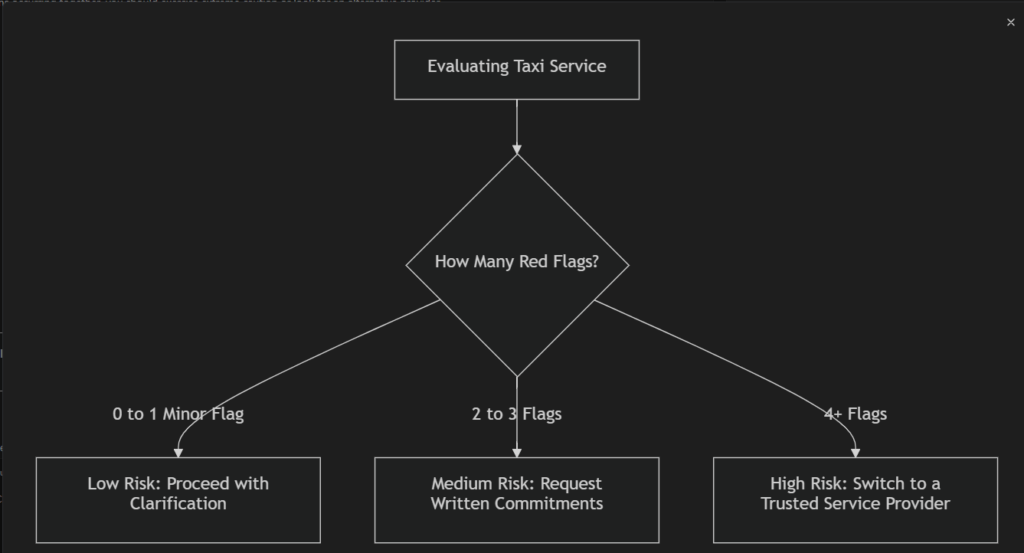
A single minor flaw does not automatically mean a company is fraudulent or unreliable. However, when you notice multiple warning signs occurring together, you should exercise extreme caution or look for an alternative provider.
1. The Quote Is Much Cheaper Than Other Companies
If three operators quote ₹18,000 to ₹20,000 for a multi-city route and a fourth operator offers ₹11,000, alarm bells should ring.
Unusually low prices usually mean key expenses are excluded, such as toll taxes, parking fees, driver night allowances, or state entry taxes. Alternatively, the company may intend to use an older non-commercial vehicle without proper insurance, or demand extra payments midway through the trip.
What to ask: “Is this the final, all-inclusive price? Exactly which expenses are included, and what extra charges could arise during the trip?”
2. The Company Won’t Provide Driver Information
If an operator refuses or repeatedly delays providing driver details before pickup, it often indicates they are subcontracting your booking to an unverified third-party driver at the last minute.
Travelers should always receive:
Driver’s full name and mobile phone number
Vehicle make, model, and official commercial registration number
Exact meeting point instructions at airport arrivals or hotel lobbies
3. Vehicle Details Are Unclear
Vague descriptions like “comfortable 4-seater car” or “luxury AC car” leave room for disappointment. You might expect a modern Toyota Innova Crysta but end up with a small hatchback with insufficient luggage space and weak air conditioning.
Questions to ask:
What exact make and model of vehicle will be assigned?
How many passengers and large suitcases can it fit comfortably?
Is dual air conditioning guaranteed to run throughout the entire journey?
Will the exact same vehicle stay with us for the duration of a multi-day itinerary?
4. The Price Has Hidden or Unclear Charges
A common trap in low-cost taxi quotes is leaving major operational costs unmentioned until the end of the journey:
Expense
Why It Must Be Clarified Upfront
State Permit & Toll Taxes
Highway tolls in Rajasthan and inter-state permits can add significant unexpected costs if not included.
Driver Night Allowance
Drivers requiring daily allowances (typically ₹300–₹500/day) if omitted from the initial quote.
Extra Kilometers
Low daily kilometer limits (e.g., 200 km/day when actual travel averages 300 km/day) leading to expensive per-km surcharges.
Parking & Sightseeing Fees
Charges for monument parking lots, hotel parking, or airport pickup surcharges.
Always demand an explicit statement: “No hidden charges.”
5. There Is No Written Booking Confirmation
Relying solely on phone calls or oral promises leaves you with no recourse if the taxi fails to show up or if the driver demands higher payment upon arrival.
A valid written booking confirmation must clearly display:
Booking date and reference number
Pickup location, date, and exact time
Complete travel itinerary and drop-off points
Vehicle category and model
Total agreed fare and advance payment received
Comprehensive list of included and excluded services
Company contact numbers and cancellation/refund policy
6. Communication Is Poor Before Booking
How a taxi company treats you during the sales phase reflects how they will support you on the road. Warning signs include:
Vague, delayed, or dismissive answers to basic questions
Changing prices multiple times without explanation
Refusal to document inclusions in writing
Agitated response when asking for vehicle photos or driver verification
7. Cancellation and Payment Terms Are Unclear
Legitimate taxi services maintain fair, transparent deposit and cancellation rules. Be wary if:
The operator demands 100% full advance payment days before arrival.
There is no stated policy for refunds if your flight is canceled or rescheduled.
Deposit requirements are non-refundable under all circumstances without clear justification.
8. Reviews Look Suspicious or Too Generic
Online reviews provide valuable feedback, but you must know how to evaluate them:
Generic Praise: Watch out for dozens of short 5-star reviews posted within a few days using identical language (e.g., “Best service good driver”).
Lack of Route Specifics: Trustworthy reviews mention specific drivers by name, exact routes taken (e.g., “Jaipur to Udaipur via Ranakpur”), and real travel details.
Single Platform Dependency: Cross-reference reviews across Google Maps, TripAdvisor, and independent travel forums rather than relying on one source.
9. The Driver or Vehicle Changes at the Last Minute Without Explanation
If you booked a specific SUV and a different smaller sedan arrives—or if a driver appears without prior notification—it shows poor management. While emergency substitutions occasionally happen due to mechanical issues, a reliable operator will contact you in advance, explain the reason, provide updated vehicle details, and ensure equal or upgraded vehicle quality.
10. There Is No Reliable Way to Contact the Company
During long-distance travel, emergencies happen—flights get delayed, weather causes road closures, or luggage gets misplaced. If a company only provides a single mobile number that goes unanswered or lacks a physical office address and business email, you risk being left stranded during late-night pickups or multi-day road tours.
What Should You Check Before Booking a Reliable Taxi Service in Rajasthan?
Pre-Booking Checklist Audit
What to Verify
1. Company Verification
Registered business, domain, valid phone & email
2. Driver Credentials
Commercial license, local experience, contact details
3. Vehicle Audit
T-permit, working AC, enough space for passengers & luggage
4. Financial Clarity
All-inclusive quote — fuel, tolls, driver bhatta
5. Booking Voucher
Written terms, pickup time, cancellation policy
Company Details
Official business registration name and address
Active website with working domain and transparent company profile
Working landline/official mobile numbers and business email addresses
Driver Details
Full name, phone number, and driving license confirmation
Outstation experience on highway routes across Rajasthan
Clear agreement on professional behavior, punctual pickups, and safety standards
Verified passenger capacity and boot space for your group’s luggage
Guaranteed air conditioning performance throughout the journey
Price and Inclusions
Written breakdown confirming fuel, toll taxes, state permit taxes, and driver allowance
Clear rates for extra kilometers or extended waiting time
Confirmation of en-route sightseeing stops included without hidden charges
Booking Terms
Exact pickup time, hotel address, or airport flight details recorded
Advance payment receipt and remaining balance payment timeline
Simple cancellation, modification, and refund policy
How to Compare Reliable Taxi Service in Rajasthan Quotes Properly
Comparing taxi quotes isn’t just about looking at the bottom-line number. Understanding what goes into each price offer is essential for finding the right balance of cost and service.
Compare the Same Things
When evaluating quotes from different operators, ensure you are comparing like-for-like parameters:
Identical Route & Itinerary: Same starting point, intermediate stops, and final destination.
Exact Vehicle Category: Comparing a Toyota Innova Crysta with another Innova Crysta (not against a basic sedan).
Same Group Size: Equal passenger count and luggage allocation.
Duration & Days: Matching total operational days for multi-city travel.
Included Services: Verifying that both quotes include toll fees, parking, driver allowance, and state permits.
Ask “What Is Not Included?”
This single question quickly exposes hidden costs. If Operator A quotes ₹15,000 all-inclusive and Operator B quotes ₹12,000 excluding tolls, parking, and driver allowance (which come to ₹3,500), Operator A is actually the better value.
Don’t Automatically Choose the Cheapest Option
Understanding the distinction between cost and value ensures a better travel experience:
TIP
Lowest Price vs. Best Value vs. Most Suitable Service
Lowest Price: Often comes with older vehicles, hidden costs, unverified drivers, and strict hidden surcharges.
Best Value: Provides transparent, all-inclusive pricing with modern vehicles, professional drivers, and 24/7 customer support.
Most Suitable Service: Tailored to your specific group size, luggage requirements, and travel pace (e.g., luxury SUV for long family highway journeys).
How Much Does a Rajasthan Taxi Cost?
Because road travel requirements vary based on group size, route selection, and seasonal timing, taxi pricing in Rajasthan is customized to your itinerary rather than fixed at a single universal rate.
What Determines the Price?
Total Distance & Duration: Standard outstation rates are calculated per kilometer (with a typical minimum daily billing limit of 250–300 km) or on a fixed itinerary package basis.
Vehicle Category: Sedans (Dzire/Etios) are the most economical, Premium SUVs (Innova Crysta) offer mid-to-high comfort, and Executive Tempo Travellers suit large families or tour groups.
One-Way vs. Round-Trip: One-way transfers require coverage for the driver’s return trip, whereas multi-day tours utilize continuous daily outstation pricing.
Seasonality: Peak tourist season in Rajasthan runs from October through March, when demand increases. Off-peak summer months (April to June) may offer lower promotional rates.
Highway Tolls & Local Permit Taxes: Multi-state routes (such as Delhi to Jaipur via Haryana) involve inter-state commercial vehicle entry permits.
Common Routes Travelers Compare
Travelers frequently evaluate cab services across these high-traffic Rajasthan corridors:
Jaipur to Jodhpur: ~330–350 km | 5.5 to 6.5 hours via NH48/NH21/NH58
Jaipur to Udaipur: ~390–400 km | 6.5 to 7.5 hours via NH48
Jodhpur to Udaipur: ~250–260 km | 4.5 to 5.5 hours (popular with en-route stops at Ranakpur Jain Temple or Kumbhalgarh Fort)
Jaipur to Jaisalmer: ~550–570 km | 9 to 10 hours via NH11/NH125
Jaipur to Pushkar: ~145–150 km | 2.5 to 3 hours via NH48
Delhi to Jaipur: ~270–300 km | 4.5 to 5.5 hours via NE4 (Delhi-Mumbai Expressway) or NH48
Note: Always request an itemized, updated quotation from your provider reflecting current fuel prices, toll structures, and your exact dates.
Taxi vs. Private Driver in Rajasthan: Which Is Better?
Selecting between a point-to-point taxi transfer and a dedicated private driver depends entirely on how your trip is structured.
Point-to-Point Taxi
Private Driver Tour
Airport/Station pickup
Multi-city itineraries
Single transfer (A to B)
Same car & driver throughout
Short local city rides
Flexible en-route stops
No luggage storage between cities
Stress-free hotel-to-hotel transfers
A Taxi Is Often Suitable For:
Simple airport or railway station transfers (e.g., Jaipur Airport to City Center hotel).
Direct point-to-point journeys without planned sightseeing stops along the way.
Short inner-city rides within a single town.
Travelers on tight, non-flexible schedules needing one-off transit.
A Private Driver Can Be Better For:
Multi-city itineraries exploring multiple destinations across Rajasthan over several days.
Frequent sightseeing, allowing you to leave luggage safely in the trunk while exploring monuments.
Journeys requiring flexible en-route stops at stepwells, fort ruins, or rural villages.
Complex Golden Triangle routes connecting Delhi, Agra, Jaipur, and beyond.
For extended multi-day itineraries, hiring a dedicated private driver in India offers unmatched convenience, flexibility, and personalized comfort compared to coordinating separate local taxis in every city.
When Does a Private Driver Make More Sense Than Separate Taxis?
To understand the practical advantage, consider a classic multi-city Rajasthan travel route:
Jaipur → Jodhpur → Udaipur → Pushkar
Option A: Booking Separate Taxis for Every Leg
High Coordination Stress: You must search, negotiate, and re-book four different local taxi companies or app cabs in four separate cities.
Inconsistent Quality: Vehicle condition, air conditioning reliability, and driver professionalism vary randomly on each leg.
Luggage Vulnerability: On transfer days, you cannot easily stop at intermediate attractions (like Ranakpur or Ajmer) because you have no secure place to keep your luggage before hotel check-in.
Strict Schedules: Delays in leaving one city can complicate your next taxi booking.
Option B: Keeping One Private Driver Throughout the Itinerary
Seamless Convenience: The same air-conditioned vehicle and professional driver pick you up at your hotel every morning and drop you at your next destination.
Complete Luggage Security: Bags stay safely locked in the boot during en-route sightseeing tours and meal stops.
Maximum Route Flexibility: Want to stop for photo opportunities, local tea at a roadside dhaba, or visit an ancient temple along the highway? Your driver adapts to your pace.
Familiarity & Trust: By day two, your driver understands your preferences for break frequencies, driving style, and temperature settings.
For seamless multi-destination road trips across North India, reserving a dedicated India private driver tour eliminates transport friction and optimizes your sightseeing time.
What to Consider When Booking Long-Distance Reliable Taxi Service in Rajasthan
Long-distance highway travel across Rajasthan involves unique considerations. Keep these factors in mind when planning outstation drives:
Long-Distance Road Travel Factors
What to Consider
1. Highway Distance
Plan realistic 5–9-hour drive windows with mandatory rest stops.
2. Vehicle Ergonomics
Select spacious SUVs for highway stability and legroom.
3. Rest Stop Access
Confirm driver stops at clean, tourist-friendly highway dhabas.
4. Hotel Access
Ensure the car can navigate narrow heritage lanes or coordinate rickshaw transfers.
Journey Distance & Realistic Travel Time: Highway travel times vary depending on road conditions, toll booth queues, and urban traffic. Avoid overly packed itineraries that require 10+ hours of driving in a single day.
Vehicle Comfort & Ergonomics: Select a car category that offers generous legroom and comfortable suspension. SUVs like the Toyota Innova Crysta perform exceptionally well on long highway stretches.
Driver Experience & Rest Protocols: Ensure your driver takes periodic breaks every 2.5 to 3 hours to maintain alertness and safety.
Clean Rest Stop Locations: Experienced outstation drivers know the cleanest highway plazas equipped with hygienic restrooms and reliable restaurants.
Luggage Accommodation: Account for all hard-shell cases and hand luggage. Never overload a vehicle beyond its designated boot capacity.
Pickup & Hotel Access in Old Cities: Historic centers in Jaipur, Jodhpur, and Udaipur feature extremely narrow lanes where large vehicles cannot physically reach hotel entry gates. Reliable taxi services coordinate seamless transfers using local auto-rickshaws or designated drop-off points near city gates.
Early-Morning or Late-Night Departures: Confirm late-night or early-morning pickup arrangements in advance to guarantee punctual driver arrival.
Seasonal Weather Precautions: During winter months (December to January), dense morning fog across North Indian highways can slow traffic speeds. In summer (April to June), robust air conditioning is essential.
Popular Rajasthan Routes Where Taxi Choice Matters
When planning outstation taxi travel, route-specific nuances can greatly affect your journey:
Jaipur to Jodhpur (~330-350 km | 5.5–6.5 hrs)
A smooth highway drive primarily along NH48 and NH58. A reliable cab operator will suggest starting early to avoid Jaipur city traffic and recommend clean lunch spots near Ajmer or Beawar.
Jaipur to Udaipur (~390-400 km | 6.5–7.5 hrs)
Traversing south across Rajasthan, this route offers opportunities to stop at Chittorgarh Fort. Ensuring an all-inclusive quote with toll inclusions is vital as this corridor features multiple major highway toll plazas.
Jodhpur to Udaipur (~250-260 km | 4.5–5.5 hrs)
One of the most popular scenic routes in the state. Travelers frequently incorporate en-route visits to the stunning Ranakpur Jain Temple or the formidable Kumbhalgarh Fort. Confirm upfront that your cab company includes these en-route sightseeing detours without hidden km surcharges.
Jaipur to Jaisalmer (~550-570 km | 9–10 hrs)
A long journey into the Thar Desert. Vehicle condition and air conditioning performance are paramount. Breaking the drive with an overnight stay in Jodhpur is highly recommended.
Jaipur to Pushkar (~145-150 km | 2.5–3 hrs)
A shorter inter-city drive ideal for a day trip or weekend getaway. Watch out for cab drivers who try to charge full multi-day outstation rates for a brief same-day round trip.
Delhi to Jaipur (~270-300 km | 4.5–5.5 hrs)
With the opening of the Delhi-Mumbai Expressway (NE4), travel times between the national capital and Jaipur have decreased significantly. Ensure your taxi has an active FASTag auto-toll payment module installed for rapid highway transit.
Connecting Delhi, Agra (Taj Mahal), and Jaipur requires inter-state commercial vehicle permits (Delhi, Uttar Pradesh, and Rajasthan). Booking a licensed outstation taxi provider ensures all state border tax permits are properly filed in advance.
How to Check Whether a Rajasthan Taxi Company Is Trustworthy
Verifying a taxi provider takes only a few minutes and saves you from potential travel disruptions.
1. Check Recent Reviews
Look for verified feedback across independent platforms (Google Reviews, TripAdvisor, travel blogs):
Focus on reviews written within the past 3 to 6 months.
Look for detailed descriptions mentioning driver names, route punctuality, vehicle cleanliness, and billing honesty.
Check how management responds to constructive feedback or customer inquiries.
2. Check the Company’s Official Website
A professional operator maintains a clear online presence featuring:
Detailed service offerings and vehicle fleet descriptions
Transparent contact information (business address, phone numbers, email)
Clear terms of service, payment methods, and cancellation guidelines
3. Evaluate Direct Communication
Observe the quality of interactions during your initial inquiries:
Are their written responses clear, polite, and comprehensive?
Do they provide explicit answers regarding pricing, inclusions, and vehicle models?
Are they willing to issue a formal written quote and booking voucher?
Rajasthan Taxi Safety Tips for Tourists
To maximize safety and peace of mind during your road travel in India, keep these practical tips in mind:
Verify Before Boarding: Confirm the driver’s name, phone number, and vehicle registration plate match your booking confirmation before getting into the car.
Keep Documents Accessible: Store digital and physical copies of your booking confirmation, driver details, hotel vouchers, and identification.
Share Trip Status: Share your driver’s contact details, vehicle registration number, and live location with a friend or family member.
Secure Important Belongings: Keep passports, electronics, wallets, and vital medications in your small carry-on bag at your seat rather than in the main boot luggage.
Confirm Pickup Points: Reconfirm exact meeting points (such as specific airport exit gates or hotel lobbies) 12 hours before pickup.
Save Support Helplines: Save your taxi company’s 24/7 manager contact number on your phone for immediate assistance if needed.
Coordinate Odd-Hour Departures: For early-morning (before 6:00 AM) or late-night pickups, reconfirm driver availability the evening before.
Avoid Unverified Side Trips: If a driver insists on taking you to unauthorized shopping emporiums or unrequested detours, politely decline and refer back to your confirmed itinerary.
Taxi Transfer vs. Sightseeing vs. Multi-Day Private Tour
Understanding service categories prevents misunderstandings regarding what your booking includes:
Service Model
Description
Point-to-Point Transfer
Direct transport from Point A to Point B. Driver departs after drop-off.
Local City Sightseeing
Dedicated car & driver for half/full-day city limits (e.g., 8 hrs/80 km).
Multi-Day Private Tour
Continuous vehicle & driver for your entire multi-city regional itinerary.
Point-to-Point Transfer: Pure A-to-B transportation (e.g., Jaipur Hotel to Jodhpur Hotel). The service ends immediately upon drop-off; local sightseeing in either city is not included.
Local Sightseeing: Cab hired for a dedicated period (e.g., 8 hours / 80 km) to visit attractions within a single city’s boundary.
Multi-Day Private Tour: The vehicle and driver remain assigned to your party exclusively across multiple cities and days, handling inter-city transfers, en-route sightseeing, local city tours, and hotel drop-offs continuously.
Always verify that your booking voucher explicitly reflects the exact service model you expect.
Common Mistakes Travelers Make When Booking a Reliable Taxi Service in Rajasthan
Choosing Solely Based on the Lowest Headline Price: Ignoring vehicle condition, driver experience, and safety standards to save a small amount.
Not Clarifying Price Inclusions: Assuming fuel, highway tolls, parking fees, and driver allowances are included when they are not.
Failing to Specific Vehicle Category: Accepting generic terms like “4-seater sedan” without specifying exact models like Dzire, Etios, or Innova.
Not Requesting Driver Details Upfront: Boarding a vehicle with an unverified, unconfirmed driver.
Relying on Oral Promises: Accepting verbal price quotes over the phone without written email or messaging documentation.
Ignoring Cancellation & Deposit Terms: Not knowing whether your advance deposit is refundable in case of schedule changes.
Assuming En-Route Sightseeing Is Included: Expecting free stops at attractions (e.g., Ranakpur between Jodhpur and Udaipur) without confirming detours in writing.
Underestimating Luggage Volume: Renting a compact car for 4 passengers traveling with large hard-shell suitcases.
Booking Disjointed Local Taxis: Organizing separate cabs for every leg instead of evaluating a continuous private driver service for multi-city trips.
Not Keeping Company Emergency Helplines: Failing to save the main agency’s management contact for real-time trip support.
Reliable Taxi Service in Rajasthan Booking Checklist
Use this interactive checklist before making your final payment:
Company Credentials Verified: Business name, official website, domain, and phone numbers confirmed.
Driver Name Received: Full name of driver documented.
Driver Contact Received: Mobile number saved on phone.
Vehicle Type Specified: Make, model, and category (e.g., Toyota Innova Crysta) explicitly recorded.
Vehicle Capacity Verified: Confirmed comfortable seating for all passengers.
Luggage Boot Space Confirmed: Vehicle trunk verified to hold all baggage.
Pickup Location & Time Recorded: Exact hotel address or airport terminal exit specified.
Destination Points Detailed: Complete city itinerary outlined.
Total Agreed Price Documented: Overall fare confirmed in writing.
Written Booking Voucher Received: Formal confirmation document saved digitally.
24/7 Emergency Support Contact Saved: Agency manager phone number stored.
Questions to Ask Before Paying for a Reliable Taxi Service in Rajasthan
Keep this 12-question cheat sheet handy during your pre-booking communications:
What is the final, total price for my entire itinerary?
What exact expenses are included in this price (fuel, tolls, parking, driver allowance)?
Are there any excluded costs or extra charges that could arise during the journey?
Which vehicle make and model will be assigned for my trip?
Will I receive the driver’s name, phone number, and vehicle registration plate before pickup?
Are all highway toll taxes and inter-state permit fees included in this quote?
Are parking fees at airports, hotels, and tourist monuments included?
What is the extra-kilometer rate if we exceed the planned distance?
Are intermediate en-route sightseeing stops included in the agreed itinerary?
What is your policy if my flight, train, or schedule is delayed?
What are the exact cancellation and deposit refund terms?
Who is my primary 24/7 management contact if I need assistance during the trip?
FAQs – How to Choose a Reliable Taxi Service in Rajasthan
How can I find a reliable taxi service in Rajasthan?
Look for providers offering transparent, all-inclusive written quotes, clear driver and vehicle details prior to pickup, strong recent customer reviews across independent platforms, and responsive customer communication.
What are the biggest red flags when booking a Rajasthan taxi?
The major red flags include quotes far below market rates, refusal to provide driver or vehicle details, hidden charges (such as tolls or driver allowances omitted from quotes), lack of written booking confirmation, and absent customer support contacts.
Should I choose the cheapest reliable taxi service in Rajasthan?
No. Unusually cheap quotes often hide excluded costs (tolls, parking, driver allowances), older vehicles with poor air conditioning, unverified drivers, or unexpected price hikes mid-trip. Prioritize overall value and pricing transparency over the lowest headline number.
Is it better to hire a taxi or private driver in Rajasthan?
For single airport transfers or direct point-to-point journeys, a local taxi is sufficient. For multi-city, multi-day itineraries across Rajasthan, hiring a dedicated private driver is significantly more comfortable, convenient, and cost-effective.
What should be included in a Rajasthan taxi quote?
A comprehensive outstation taxi quote should explicitly cover vehicle hire, fuel, highway tolls, state entry permits, parking charges, driver allowances (bhatta), and all scheduled itinerary sightseeing stops.
Is a private driver useful for a multi-city Rajasthan tour?
Yes. Having one dedicated car and driver throughout a multi-city journey (e.g., Jaipur to Jodhpur to Udaipur) ensures seamless hotel pickups, complete luggage security during en-route sightseeing, total route flexibility, and consistent service quality.
How far in advance should I book a Rajasthan taxi?
During the peak travel season (October through March), it is advisable to book 2 to 4 weeks in advance—especially if you require popular vehicle models like a Toyota Innova Crysta or a Tempo Traveller. Off-peak bookings can typically be arranged a few days prior.
What information should I receive before my Rajasthan taxi pickup?
At least 12 to 24 hours prior to departure, you should receive your booking confirmation voucher, the driver’s full name and phone number, the vehicle’s model and commercial license plate number, and exact pickup location instructions.
Final Takeaway: Choose Transparency Over the Lowest Price
Navigating Rajasthan’s royal cities and desert highways should be an inspiring travel experience, free from transport anxiety. When selecting your ground transportation, remember that clarity, safety, and operational reliability are far more valuable than a deceptive discount.
A dependable taxi operator ensures that you feel fully informed and confident before your journey begins. Before transferring any payment, ensure you have complete clarity on:
Who is driving you: Professional, licensed outstation driver with verified experience.
What vehicle you are getting: Clean, commercial yellow-plate vehicle with functional AC and adequate luggage boot space.
Where and when you will be met: Exact pickup time and location pre-confirmed.
What you are paying: Transparent, itemized breakdown of costs.
What is included: Clear statement covering fuel, tolls, parking, driver allowances, and sightseeing.
What happens if plans change: Fair, documented cancellation and delay policies.
Who to contact: 24/7 dedicated agency helpline for real-time support.
Whether you need seamless point-to-point transfers or a customized multi-day road adventure across North India, choose a provider committed to upfront honesty and top-tier service.
Ready to explore Rajasthan in comfort and safety? Discover our curated Rajasthan Tour Packages or book a dependable Rajasthan private taxi service today to enjoy a tailored, worry-free journey across India’s most enchanting state.
Quick Answer The best time to visit Rajasthan is from October to March, when daytime temperatures range from 20–30°C (68–86°F) and nights are cool at 5–15°C (41–59°F). November and February offer the sweet spot — excellent weather with slightly fewer crowds than December–January. The cheapest months are April–September (summer and monsoon), though summer heat exceeds 45°C in desert areas. Best for honeymoon: October (post-monsoon greenery, full lakes, quieter palaces). Best for wildlife: April–June (Ranthambore tiger sightings peak as animals gather at water sources). Best for photography: September–October (desert turns briefly green, dramatic skies) and November–February (crisp winter light). Key Takeaways CategoryBest TimeBest OverallNovember, February (ideal weather, manageable crowds)Cheapest TimeApril–September (summer heat + monsoon)Peak SeasonDecember–January (coolest weather, highest prices, biggest crowds)Shoulder SeasonOctober, March (good value, warm but manageable)Off SeasonApril–June (extreme heat, lowest prices)Best for FamiliesNovember–February (comfortable weather, flat terrain, kid-friendly activities)Best for CouplesOctober–November (romantic weather, full lakes, quieter palaces)Best for Luxury TravelDecember–January (heritage hotels at their finest, clear skies)Best for Desert SafariNovember–February (cool days, cold clear nights)Best for WildlifeApril–June (animals gather at water sources in Ranthambore) Introduction Rajasthan is India's most regal state — a land of maharajas, magnificent forts, golden deserts, and palaces that seem to float on lakes. But here's the thing: Rajasthan's weather is extreme, and choosing the wrong time to visit can turn your dream vacation into a dusty, sweaty ordeal. Timing matters more in Rajasthan than almost anywhere else in India. The Thar Desert scorches at over 45°C in summer, while winter nights in Jaisalmer can drop to near-freezing. Monsoon transforms the landscape briefly green, and festivals like the Pushkar Camel Fair draw crowds from around the world. Ask ten people when to visit and most will say "winter" and stop there — which is true, but it's only half the story. The best time to
Quick Answer
The best time to visit Rajasthan is from October to March, when daytime temperatures range from 20–30°C (68–86°F) and nights are cool at 5–15°C (41–59°F). November and February offer the sweet spot — excellent weather with slightly fewer crowds than December–January. The cheapest months are April–September (summer and monsoon), though summer heat exceeds 45°C in desert areas. Best for honeymoon: October (post-monsoon greenery, full lakes, quieter palaces). Best for wildlife: April–June (Ranthambore tiger sightings peak as animals gather at water sources). Best for photography: September–October (desert turns briefly green, dramatic skies) and November–February (crisp winter light).
Key Takeaways
Category
Best Time
Best Overall
November, February (ideal weather, manageable crowds)
October–November (romantic weather, full lakes, quieter palaces)
Best for Luxury Travel
December–January (heritage hotels at their finest, clear skies)
Best for Desert Safari
November–February (cool days, cold clear nights)
Best for Wildlife
April–June (animals gather at water sources in Ranthambore)
Introduction
Rajasthan is India’s most regal state — a land of maharajas, magnificent forts, golden deserts, and palaces that seem to float on lakes. But here’s the thing: Rajasthan’s weather is extreme, and choosing the wrong time to visit can turn your dream vacation into a dusty, sweaty ordeal.
Timing matters more in Rajasthan than almost anywhere else in India. The Thar Desert scorches at over 45°C in summer, while winter nights in Jaisalmer can drop to near-freezing. Monsoon transforms the landscape briefly green, and festivals like the Pushkar Camel Fair draw crowds from around the world.
Ask ten people when to visit and most will say “winter” and stop there — which is true, but it’s only half the story. The best time to visit Rajasthan depends on whether you prioritize pleasant weather, festivals, wildlife, photography, or lower prices. This guide breaks down every month, every festival, and every travel style so you can make the right choice.
Ready to plan your royal adventure? Explore our Rajasthan Tour Packages for expertly crafted itineraries.
Rajasthan Weather at a Glance
Season
Months
Day Temp
Night Temp
Crowds
Hotel Prices
Best For
Winter
Nov–Feb
20–30°C
5–15°C
Peak
Highest
Sightseeing, festivals, desert camping
Summer
Apr–Jun
35–45°C+
25–30°C
Very low
Lowest
Budget travel, wildlife (Ranthambore)
Monsoon
Jul–Sep
30–38°C
24–28°C
Low
Low
Greenery, photography, Udaipur lakes
Rajasthan Weather by Month
January
Weather: Cool and dry — the coolest month of the year. Days are pleasant at 23°C (73°F), but nights can drop to 9°C (48°F). Rain is virtually absent (6% of days).
Crowd Level: Peak season — the busiest month after December.
Average Temperature: 23°C day / 9°C night.
Best Cities: All cities are at their best. Jaisalmer, Jodhpur, Udaipur, and Jaipur all score 10/10.
Festivals: Desert Festival in Jaisalmer (January 30 – February 1, 2026).
Activities: Fort exploration, desert camping under clear cold skies, photography in crisp winter light.
Photography: Excellent — clear blue skies, golden winter light, comfortable conditions for extended shoots.
Who Should Visit: First-time visitors, families, luxury travelers, photographers.
Packing Tips: Layers are essential. Light cotton for daytime, warm jacket, scarf, and gloves for chilly desert nights.
February
Weather: Warming slightly but still excellent. Days at 27°C (81°F), nights at 12°C (54°F). Very low rainfall.
Crowd Level: High — still peak season but slightly fewer crowds than January.
Average Temperature: 27°C day / 12°C night.
Best Cities: All cities score 10/10.
Festivals: Desert Festival continues (Jan 30 – Feb 1).
Activities: Rooftop dining, palace tours, boat rides on Lake Pichola in Udaipur.
Photography: Excellent — temperatures of 14–27°C make it perfect for all-day shooting.
Who Should Visit: All travelers — one of the two best months overall.
Packing Tips: Light clothing for days, a jacket and scarf for evenings.
March
Weather: Warming significantly — 33°C (91°F) days, 18°C (64°F) nights. March 2026 saw temperatures cross 40°C in 14 Rajasthan cities, breaking records.
Crowd Level: Moderate — shoulder season.
Average Temperature: 33°C day / 18°C night.
Best Cities: Jaipur, Jodhpur score 8/10; Udaipur 8/10; Jaisalmer 8/10.
Festivals:Holi (Dhulandi) — March 3, 2026. Braj Holi Festival in Bharatpur (March 26–27). Gangaur Fair in Jaipur (March 21–22).
Activities: Holi celebrations are spectacular across Rajasthan. Front-load your trip — early March is comfortable, late March gets hot.
Photography: Good in early March; challenging by month-end due to heat haze.
Who Should Visit: Festival lovers, photographers wanting Holi shots, budget travelers seeking shoulder season value.
Packing Tips: Light cotton for days, a light jacket for evenings. Sun protection essential.
April
Weather: Hot — 38°C (100°F) days, 24°C (75°F) nights. Heat builds fast. April 2026 saw temperatures reaching 44°C in parts of Rajasthan.
Crowd Level: Low — most tourists avoid the heat.
Average Temperature: 38°C day / 24°C night.
Best Cities: Not recommended. Jaisalmer and Jodhpur score only 4/10; Udaipur scores 6/10.
Festivals: Few major festivals.
Activities: Limited to early morning and late afternoon sightseeing. Wildlife viewing in Ranthambore improves as animals gather at water sources.
Photography: Poor — harsh light, heat haze.
Who Should Visit: Budget travelers (hotels drop rates significantly), wildlife enthusiasts (tiger sightings peak in Ranthambore).
Packing Tips: Lightweight cotton, wide-brim hat, sunscreen, sunglasses. Hydration is critical.
May
Weather: Extreme — 42°C (108°F) days, 28°C (82°F) nights. Jaisalmer can hit 50°C — the Thar Desert at its fiercest.
Crowd Level: Very low.
Average Temperature: 42°C day / 28°C night.
Best Cities: All cities score 2/10 — not recommended.
Festivals: Few.
Activities: Very limited — heatstroke is a real risk. Avoid outdoor activity between 11 AM and 5 PM.
Photography: Poor.
Who Should Visit: Only serious budget travelers who can tolerate extreme heat, or wildlife photographers targeting Ranthambore.
Packing Tips: Lightest possible clothing, multiple water bottles, electrolyte powders. Avoid this month if possible.
June
Weather: Pre-monsoon heat — 40°C (104°F) days, 28°C (82°F) nights. Rajasthan recorded 154–187% excess rainfall in June 2026, bringing some relief from heat but also localized flooding.
Crowd Level: Very low.
Average Temperature: 40°C day / 28°C night.
Best Cities: All cities score 2/10.
Festivals: Few.
Activities: Limited — pre-monsoon dust storms and occasional rain.
Photography: Poor.
Who Should Visit: Budget travelers who don’t mind heat and occasional rain.
Packing Tips: Lightweight clothing, umbrella or rain jacket for sudden downpours.
July
Weather: Monsoon arrives — 34°C (93°F) days, 26°C (79°F) nights. Jaipur receives 150–200mm of rain across 12–15 days.
Crowd Level: Low.
Average Temperature: 34°C day / 26°C night.
Best Cities: Udaipur scores 6/10; Jaisalmer and Jodhpur score 4/10.
Festivals: Few major festivals.
Activities: Udaipur’s lakes are full and beautiful. Fort explorations can be slippery. Some flooding in old town lanes.
Photography: Good for dramatic monsoon skies and greenery.
Who Should Visit: Budget travelers, photographers wanting unique monsoon shots, those who don’t mind humidity.
Best: October–November. Post-monsoon greenery, full lakes (Udaipur’s Lake Pichola at its most beautiful), palaces quieter than any other dry-season month. Also good: February for comfortable weather and fewer crowds than December–January.
Families
Best: November–February. Rajasthan is India’s best family destination — flat terrain, camels, forts, palaces, lake boats — kids love it all. Avoid: April–June. The heat is not something to manage around — it’s something to avoid entirely.
Senior Travelers
Best: October–March. Comfortable temperatures, easy accessibility at major sites. Avoid summer heat and monsoon slippery conditions.
Solo Travelers
Best: November–February. Peak season means plenty of fellow travelers to meet. Safe, well-trodden circuit.
Friends & Groups
Best: November–February. Perfect weather for fort-hopping, desert camping, and festival experiences.
Luxury Travelers
Best: December–January. Heritage hotels at their finest, clear skies, every day dawns bright and blue. Book well ahead.
Best: July–September (monsoon) or April–June (summer). Hotels drop rates up to 70%. September offers the best value — monsoon retreats, greenery remains, prices still low.
Wildlife Lovers
Best: April–June. Tiger sightings in Ranthambore peak as animals gather at shrinking water sources. The park is open October–June.
Best months: October–March. November and February are ideal — clear skies, comfortable temperatures, fewer crowds than December. Why visit then: Amber Fort, Hawa Mahal, and City Palace are comfortable to explore. Weather: 10–27°C in winter; 33–42°C in summer. Major attractions: Amber Fort, City Palace, Hawa Mahal, Jantar Mantar, Nahargarh Fort.
Udaipur (The City of Lakes)
Best months: September–March. September offers post-monsoon greenery and full lakes with fewer crowds. October–November is peak romance — Lake Pichola at its most beautiful. Why visit then: Lakes are full, hills green, palace views spectacular. Weather: 14–30°C in winter. Major attractions: City Palace, Lake Pichola, Jag Mandir, Fateh Sagar Lake, Monsoon Palace.
Jodhpur (The Blue City)
Best months: October–March. Mehrangarh Fort is walkable in winter; ramparts become an oven by 10 AM in summer. Why visit then: Blue City is comfortable to explore, fort views spectacular. Weather: 10–27°C in winter. Major attractions: Mehrangarh Fort, Jaswant Thada, Umaid Bhawan Palace, Clock Tower Market.
Jaisalmer (The Golden City)
Best months: November–February. Jaisalmer Fort glows golden in winter light. December–January are peak for desert camping under clear cold skies. Why visit then: Desert temperatures are bearable, camping magical. Weather: 5–23°C in winter; can hit 50°C in summer. Major attractions: Jaisalmer Fort (Sonar Quila), Patwon Ki Haveli, Sam Sand Dunes, Gadisar Lake.
Pushkar
Best months: November (for the Pushkar Camel Fair); October–March for general sightseeing. Why visit then: The fair is Rajasthan’s most famous festival. Weather: 12–28°C in November. Major attractions: Pushkar Lake, Brahma Temple, camel fair grounds, local markets.
Bikaner
Best months: October–March. The desert city is comfortable in winter; camel safari weather is ideal. Why visit then: Junagarh Fort and Karni Mata temple comfortable all day. Weather: 5–25°C in winter. Major attractions: Junagarh Fort, Karni Mata Temple (rat temple), camel breeding farm.
Mount Abu (Rajasthan’s Only Hill Station)
Best months: October–March. September is also excellent for post-monsoon greenery and flowing waterfalls. Why visit then: Pleasant temperatures, Dilwara Temples comfortable, Nakki Lake calm. Weather: 10–26°C in winter. Major attractions: Dilwara Temples, Nakki Lake, Sunset Point, Guru Shikhar.
Ranthambore National Park
Best months: October–June (park open). Best for tiger sightings: April–June when animals gather at water sources. Best for comfort: November–February (pleasant weather). Why visit then: Tiger sightings peak in summer; comfort peaks in winter. Weather: Varies by season. Major attractions: Tiger safaris, Ranthambore Fort, Padam Talao.
Chittorgarh
Best months: October–March. The massive fort covers 700 acres and requires comfortable weather for exploration. Why visit then: Fort exploration is manageable in cool weather. Weather: 12–30°C in winter. Major attractions: Chittorgarh Fort, Vijay Stambh, Kirti Stambh, Padmini Palace.
Kumbhalgarh
Best months: November–February. The fort wall walk and light show are best in clear, cool weather. Why visit then: Ideal 12–28°C range, clear skies. Weather: 12–28°C in winter. Major attractions: Kumbhalgarh Fort (world’s second-longest wall), Badal Mahal.
Rajasthan Festivals Calendar
Festival
2026 Date
Location
Why Visit
Travel Tips
Desert Festival
Jan 30 – Feb 1
Jaisalmer
Folk performances, camel races, turban-tying competitions
Book accommodation months ahead
Jaipur Literature Festival
January
Jaipur
World’s largest free literary festival
Arrive early for sessions
Gangaur Fair
March 21–22
Jaipur
Colorful processions celebrating spring
Great for photography
Holi (Dhulandi)
March 3
Statewide
The festival of colors — Jaipur and Jodhpur celebrations are world-famous
Wear old clothes, protect cameras
Braj Holi
March 26–27
Bharatpur
Traditional Holi celebrations
More authentic than city celebrations
Teej Festival
July–August
Statewide
Monsoon festival, swinging processions
Best in Jaipur
Independence Day
August 15
Statewide
National celebrations
Major monuments illuminated
Diwali
October–November
Statewide
Festival of lights — decorations, fireworks
Book accommodation well ahead
Pushkar Camel Fair
November 22–23
Pushkar
Rajasthan’s most famous fair — camel trading, folk music, cultural performances
Book 6 months ahead — hotels fill up
Best Time for Popular Activities
Activity
Best Months
Why
Camel Safari
November–February
Cool days, cold clear nights; perfect for desert camping
Covered bazaars operate in all weather; winter is more comfortable
Cultural Shows
Year-round
Indoor performances unaffected by weather
Which Month Should You Visit? (Decision Guide)
If you want…
Choose…
Pleasant weather
November or February
Green landscapes
September (monsoon retreat, desert briefly green)
Luxury vacation
December–January (heritage hotels at their finest)
Budget trip
July–September (lowest prices) or April–June (heat)
Romantic honeymoon
October (post-monsoon greenery, full lakes, quieter palaces)
Family vacation
November–February (comfortable, kid-friendly)
Photography
September–October (dramatic skies, green desert) or November–February (crisp light)
Festivals
March (Holi), November (Pushkar Fair), January–February (Desert Festival)
Wildlife
April–June (tiger sightings peak in Ranthambore)
Desert experience
November–February (cool days, clear nights)
Rajasthan Crowd Calendar
Month
Tourist Crowds
Hotel Availability
Attraction Wait Time
January
Peak
Limited
Long queues
February
High
Moderate
Moderate queues
March
Moderate
Good
Short queues
April
Low
Excellent
No queues
May
Very low
Excellent
No queues
June
Very low
Excellent
No queues
July
Low
Excellent
No queues
August
Low
Excellent
No queues
September
Low–Moderate
Good
Short queues
October
Rising
Good
Short queues
November
Peak begins
Limited
Moderate queues
December
Peak
Very limited
Long queues
The most crowded months are October to March, with special peaks during Diwali, Pushkar Fair, Christmas, and New Year.
Rajasthan Hotel Prices by Season
Peak Season (December–January): Highest prices. Heritage hotels book out months in advance. Expect to pay 2–3x off-season rates.
Shoulder Season (October, March): Good value. Rates are lower than peak, weather is still comfortable.
Off Season (April–September): Lowest prices. Hotels drop rates up to 70%. September offers the best value — monsoon retreats, greenery remains, prices still low.
Money-saving tips:
Book 3–6 months ahead for peak season
Travel in September for the best value-to-weather ratio
Consider heritage havelis instead of 5-star palaces
Book directly with hotels or through local tour operators
Cheapest Time to Visit Rajasthan
The cheapest time to visit Rajasthan is July–September (monsoon season) and April–June (summer heat).
Cost Category
Peak Season (Dec–Jan)
Off Season (Jul–Sep)
Flights
Highest
30–50% lower
Hotels
Highest
50–70% lower
Tour prices
Highest
20–40% lower
Taxi/Driver
Highest
Negotiable
Best value month: September. Monsoon retreats, the desert turns briefly green, tourist facilities reopen, and prices haven’t yet risen to peak season levels.
For travelers comparing value, our Rajasthan Tour Packages offer competitive rates across all seasons.
Sample Rajasthan Itineraries by Season
5 Days (Winter Recommended)
Delhi → Jaipur (2 days) → Agra (Taj Mahal) → Delhi. Best in November–February.
7 Days
Delhi → Jaipur (2 days) → Jodhpur (2 days) → Udaipur (2 days) → Delhi. Best in October–March.
10 Days
Recommended: Delhi → Agra (Taj Mahal) → Jaipur → Jodhpur → Udaipur → Delhi. This itinerary covers the Golden Triangle plus Rajasthan’s two most iconic cities.
For first-time visitors wanting a broader North India experience, explore our Delhi Agra Jaipur Jodhpur Udaipur Tour (10 Days). This tour covers major destinations and is perfect for first-time travelers.
13 Days
Recommended: Delhi → Agra → Jaipur → Bikaner → Jaisalmer → Jodhpur → Udaipur → Delhi. This is the complete Rajasthan circuit.
For travelers wanting an in-depth journey covering Rajasthan’s major heritage cities, our Ultimate Classical Rajasthan Tour (13 Days) takes you through Delhi, Agra, Jaipur, Bikaner, Jaisalmer, Jodhpur, and Udaipur. It’s ideal for those who want to experience Rajasthan’s full cultural and historical richness.
Common Mistakes Travelers Make
Visiting Jaisalmer in May: Jaisalmer can hit 50°C in May. Fort sandstone burns bare feet. This isn’t discomfort — it’s dangerous.
Underestimating winter nights: Desert nights in December–January can drop to near-freezing (5–8°C). Pack warm layers even if you’re from a cold climate.
Booking late during peak season: December–January hotels book out months in advance. Book at least 3–6 months ahead.
Ignoring festival dates: Arriving during Pushkar Fair without a hotel booked is a disaster. Check the festival calendar before booking.
Packing incorrect clothing: Summer requires lightweight cotton and sun protection. Winter requires layers, jackets, and warm accessories. Don’t pack for one season only.
Not factoring in travel times: Rajasthan is a large state — distances between cities can be 3–6 hours. Plan accordingly.
Assuming all Rajasthan is the same temperature: Desert cities like Jaisalmer and Bikaner run hotter by day and colder by night than Jaipur.
Local Travel Tips
Clothing:
Winter (Oct–Mar): Layers are essential. Light cotton for days, warm jacket, scarf, and gloves for nights
Summer (Apr–Jun): Lightweight, light-colored cotton and linen. Wide-brim hat, sunscreen, sunglasses
General: Modest clothing is appreciated — loose cotton kurtas, linen shirts, and trousers work best
Hydration: Carry water bottles everywhere. In summer, dehydration is a serious risk. Add electrolyte powders to your water.
Transport: Private AC cars are the most comfortable way to travel between cities. Book through reputable operators.
Desert etiquette: Respect local customs. Ask permission before photographing people. Dress modestly in rural areas.
Festival planning: Book accommodation 3–6 months ahead for major festivals like Pushkar Fair and Desert Festival.
Photography tips:
Sunrise and sunset offer the best light for forts and palaces
The Taj Mahal and Amber Fort are best photographed in early morning light
During monsoon, dramatic skies create unique photo opportunities
Ask permission before photographing locals
Sunrise vs sunset visits: In summer, sightsee at sunrise and sunset only. In winter, all-day sightseeing is comfortable.
Expert Recommendations
Travel Goal
Best Month
Why
Honeymoon
October
Post-monsoon greenery, full lakes, quieter palaces
Family
December
Cool weather, festive atmosphere, clear skies
Luxury
January
Heritage hotels at their finest, perfect weather
Budget
August
Lowest prices, lush landscapes
Wildlife
April
Tiger sightings peak in Ranthambore
Photography
September
Desert turns green, dramatic monsoon skies
Festivals
November
Pushkar Camel Fair — Rajasthan’s most famous event
Desert Safari
February
Cool days, clear nights, ideal camping
First-time visit
November
Best weather, manageable crowds
Value + Weather
October/February
Shoulder season — lower prices, good weather
FAQs – Best Time to Visit Rajasthan
What is the best month to visit Rajasthan?
November is the best month to visit Rajasthan — it offers ideal weather (28°C days, 13°C nights), clear skies, the Pushkar Camel Fair, and manageable crowds before December’s peak. February is a close second.
Is Rajasthan too hot in summer?
Yes — summer (April–June) in Rajasthan is extreme, with temperatures regularly exceeding 45°C (113°F) in desert areas. Jaisalmer can hit 50°C. Heatstroke is a real risk. Only budget travelers or wildlife enthusiasts should consider summer visits.
Can I visit Rajasthan during monsoon?
Yes — monsoon (July–September) offers a different Rajasthan. The desert turns briefly green, Udaipur’s lakes fill, and prices are low. However, humidity rises and occasional flooding can disrupt travel. September is the best monsoon month.
Is December the best month?
December offers the coolest weather (23°C days / 8°C nights) and clear blue skies, but it’s also the busiest and most expensive month. November and February offer similar weather with fewer crowds and lower prices.
How many days are enough for Rajasthan?
10–13 days are ideal for a comprehensive Rajasthan tour covering major cities. 7 days covers the highlights (Jaipur, Jodhpur, Udaipur). 5 days covers the Golden Triangle (Delhi, Agra, Jaipur).
Which city is coolest in Rajasthan?
Mount Abu, Rajasthan’s only hill station, is the coolest city year-round. Among major cities, Udaipur and Jaipur are slightly cooler than Jaisalmer and Bikaner due to their inland locations.
Is Rajasthan expensive in winter?
Yes — winter (December–January) is peak season with the highest prices. Hotels can cost 2–3x off-season rates. Book 3–6 months ahead. Shoulder months (October, February, March) offer better value.
What clothes should I pack for Rajasthan?
Winter (Oct–Mar): Layers — light cotton for days, warm jacket, scarf, gloves for cold desert nights. Summer (Apr–Jun): Lightweight, light-colored cotton and linen, wide-brim hat, sunscreen. Monsoon (Jul–Sep): Rain jacket, waterproof shoes, quick-dry clothing.
Which month has the fewest crowds?
May–June have the fewest crowds (extreme heat). July–September also have low crowds (monsoon). For fewer crowds with better weather, choose October or March — shoulder season with manageable crowds.
Is Rajasthan good for a honeymoon?
Yes — Rajasthan is excellent for honeymoons. October is the best month — post-monsoon greenery, full lakes (Udaipur’s Lake Pichola at its most beautiful), and palaces quieter than any other dry-season month. November–February are also romantic with cool weather and clear skies.
Conclusion – Best Time to Visit Rajasthan
Rajasthan is one of the world’s most extraordinary destinations — a land of maharajas, mighty forts, golden deserts, and palaces that defy imagination. But choosing the best time to visit Rajasthan is the single most important decision you’ll make.
The short answer: October to March offers the best weather. November and February are the sweet spots — ideal conditions with manageable crowds. December–January are perfect but crowded and expensive. April–June are brutally hot — only for budget travelers or wildlife enthusiasts. July–September offer green landscapes and low prices but come with humidity and rain.
The real answer: The best time depends on you. Ask yourself:
Do you want perfect weather? → November or February
Are you on a tight budget? → July–September
Do you want to experience festivals? → March (Holi) or November (Pushkar Fair)
Are you a photographer? → September–October or November–February
Are you traveling with family? → November–February
Is this a honeymoon? → October
Whatever you choose, Rajasthan will reward you with unforgettable experiences. The forts will still be magnificent. The deserts will still be magical. The food will still be extraordinary. The people will still welcome you with warmth.
Ready to plan your Rajasthan adventure? Explore our Rajasthan Tour Packages for expertly crafted itineraries.
If you've typed "how many days are enough for Rajasthan?" into Google, you've probably noticed that every article gives you a slightly different number — 5 days here, 7 days there, 10 days somewhere else. None of them really explain why. This guide takes a different approach: instead of just handing you a number, it explains the one factor that decides whether your trip feels relaxed or rushed — travel time between cities — and how to plan around it. If you'd rather skip the planning altogether, our Rajasthan tour packages are built around exactly this kind of realistic pacing, with a private vehicle and driver handling the logistics for you. Quick Recommendation 3 days: Jaipur only 5 days: Jaipur + Udaipur 7 days: Jaipur + Jodhpur + Udaipur (best for first-time visitors) 10 days: Add Jaisalmer 14 days: Include Jawai, Ranakpur, and Kumbhalgarh These numbers only work, though, if you understand why they're set where they are — which is what the rest of this guide covers. Why Most Rajasthan Itineraries Feel Rushed Almost every traveler who feels their Rajasthan trip was "too fast" made the same miscalculation: they planned their days around attractions instead of around travel time. A typical day involves not just the drive itself, but hotel check-out, breakfast, a fort or palace visit along the way, lunch, traffic through town centers, and check-in at the next hotel. Multiply that across a 5–7 hour drive and a "half day of travel" easily becomes a full day with almost no time left for the destination itself. This is the real answer to how many days are enough for Rajasthan — it depends far less on how many cities you want to see, and far more on how realistically you've mapped the driving time between them. There's also
If you’ve typed “how many days are enough for Rajasthan?” into Google, you’ve probably noticed that every article gives you a slightly different number — 5 days here, 7 days there, 10 days somewhere else. None of them really explain why. This guide takes a different approach: instead of just handing you a number, it explains the one factor that decides whether your trip feels relaxed or rushed — travel time between cities — and how to plan around it. If you’d rather skip the planning altogether, our Rajasthan tour packages are built around exactly this kind of realistic pacing, with a private vehicle and driver handling the logistics for you.
Quick Recommendation
3 days: Jaipur only 5 days: Jaipur + Udaipur 7 days: Jaipur + Jodhpur + Udaipur (best for first-time visitors) 10 days: Add Jaisalmer 14 days: Include Jawai, Ranakpur, and Kumbhalgarh
These numbers only work, though, if you understand why they’re set where they are — which is what the rest of this guide covers.
Why Most Rajasthan Itineraries Feel Rushed
Almost every traveler who feels their Rajasthan trip was “too fast” made the same miscalculation: they planned their days around attractions instead of around travel time. A typical day involves not just the drive itself, but hotel check-out, breakfast, a fort or palace visit along the way, lunch, traffic through town centers, and check-in at the next hotel. Multiply that across a 5–7 hour drive and a “half day of travel” easily becomes a full day with almost no time left for the destination itself.
This is the real answer to how many days are enough for Rajasthan — it depends far less on how many cities you want to see, and far more on how realistically you’ve mapped the driving time between them.
There’s also a chain reaction most travelers don’t notice until they’re already mid-trip: an underestimated drive time leads to squeezing in too many cities, which leads to longer days on the road, which leaves less time actually exploring, which is what makes a trip feel rushed in hindsight. Once you notice this pattern, it becomes much easier to plan around it — not necessarily by adding more days, but by choosing fewer cities and giving each one the time it actually needs. This is also why Rajasthan itinerary planning shouldn’t start with a bucket list of forts and palaces — it should start with a map and a realistic look at how far apart everything actually is.
In our experience planning Rajasthan road trips, this is the single most common gap between what travelers expect and what actually happens on the ground: a route that looks entirely manageable on paper becomes a full day once sightseeing stops, meals, and photo breaks are added in. It’s rarely one big miscalculation — it’s several small ones that add up across the trip.
Don’t Plan Only Using Google Maps
This is the single biggest planning mistake first-time visitors make. Google Maps might show Jaipur to Jodhpur as a 5–6 hour drive. In practice, once you add a stop at a roadside dhaba, a quick photo break, a stepwell or fort along the highway, and the usual delays of Indian road travel, that 5–6 hour estimate frequently stretches into a 7–8 hour day.
The same applies to almost every major route in the state:
Jaipur to Jodhpur: ~350 km, roughly 6–7 hours by road
Jaipur to Ranthambore: ~180–200 km, roughly 3–3.5 hours
Jodhpur to Jaisalmer: ~280 km, roughly 4.5–5 hours
Udaipur to Jaisalmer: ~490–520 km, roughly 9–11 hours
Here’s the gap in numbers, comparing what a map estimate shows versus what a real travel day with stops usually looks like:
Route
Google Maps Estimate
Realistic Travel Day
Jaipur → Jodhpur
~6 hours
7–8 hours
Jodhpur → Jaisalmer
~4.5 hours
5–6 hours
Udaipur → Jaisalmer
~9 hours
10–11 hours
Jaipur → Udaipur
~7 hours
8–9 hours
That last route is the one that catches people out the most. Anyone trying to fit Jaisalmer into a short Rajasthan trip planning schedule alongside Udaipur ends up sacrificing an entire day to driving alone.
If you’d rather not do this math yourself, a Rajasthan private taxi service with a local driver will usually build in realistic timing automatically, since they’ve made these drives hundreds of times and know exactly where the real delays happen.
The Biggest Mistake First-Time Visitors Make
The most common regret among travelers is attempting to see too many cities in too short a window — typically Jaipur, Jodhpur, Jaisalmer, and Udaipur, all within 5 days. On paper, it looks doable. In practice, it means three to four full travel days out of five, leaving almost no time to actually experience any of the destinations.
Here’s how pace changes as you add more cities into the same number of days:
Days
Cities
Pace
Recommended?
3
1
Relaxed
✅
5
2
Comfortable
✅
5
4
Very rushed
❌
7
3
Best balance
⭐
10
4
Comfortable
✅
❌ Avoid an itinerary like this:
Day 1: Arrive Jaipur → Day 2: Drive to Jodhpur → Day 3: Drive to Jaisalmer → Day 4: Drive to Udaipur → Day 5: Drive back to Jaipur for departure
Four cities in five days means four travel days out of five. There’s barely a morning left anywhere that isn’t spent packing, checking out, or sitting in a car.
Realistic 5-day plan: Jaipur (2–3 nights) → Udaipur (2–3 nights) Two cities, done properly, with time to actually walk through the old city, sit by a lake, and enjoy a slower pace.
This is really the core of answering how many days are enough for Rajasthan: fewer cities, done well, consistently beat more cities squeezed into the same window.
Minimum Nights You Should Spend in Each City
Based on realistic travel time and what each destination actually offers, here’s a general rule for how many nights each major stop deserves:
City
Minimum Nights
Ideal Nights
Why
Jaipur
2
3
Forts, palaces, old-city markets
Udaipur
2
3
Lakes, palaces, best enjoyed slowly
Jodhpur
1
2
Mehrangarh Fort and the Blue City
Jaisalmer
2
3
Fort, desert safari, sunset dunes
Pushkar
1
1
Short, spiritual stop
Ranthambore
2
2
Allows for more than one safari attempt
Two cities stand out here: Udaipur and Jaisalmer. Travelers who spend only one night in either city consistently say afterward that they wish they’d stayed longer.
Udaipur — Minimum 2 nights, ideally 3. Best for couples, relaxed sightseeing, photography, and lake views. Common regret: “I wish I had stayed longer.”
Jaisalmer — Minimum 2 nights, ideally 3. Best for the desert safari, sunset over the dunes, and exploring the fort without rushing. Common regret: “One night wasn’t enough to actually enjoy the desert.”
Recommended Itineraries
Once you’ve settled on roughly how many days you have, here’s what a realistic Rajasthan itinerary looks like at each length, along with who each one suits best.
3 Days — Jaipur only, or Jaipur plus a day trip to Pushkar. Day 1: arrive and settle in, evening in the old city. And Day 2: Amber Fort, City Palace, and Hawa Mahal. Day 3: a half-day in local markets before departure. Best for a short stopover or an extension to a Delhi–Agra trip. (If you’re combining Rajasthan with the Golden Triangle, it’s worth reading our comparison of Golden Triangle by train vs. car before deciding how to connect the two.)
5 Days — Jaipur (2–3 nights) and Udaipur (2–3 nights), connected by a single travel day. This is the minimum length where a trip doesn’t feel rushed, since each city gets proper time rather than a rushed half-day visit.
7 Days — Jaipur, Jodhpur, Udaipur, roughly 2 nights each with a travel day between stops. This is the most balanced option for first-time visitors, and the length most Rajasthan tour packages are actually built around.
10 Days — Jaipur, Jodhpur, Jaisalmer, Udaipur. This is the first duration where Jaisalmer’s desert experience fits comfortably without cutting into time elsewhere, since it accounts for the long drive both in and out of the desert.
14 Days — The full circuit, plus room to add Ranthambore, Jawai, Ranakpur, or Kumbhalgarh, with rest days built in between drives rather than back-to-back travel.
Anyone still unsure where to start should read our full guide on planning your Rajasthan tour, which breaks down routing in more detail.
Best Trip Length by Season
The season you travel in changes how many days you actually need, since heat and daylight hours directly affect how much sightseeing is realistic each day.
Season
Recommended Days
Why
Winter (Oct–Mar)
7–10
Pleasant weather supports longer sightseeing days
Summer (Apr–Jun)
5–7
Heat slows travel; afternoons are best spent resting
Monsoon (Jul–Sep)
6–8
Cooler, greener landscapes, but occasional road delays
Winter is when most of the longer, denser itineraries (10–14 days) actually work well. In summer, it’s worth trimming your Rajasthan trip planning down and avoiding long afternoon drives entirely. In other words, how many days are enough for Rajasthan changes with the calendar just as much as it does with your city list.
If You Have More Than 10 Days
Most standard itineraries stop at Jaipur, Jodhpur, Jaisalmer, and Udaipur. If you have 10 or more days, it’s worth going further off the usual circuit:
Jawai — known for leopard sightings and rural Rajasthan landscapes
Ranakpur — home to an intricately carved Jain temple, usually visited en route between Udaipur and Jodhpur
Kumbhalgarh — a massive hilltop fort with one of the longest walls in the world
Bundi and Chittorgarh — quieter heritage towns that most first-time visitors skip entirely
These destinations rarely appear in standard Rajasthan itinerary guides, which is exactly why they’re worth adding if you have the time — you’ll see a version of the state that most visitors miss.
Travel Like a Local
A few small adjustments make a bigger difference than adding extra days ever could:
Visit Amber Fort before 9 AM — you’ll beat the tour buses, avoid the midday heat, and get better photos.
Avoid long afternoon drives in summer — plan travel days for early morning instead.
Leave room for markets and cafés — some of the best moments in Rajasthan happen outside the “official” attractions.
Don’t overplan every hour — a schedule with breathing room survives contact with real traffic and real weather; a minute-by-minute plan doesn’t.
If you’re staying in Jaipur specifically, our guide to private taxi service in Jaipur covers how to time these early visits without arranging transport the night before.
Common Planning Mistakes
Most of the disappointment travelers report after a Rajasthan trip traces back to one of these five mistakes:
Trying to fit 4–5 cities into a 5-day trip — the single most common regret, and the answer most people are really looking for when they ask how many days are enough for Rajasthan
Ignoring realistic driving time between destinations — treating the Google Maps estimate as the full travel day, rather than a starting point
Booking only one night in Udaipur or Jaisalmer — both cities consistently get “I wish I’d stayed longer” feedback from travelers
Scheduling long drives or heavy sightseeing during summer afternoons — when temperatures make both driving and walking far more exhausting
Leaving no rest days in a 10+ day itinerary — turning a holiday into a series of back-to-back drives with no downtime
Every one of these mistakes is avoidable with basic route planning done in advance — which is usually the difference between a trip that feels like an adventure and one that feels like a checklist to get through.
Which Rajasthan Itinerary Is Right for You?
There’s no single correct answer to how many days are enough for Rajasthan, because the right length depends heavily on who’s traveling and what they’re looking for. Use the table below as a starting point rather than a fixed rule.
Traveler Type
Suggested Length
Focus
Family
7–10 days
Fewer cities, more downtime, easier pacing
Couple
5–7 days
Jaipur and Udaipur, romantic and relaxed
Solo Traveler
7–14 days
Flexible pace, room for offbeat stops
Luxury Traveler
10–14 days
Heritage hotels, private transport, slower days
Photographer
10+ days
Early mornings, golden hour, offbeat locations
Wildlife Lover
7–10 days
Extra time built in for Ranthambore safaris
Frequently Asked Questions
Is 5 days enough for Rajasthan?
Yes, but only for two cities — typically Jaipur and Udaipur. Five days is not enough to comfortably cover four cities.
Is 7 days enough for Rajasthan?
Seven days is the most commonly recommended length for first-timers, usually covering Jaipur, Jodhpur, and Udaipur with 2 nights each.
Which city should I skip if I’m short on time?
Pushkar is the easiest to drop on a short trip, since it works well as a short stop rather than requiring a dedicated overnight stay.
Is Jaisalmer worth visiting?
Yes, but only if you have at least 9–10 days total, since the drive to and from Jaisalmer takes a significant chunk of a shorter trip.
Which city deserves the most time?
Udaipur and Jaisalmer are the two cities travelers most often wish they’d stayed longer in.
What is the best month to visit?
October through March offers the most comfortable weather for sightseeing and supports longer, denser itineraries.
How many days are enough for Rajasthan if I want to add offbeat destinations?
Around 12–14 days, which leaves room for Jawai, Ranakpur, and Kumbhalgarh alongside the main cities without cutting time from the main circuit.
Should I combine Rajasthan with Delhi and Agra?
Only if you have enough total days for both. A common mistake is treating a Golden Triangle trip and a full Rajasthan circuit as the same length of time, when in reality combining them properly needs 10–12 days for Rajasthan plus another 3 for Delhi and Agra.
How much driving should I expect on a typical Rajasthan trip?
On a 7-day itinerary covering Jaipur, Jodhpur, and Udaipur, expect roughly 2–3 full travel days out of the 7, depending on how many stops you make along the way.
Is it better to hire a private driver or take a package tour?
For most travelers, a private driver offers more flexibility to adjust the pace day by day, which matters more in Rajasthan than in most other parts of India given how much the driving time affects the overall trip.
Conclusion
The real answer to how many days are enough for Rajasthan isn’t a single number — it’s a mindset. Don’t judge your trip by how many cities you managed to visit. Judge it by how much you actually got to experience in each one.
The best Rajasthan trips aren’t the ones that cover the most cities — they’re the ones that leave enough time to truly experience each destination. If you return home remembering sunsets over Lake Pichola, conversations in local markets, and evenings in the desert instead of hours on the highway, you’ve planned your itinerary well.
If you’d rather have this pacing handled for you, our team specializes in exactly this kind of realistic route planning. Explore our Rajasthan tour packages, or if your trip extends beyond the state, take a look at private trip planning across India with an experienced local driver who already knows which roads take longer than the map suggests.
Table of Contents Why Jaipur Needs a Private Taxi Services Offered Vehicle Options Booking Process Best Time to Hire Pricing Private Taxi vs Street Taxi Common Taxi Scams Choosing the Right Operator FAQs Jaipur welcomed a record share of Rajasthan's 25.44 crore tourist visits in 2025, and most of them arrived needing one thing sorted first: a way to get from the airport or station into the city safely. A reliable private taxi service in Jaipur is the difference between starting your trip relaxed or starting it stressed, haggling over fares before you've even seen the Pink City. Whether you need a Jaipur airport taxi, a private cab for city sightseeing, or a full-day Jaipur chauffeur service, this guide covers what to expect, what it costs, and how to avoid the handful of problems that catch first-time visitors off guard. If you're planning a longer trip beyond Jaipur, our India private driver tour service covers pickups and multi-city journeys across the state with the same driver from start to finish. Why Jaipur Needs a Reliable Private Taxi Service Jaipur isn't a small stop-off anymore. It's one of the few cities in the world holding three UNESCO World Heritage recognitions inside its own city limits — the Walled City, Amber Fort, and Jantar Mantar — and it was named among the world's best travel destinations in 2025, a reflection of how fast international interest in the city has grown. Rajasthan's Tourism Department reported that the state's foreign tourist arrivals fell just 6.4% in 2025, far less than the 12.53% national decline recorded across India, meaning Jaipur is holding onto international visitors even as broader travel patterns shift. That growth brings real pressure onto local transport. During peak season, traffic around Amber Fort, MI Road, and the walled city gets heavy fast,
Table of Contents
Why Jaipur Needs a Private Taxi
Services Offered
Vehicle Options
Booking Process
Best Time to Hire
Pricing
Private Taxi vs Street Taxi
Common Taxi Scams
Choosing the Right Operator
FAQs
Jaipur welcomed a record share of Rajasthan’s 25.44 crore tourist visits in 2025, and most of them arrived needing one thing sorted first: a way to get from the airport or station into the city safely. A reliable private taxi service in Jaipur is the difference between starting your trip relaxed or starting it stressed, haggling over fares before you’ve even seen the Pink City. Whether you need a Jaipur airport taxi, a private cab for city sightseeing, or a full-day Jaipur chauffeur service, this guide covers what to expect, what it costs, and how to avoid the handful of problems that catch first-time visitors off guard.
If you’re planning a longer trip beyond Jaipur, our India private driver tour service covers pickups and multi-city journeys across the state with the same driver from start to finish.
Why Jaipur Needs a Reliable Private Taxi Service
Jaipur isn’t a small stop-off anymore. It’s one of the few cities in the world holding three UNESCO World Heritage recognitions inside its own city limits — the Walled City, Amber Fort, and Jantar Mantar — and it was named among the world’s best travel destinations in 2025, a reflection of how fast international interest in the city has grown. Rajasthan’s Tourism Department reported that the state’s foreign tourist arrivals fell just 6.4% in 2025, far less than the 12.53% national decline recorded across India, meaning Jaipur is holding onto international visitors even as broader travel patterns shift.
That growth brings real pressure onto local transport. During peak season, traffic around Amber Fort, MI Road, and the walled city gets heavy fast, and a taxi service in Jaipur that plans routes around this — instead of relying on a shared cab or a last-minute street hail — saves real time on a short trip.
What a Private Taxi Service in Jaipur Actually Covers
This kind of service typically falls into two categories, and it’s worth knowing which one you need before you book:
Airport & Station Transfers
A single pickup or drop between Jaipur International Airport, Jaipur Junction Railway Station, or Sindhi Camp Bus Stand and your hotel — whether you’re staying in C-Scheme, Bani Park, Malviya Nagar, or near MI Road. This is a fixed point-to-point trip, usually taking 20–40 minutes depending on where you’re staying in the city.
Full-Day or Half-Day City Tours
A private car and driver for several hours or a full day, covering Amber Fort, City Palace, Hawa Mahal, Jal Mahal, and Jaipur’s markets at your own pace, with the driver waiting at each stop. This is what most people mean when they search for a Jaipur sightseeing taxi or a private cab for a Jaipur city tour.
Some travelers need both — a Jaipur airport transfer on arrival, then a private cab Jaipur travelers can rely on for sightseeing over the following days. Booking both with the same operator usually works out simpler and often cheaper than arranging them separately.
Planning your Jaipur trip? Book a verified private taxi service in Jaipur with an experienced local driver and get fixed pricing, flexible sightseeing, and comfortable travel across the city.
Choose the Right Vehicle for Your Jaipur Trip
Vehicle choice affects both comfort and price, so it’s worth matching the car to your trip type:
Sedan — Ideal for couples or solo travelers doing an airport transfer or a light sightseeing day
SUV — Best for families or small groups needing more luggage space
Innova Crysta — The most common choice for longer Rajasthan tours and multi-day trips, comfortable over long distances
Tempo Traveller — Suited to larger groups of 8–12, common for family reunions or group bookings
How to Book a Private Taxi in Jaipur
Booking a Jaipur car rental with driver is usually a short process:
Share your pickup location — Jaipur International Airport, Jaipur Junction, or your hotel address
Confirm your itinerary — airport transfer only, a city tour, or a multi-day Rajasthan trip
Receive your vehicle and driver details in advance, not on the day
Meet your driver at the agreed pickup point
Enjoy your journey with fixed, pre-agreed pricing
Best Time to Hire a Private Taxi in Jaipur
Timing your booking around Jaipur’s traffic and tourist patterns makes a real difference:
October to March is peak season — book vehicles a few days ahead, since local taxi services get booked out around Diwali and other festival weeks
Early morning is the best time to start an Amber Fort visit, both to beat the crowds and the heat
Avoid late afternoon rush hour (roughly 5–8 PM) around MI Road and the walled city if your itinerary is time-sensitive, such as a train or flight connection
Typical Pricing for a Private Taxi Service in Jaipur
Fares vary by vehicle type, season, and whether you book an outstation operator or a local one, but as a general guide:
Service
Typical Vehicle
Approximate Price Range (INR)
Airport/station transfer
Sedan
₹700–₹1,200
Full-day city tour (8 hrs/80 km)
Sedan
₹2,000–₹2,800
Full-day city tour (8 hrs/80 km)
SUV/Innova
₹3,500–₹5,000
Outstation (per km, one-way)
Sedan
₹12–₹15/km
These are indicative ranges — always confirm the exact fare, inclusions (tolls, parking, driver allowance), and cancellation terms before you book, since pricing shifts with fuel costs and festival-season demand.
Private Taxi vs Street Taxi: What Actually Changes
Factor
Street Taxi
Private Taxi Service
Fixed price agreed upfront
Rarely
Yes
Airport pickup with meet-and-greet
Rarely
Yes
Waiting charges
Usually extra
Usually included in the package
English-speaking driver
Uncommon
Common with established operators
Unscheduled shopping stops
Common
Only if you ask for them
The Real Difficulties Tourists Face With Jaipur Taxis
This is worth being direct about, because it’s the single biggest complaint from first-time visitors to Jaipur, and it’s well documented by travel safety guides and Rajasthan’s own tourism authorities:
Meter refusal and inflated fares. Street taxis and autos sometimes refuse to use a meter and quote a fixed price well above the going rate, particularly near Hawa Mahal and other tourist hotspots.
Fake ticket agents at monuments. Unofficial agents outside Amber Fort sell counterfeit or already-used entry tickets to tourists, who only discover the problem at the checkpoint.
Commission-driven detours. Some drivers steer visitors toward specific gem or handicraft shops that pay a commission, adding unplanned stops and pressure to buy.
“Your hotel is closed” scam. A driver claims a pre-booked hotel is full or shut and redirects the traveler to a different property that pays the driver a cut.
Unregulated touts (“lapkas”). Rajasthan authorities have acknowledged that touts posing as guides are a persistent problem in Jaipur and Udaipur specifically, and the state has moved to make misbehaviour toward tourists a cognisable offence to address it.
None of this means Jaipur is unsafe — most visits are trouble-free in the main tourist areas — but it’s exactly why booking verified, upfront-priced private transport removes most of the risk before it starts, rather than trying to negotiate your way out of it on the street. Our guide on hiring a chauffeur driver safely in India covers this in more depth for first-time and foreign travelers.
What to Look for in a Private Taxi Service in Jaipur
Upfront, written pricing — no “discuss on arrival” fares
Verified drivers with commercial plates and ID, not informal street operators
No unscheduled shopping stops unless you ask for them
Confirmed vehicle and driver details before pickup, not on the day
A single point of contact for support if plans change mid-trip
Our drivers work Jaipur’s airport, station, and city routes daily, so pricing, timing, and route decisions are based on what actually works on the ground — not a generic quote. If you’re combining Jaipur with the wider region, our Rajasthan private taxi service extends the same private car and driver across Jodhpur, Udaipur, and Jaisalmer. For a single day trip within the city, our same day Jaipur tour package is a ready-made option, and our post on private drivers in Jaipur covers route-by-route detail if you want to plan it yourself first.
Frequently Asked Questions
How much does a private taxi cost from Jaipur airport to the city?
Expect roughly ₹700–₹1,200 for a sedan, depending on your exact drop location, time of day, and whether you book in advance or on arrival.
Is it safe to hire a private taxi in Jaipur?
Yes, for the vast majority of travelers, especially when booking through a verified operator rather than an unregulated street taxi. The main risks are overcharging and touts, not violent crime.
Should I use a metered taxi or book a private car in advance?
For a single short trip, a metered taxi can work if the driver agrees to use it. For airport transfers, multi-stop sightseeing, or if you’re traveling with family, a pre-booked private taxi service in Jaipur avoids the meter dispute altogether.
What’s the biggest scam to watch for with Jaipur taxis?
Meter refusal combined with inflated flat-rate quotes, and drivers redirecting you to commission-paying shops mid-trip. Agreeing on the fare and itinerary in writing before you start avoids both.
Can I book a private taxi for a full day of Jaipur sightseeing?
Yes — full-day and half-day city tour packages are the most common way to see Amber Fort, City Palace, Hawa Mahal, and Jal Mahal in one trip without switching transport between stops.
Do Jaipur taxi drivers speak English?
Drivers working with established tour operators generally speak conversational English; drivers picked up informally on the street may not, which can make negotiating fares and directions harder.
Can I hire a private taxi in Jaipur for two days or more?
Yes, multi-day bookings are common, especially for travelers combining Jaipur with Pushkar, Ajmer, or onward Rajasthan destinations. Confirm the daily kilometer limit and overnight driver allowance when booking.
Is fuel included in the price?
Most local and outstation packages quote an all-inclusive per-day or per-km rate that covers fuel, but this varies by operator — always confirm what’s included before you book rather than assuming.
Do drivers help with luggage?
Most private drivers assist with loading and unloading luggage as a standard courtesy, though it’s worth confirming in advance if you’re traveling with a large amount of luggage or heavy bags.
Are child seats available?
Some operators can arrange child seats on request, but it’s not universal — mention this when booking so the operator can confirm availability rather than assuming it’s included by default.
Can I visit Pushkar from Jaipur with a private taxi?
Yes, Pushkar is a popular day-trip or one-way outstation route from Jaipur, roughly 2.5–3 hours each way. Our Rajasthan tour planning guide covers how to fit this into a wider itinerary.
Can I travel from Jaipur to Delhi by private taxi?
Yes, this is a common outstation route, typically 5–6 hours by road depending on traffic, and can be booked one-way or as part of a Golden Triangle circuit.
Booking Your Private Taxi Service in Jaipur
Whether you need a single airport transfer or a multi-day private car and driver booking, arranging it ahead with verified pricing is the simplest way to avoid the common pitfalls above. For trips that extend beyond Jaipur, browse our Rajasthan tour packages covering Jodhpur, Udaipur, and Jaisalmer with the same private car and driver throughout.
Sources: Rajasthan Tourism Department (via Business Standard, January 2026); Ministry of Tourism, Government of India; Jaipur Metro tourist attractions data; Deccan Herald reporting on Rajasthan tourist-safety legislation; MICE Travel Advisor.
Rajasthan does not simply welcome visitors — it transports them. One moment you're watching the sun set behind a 15th-century fort wall, and the next you're sipping masala chai in a desert camp while a folk musician tunes his kamaicha under the stars. Few places on earth pack this much royal history, colour, and raw landscape into a single region. But here's the honest truth: Rajasthan is big. It's roughly the size of Germany, dotted with cities that each deserve their own chapter, and it rewards travellers who plan ahead far more than those who wing it. That's exactly why so many first-time visitors search for guidance on how to plan a Rajasthan trip before they book a single hotel. This guide walks you through everything — when to go, how many days you need, which cities matter most, what it costs, how to get around, and how to build an itinerary that actually fits your travel style, whether you're backpacking solo, honeymooning, travelling with kids, or booking a fully custom Rajasthan Tour Packages experience with a private guide and driver. By the end, you'll have a clear, practical framework for how to plan your Rajasthan tour with confidence — no guesswork required. Why plan your Rajasthan tour? Rajasthan is often called the "Land of Kings," and the name isn't just marketing. This is a region shaped by centuries of Rajput dynasties, and that history is still visible everywhere you look. Here's what draws travellers back again and again: Royal history and architecture — hilltop forts, ornate palaces, and havelis that once housed maharajas UNESCO World Heritage Sites — including the hill forts of Rajasthan and the astronomical Jantar Mantar Lakes and desert landscapes — from the serene waters of Udaipur to the golden dunes near Jaisalmer Wildlife — tiger
Rajasthan does not simply welcome visitors — it transports them. One moment you’re watching the sun set behind a 15th-century fort wall, and the next you’re sipping masala chai in a desert camp while a folk musician tunes his kamaicha under the stars. Few places on earth pack this much royal history, colour, and raw landscape into a single region.
But here’s the honest truth: Rajasthan is big. It’s roughly the size of Germany, dotted with cities that each deserve their own chapter, and it rewards travellers who plan ahead far more than those who wing it. That’s exactly why so many first-time visitors search for guidance on how to plan a Rajasthan trip before they book a single hotel.
This guide walks you through everything — when to go, how many days you need, which cities matter most, what it costs, how to get around, and how to build an itinerary that actually fits your travel style, whether you’re backpacking solo, honeymooning, travelling with kids, or booking a fully custom Rajasthan Tour Packages experience with a private guide and driver.
By the end, you’ll have a clear, practical framework for how to plan your Rajasthan tour with confidence — no guesswork required.
Why plan your Rajasthan tour?
Rajasthan is often called the “Land of Kings,” and the name isn’t just marketing. This is a region shaped by centuries of Rajput dynasties, and that history is still visible everywhere you look.
Here’s what draws travellers back again and again:
Royal history and architecture — hilltop forts, ornate palaces, and havelis that once housed maharajas
UNESCO World Heritage Sites — including the hill forts of Rajasthan and the astronomical Jantar Mantar
Lakes and desert landscapes — from the serene waters of Udaipur to the golden dunes near Jaisalmer
Wildlife — tiger safaris in Ranthambore National Park draw nature lovers from across the globe
Vibrant culture — folk dance, puppet shows, and live Rajasthani music appear in courtyards and rooftop restaurants alike
Festivals — Pushkar Camel Fair, Jaipur Literature Festival, and Teej celebrations bring the streets to life
Shopping — block-printed textiles, blue pottery, leather juttis, and precious stones
Local cuisine — dal baati churma, laal maas, and ghewar are just the beginning
Luxury experiences — heritage palace hotels that rank among the finest in the world
Whatever kind of traveller you are, Rajasthan has a version of the trip that’s built for you.
Best Time to plan your Rajasthan tour
Timing shapes almost every other decision in your trip, so it’s worth understanding the three broad seasons before you start building your Rajasthan itinerary.
October to March (Peak Season)
This is the most comfortable window for exploring Rajasthan. Days are warm and pleasant, nights turn cool (especially in the desert), and visibility is excellent for photography. It’s also festival season, with Pushkar’s camel fair and winter cultural events drawing large crowds. Expect higher hotel rates and busier forts, particularly around Christmas, New Year, and Republic Day.
April to June (Summer)
Temperatures climb sharply, often exceeding 40°C (104°F) in cities like Jaisalmer and Bikaner. This isn’t the ideal stretch for outdoor sightseeing, but it does mean lower hotel prices and thinner crowds at major monuments. Early morning fort visits and evening desert excursions help you avoid the harshest heat.
July to September (Monsoon)
Monsoon transforms the desert state in unexpected ways — lakes fill up, hillsides turn green, and the light after rainfall is spectacular for photography. Humidity rises and occasional heavy showers can disrupt outdoor plans, but this is also when you’ll find some of the best off-season hotel rates and near-empty palaces.
Quick takeaway: if flexibility allows, October through March remains the gold standard for a first Rajasthan trip, particularly if wildlife spotting in Ranthambore is on your list.
Decide How Many Days You Need
One of the first questions in any Rajasthan trip planning process is simply: how long should this trip be? Here’s a realistic breakdown.
3 Days: Enough for Jaipur alone — Amber Fort, City Palace, Hawa Mahal, and a bazaar visit. Good for a short stopover from Delhi.
5 Days: Covers the “Golden Triangle extension” — Jaipur and Pushkar or Jaipur and Udaipur, with time to actually absorb each city rather than rush through it.
7 Days: A well-rounded introduction — Jaipur, Pushkar, Jodhpur, and Udaipur, hitting forts, lakes, and desert culture without feeling rushed.
10 Days: Adds Jaisalmer and its dunes into the mix, giving you the classic western Rajasthan loop most first-time visitors dream about.
14 Days: The complete Rajasthan itinerary — Jaipur, Pushkar, Jodhpur, Jaisalmer, Udaipur, and either Mount Abu or Ranthambore, with breathing room built in for slower travel days and spontaneous detours.
There’s no universally “right” number — it depends on your pace, budget, and whether wildlife or hill-station time is a priority.
Choose the Best Rajasthan Route
Once you know how many days you have, the next step in how to plan your Rajasthan tour is mapping a logical route so you’re not backtracking across the state.
Both routes work well by road, and many travellers find that a chauffeur-driven car makes the whole loop far smoother than juggling flights and trains between cities.
Which Rajasthan Cities Should You Visit?
Jaipur
The Pink City is where most Rajasthan trips begin. Why visit: it’s the gateway city with the best flight and train connections, plus three UNESCO-listed sites in one place. Top attractions: Amber Fort, Hawa Mahal, City Palace, Jal Mahal. Ideal stay: 2–3 days. Best experience: an early-morning elephant or jeep ride up to Amber Fort before the tour groups arrive.
Udaipur
Known as the “City of Lakes,” Udaipur is Rajasthan’s most romantic stop. Why visit: stunning lake views, boutique heritage hotels, and a relaxed pace after busier cities. Top attractions: Lake Pichola, City Palace Udaipur, Jagdish Temple. Ideal stay: 2 days. Best experience: a sunset boat ride on Lake Pichola facing the Taj Lake Palace.
Jodhpur
The “Blue City” sits beneath the imposing Mehrangarh Fort. Why visit: dramatic fort architecture and an atmospheric old-city maze of blue-washed lanes. Top attractions: Mehrangarh Fort, Umaid Bhawan Palace, Jaswant Thada. Ideal stay: 2 days. Best experience: watching the sun set over the blue city from the fort ramparts.
Jaisalmer
A living sandstone fort city on the edge of the Thar Desert. Why visit: it’s the closest major city to genuine desert experiences. Top attractions: Jaisalmer Fort, Patwon Ki Haveli, Sam Sand Dunes. Ideal stay: 2 days. Best experience: a camel safari at sunset followed by an overnight desert camp under a clear sky.
Pushkar
A small, sacred lake town with an entirely different rhythm from the bigger cities. Why visit: it’s spiritually significant and famous for its annual camel fair. Top attractions: Pushkar Lake, Brahma Temple, the bustling bazaar. Ideal stay: 1 day. Best experience: visiting at sunrise for the ghats before the town wakes up.
Mount Abu
Rajasthan’s only hill station, and a cool escape from the desert heat. Why visit: greenery, lakes, and the intricately carved Dilwara Jain Temples. Top attractions: Nakki Lake, Dilwara Temples, Guru Shikhar viewpoint. Ideal stay: 1–2 days. Best experience: a sunset viewpoint drive with panoramic Aravalli views.
Ranthambore
One of India’s best tiger reserves, easily added to an eastern Rajasthan route. Why visit: genuine wildlife encounters in a former royal hunting ground. Top attractions: Ranthambore National Park, Ranthambore Fort. Ideal stay: 2 days (for two safari attempts). Best experience: an early-morning jeep safari with a naturalist guide.
Budget Planning
Rajasthan can flex to almost any budget, which is part of why it works so well for such a wide range of travellers.
Budget travellers (approx. $30–50/day): guesthouses and budget hotels, local thalis and street food, shared transport or state buses, standard monument entry fees, modest souvenir shopping.
Mid-range travellers (approx. $80–150/day): three- and four-star hotels or boutique heritage stays, a mix of local and multi-cuisine restaurants, private car or driver for city-to-city travel, a few paid experiences like a camel safari or cooking class.
Luxury travellers (approx. $250+/day): palace hotels and five-star heritage properties, private guided tours and fine dining, a dedicated chauffeur-driven vehicle for the entire trip, exclusive experiences such as private folk performances or hot air balloon rides.
Whatever tier you fall into, transport and accommodation will be your two biggest line items — and both are where a bit of upfront Rajasthan travel planning pays off the most.
Best Ways to Travel Around Rajasthan
There isn’t one “correct” way to move between cities — it depends on your time, comfort needs, and how many stops you’re making.
Flights: Fastest between Delhi, Jaipur, Udaipur, and Jodhpur, but limited routes between smaller towns.
Trains: Scenic and often comfortable on major routes, though schedules can be limited and stations sit outside town centres.
Buses: Budget-friendly and frequent, but long travel times and variable comfort levels.
Self-drive: Technically possible, but Indian traffic patterns and unfamiliar roads make this genuinely challenging for first-time visitors.
Private taxi: Point-to-point convenience without a long-term commitment to one driver.
Chauffeur-driven car: The most popular option among international travellers doing a multi-city Rajasthan road trip itinerary.
This is where hiring a Private Driver in India genuinely changes the experience. Instead of coordinating flights, train tickets, and station transfers between five or six cities, you have one vehicle and one experienced driver for the entire trip. That means flexible stops at roadside forts you didn’t plan for, no lost time at ticket counters, and a driver who already knows which route avoids traffic bottlenecks. For families juggling luggage and kids, couples wanting privacy, or senior travellers who’d rather not navigate train platforms, it’s often the single decision that makes a Rajasthan itinerary feel relaxed instead of rushed.
Where to Stay
Luxury Hotels: Five-star international brands and iconic properties like the Taj and Oberoi group hotels, offering spa facilities, fine dining, and polished service.
Heritage Hotels: Converted forts, havelis, and royal residences — sleeping in a genuine piece of Rajasthan’s history.
Boutique Hotels: Smaller, design-forward properties with personalised service, popular with couples and solo travellers.
Budget Hotels: Clean, simple guesthouses and mid-range chains, ideal for travellers prioritising value over frills.
Booking heritage or palace hotels well in advance is worth it, especially in Udaipur and Jodhpur, since the most atmospheric rooms sell out quickly in peak season.
Must-Visit Attractions
Amber Fort (Jaipur) — hilltop fort with mirrored halls and sweeping valley views
Hawa Mahal (Jaipur) — the honeycomb-fronted “Palace of Winds”
Jal Mahal (Jaipur) — a palace that appears to float on Man Sagar Lake
City Palace Jaipur — still partly home to Jaipur’s royal family
Mehrangarh Fort (Jodhpur) — one of India’s largest and best-preserved forts
Umaid Bhawan Palace (Jodhpur) — part royal residence, part heritage hotel
Lake Pichola (Udaipur) — the scenic heart of the city
City Palace Udaipur — a sprawling complex overlooking the lake
Jaisalmer Fort — a living fort with shops, homes, and hotels inside its walls
Sam Sand Dunes — classic Thar Desert scenery near Jaisalmer
Chittorgarh Fort — one of India’s largest fort complexes, rich in Rajput legend
Kumbhalgarh Fort — famous for its massive perimeter wall
Ranthambore National Park — tiger territory inside a former royal reserve
Unique Experiences
Camel Safari across the dunes near Jaisalmer or Bikaner
Desert Camping under the stars with folk music around a bonfire
Palace Stay in a converted royal residence for at least one night
Village Tour to see rural Rajasthani life and traditional crafts
Cooking Class learning to make dal baati churma or laal maas
Folk Dance performances featuring Kalbelia or Ghoomar styles
Hot Air Balloon ride over Jaipur or Pushkar at sunrise
Jeep Safari through Ranthambore’s tiger habitat
Shopping for block-print textiles, gemstones, and handicrafts
Food Tour sampling street food in Jaipur’s old city
Packing Checklist
October–March: layered clothing, a light jacket for cool desert nights, comfortable walking shoes, sunglasses, and a scarf or shawl for temple visits.
April–June: breathable cotton clothing, a wide-brim hat, high-SPF sunscreen, a reusable water bottle, and electrolyte sachets.
July–September: a lightweight rain jacket, quick-dry clothing, waterproof footwear covers, and a dry bag for electronics.
Year-round essentials: modest clothing for temples and forts, a universal power adapter, a basic first-aid kit, and copies of important documents.
Safety Tips
Women travellers: Rajasthan is generally welcoming, but dressing modestly and avoiding isolated areas after dark is sensible practice, as it would be anywhere.
Money: carry a mix of cash and cards; UPI-based digital payments are widely used locally, though international visitors typically rely on cash and cards.
SIM card: a local prepaid SIM or eSIM makes navigation and communication far easier throughout the trip.
Local customs: dress modestly at religious sites, ask before photographing people, and remove shoes where required.
Health: drink bottled or filtered water, carry basic medication, and consider travel insurance with medical coverage.
Emergency contacts: save local emergency numbers and your hotel’s contact details before heading out each day.
Scams to avoid: overly persistent “guides” near major forts, inflated “commission” shopping tours, and unlicensed taxi touts at stations.
Sample Rajasthan Itineraries
5 Days: Jaipur (2 nights) → Pushkar (1 night) → Jaipur departure or onward to Udaipur by flight.
Each of these can be adapted into a Rajasthan honeymoon itinerary with more lake-facing suites and private dinners, or into a Rajasthan family tour plan with shorter driving days and kid-friendly activities built in between forts.
Why Choose a Private Driver?
By this point in your Rajasthan trip planning, one theme keeps resurfacing: logistics matter as much as sightseeing. This is exactly why so many travellers — from first-timers to seasoned luxury guests — choose a dedicated chauffeur for the entire journey.
Flexible itinerary: stop at a roadside temple, extend time at a fort, or skip a tired afternoon without renegotiating tickets.
Comfortable travel: air-conditioned, private vehicles instead of shared transport between long-distance stops.
Local knowledge: experienced drivers often double as informal guides, pointing out lesser-known viewpoints and eateries.
Photography stops: pull over whenever the light or landscape calls for it.
Family convenience: no station transfers, no lost luggage between trains, no separate seating arrangements.
Luxury experience: a private car pairs naturally with palace hotel stays for a seamless, high-comfort trip.
Travelling between Jaipur, Jodhpur, Udaipur, and Jaisalmer by a dedicated Rajasthan private taxi service removes nearly all the friction of multi-city travel, letting you focus on the destinations rather than the logistics between them. For travellers who’d rather have the entire route — hotels, driver, and sightseeing stops — mapped out in advance, a structured Rajasthan Tour Packages itinerary built around a private vehicle is often the simplest way to bring every piece of this guide together into one smooth trip.
FAQs – How to Plan Your Rajasthan Tour
1. How do I plan a Rajasthan tour? Start by deciding your trip length and season, then choose 3–6 cities that match your interests — history, desert, lakes, or wildlife — and arrange transport (ideally a private driver) to connect them logically.
2. How many days are enough for Rajasthan? Seven to ten days is the sweet spot for first-time visitors, covering Jaipur, Jodhpur, Udaipur, and either Pushkar or Jaisalmer without feeling rushed.
3. Is Rajasthan expensive to visit? Not necessarily — budget travellers can manage on $30–50 a day, while mid-range and luxury travellers have excellent options at every price point, including palace hotels.
4. Is Rajasthan safe for tourists? Yes, Rajasthan is one of India’s most visited states and generally safe for tourists, including solo and women travellers, provided you take standard precautions.
5. Which city in Rajasthan is best to visit? There’s no single “best” — Jaipur suits first-timers, Udaipur suits romance, Jodhpur suits fort lovers, and Jaisalmer suits desert seekers.
6. What is the best month to visit Rajasthan? November through February offers the most comfortable weather for sightseeing, festivals, and outdoor experiences.
7. Should I hire a private driver in Rajasthan? For multi-city trips, yes — a private driver saves time, adds flexibility, and removes the stress of coordinating trains, buses, or flights between towns.
8. Can Rajasthan be explored by road? Absolutely — most travellers cover the state by road, and a well-planned Rajasthan road trip itinerary with a private car is one of the most popular and comfortable ways to see it.
Conclusion – How to Plan Your Rajasthan Tour
Rajasthan rewards travellers who plan with intention. Once you’ve settled on your season, decided how many days you have, chosen your route, and figured out how you’ll travel between cities, the rest of the trip tends to fall into place naturally.
Whether you’re chasing forts and palaces, desert sunsets, tiger sightings, or simply a slower, more scenic way to see India, this guide gives you the framework for how to plan your Rajasthan tour with clarity rather than guesswork.
If you’d rather skip the spreadsheet-building and let local experts handle the routing, hotels, and driver arrangements, exploring a customised Rajasthan Tour Packages option is a practical next step — built around your dates, your pace, and the cities that matter most to you.
Choosing how you travel between Delhi, Agra, and Jaipur can make or break your trip. The Golden Triangle by train vs car decision isn't just about logistics — it shapes how much you see, how comfortable you feel, and how much flexibility you have along the way. Both options have real advantages, and the right one depends entirely on your travel style, budget, and what you actually want out of the journey. In this guide, you'll get a full breakdown of cost, comfort, scenic stops, hidden expenses, and which option fits different types of travelers, so you can plan with confidence. If you're leaning toward flexibility and door-to-door comfort from the start, our Golden Triangle Tour India by private car is built around exactly that. In This Guide - Golden Triangle by Train vs Car SectionWhat You'll LearnWhat Is the Golden Triangle?Understand India's famous Delhi–Agra–Jaipur tourist circuit and why it's so popular.Train vs Car at a GlanceGet a quick side-by-side comparison before diving into the details.Cost ComparisonCompare train fares, private car costs, and the hidden expenses travelers often overlook.Travel Time ComparisonSee how long each journey takes, including Delhi–Agra, Agra–Jaipur, and Jaipur–Delhi.Door-to-Door ExperienceDiscover the real travel time, including station transfers, waiting time, and hotel pickups.Comfort & ConvenienceCompare seating comfort, privacy, flexibility, luggage handling, and rest stops.Scenic ExperiencesExplore attractions and roadside experiences only accessible by private car, including Fatehpur Sikri and Chand Baori.Traveler Type GuideFind the best option for families, couples, solo travelers, photographers, seniors, and luxury travelers.Hidden CostsLearn about additional expenses like taxis, porter fees, tolls, parking, and travel delays.Hybrid Travel (Train + Car)Discover how combining train and private car can offer the perfect balance of speed and flexibility.Best Choice by BudgetCompare the best transport option for budget, mid-range, and luxury travelers.Frequently Asked QuestionsGet answers to the most common questions about
Choosing how you travel between Delhi, Agra, and Jaipur can make or break your trip. The Golden Triangle by train vs car decision isn’t just about logistics — it shapes how much you see, how comfortable you feel, and how much flexibility you have along the way. Both options have real advantages, and the right one depends entirely on your travel style, budget, and what you actually want out of the journey. In this guide, you’ll get a full breakdown of cost, comfort, scenic stops, hidden expenses, and which option fits different types of travelers, so you can plan with confidence. If you’re leaning toward flexibility and door-to-door comfort from the start, ourGolden Triangle Tour India by private car is built around exactly that.
In This Guide – Golden Triangle by Train vs Car
Section
What You’ll Learn
What Is the Golden Triangle?
Understand India’s famous Delhi–Agra–Jaipur tourist circuit and why it’s so popular.
Train vs Car at a Glance
Get a quick side-by-side comparison before diving into the details.
Cost Comparison
Compare train fares, private car costs, and the hidden expenses travelers often overlook.
Travel Time Comparison
See how long each journey takes, including Delhi–Agra, Agra–Jaipur, and Jaipur–Delhi.
Door-to-Door Experience
Discover the real travel time, including station transfers, waiting time, and hotel pickups.
Comfort & Convenience
Compare seating comfort, privacy, flexibility, luggage handling, and rest stops.
Scenic Experiences
Explore attractions and roadside experiences only accessible by private car, including Fatehpur Sikri and Chand Baori.
Traveler Type Guide
Find the best option for families, couples, solo travelers, photographers, seniors, and luxury travelers.
Hidden Costs
Learn about additional expenses like taxis, porter fees, tolls, parking, and travel delays.
Hybrid Travel (Train + Car)
Discover how combining train and private car can offer the perfect balance of speed and flexibility.
Best Choice by Budget
Compare the best transport option for budget, mid-range, and luxury travelers.
Frequently Asked Questions
Get answers to the most common questions about traveling the Golden Triangle by train or car.
What Is the Golden Triangle Tour?
The Golden Triangle refers to the classic travel circuit connecting Delhi, Agra, and Jaipur — three cities that, when mapped, form a rough triangular route across North India. Delhi offers the political and historic capital experience, Agra is home to the Taj Mahal and Agra Fort, and Jaipur delivers the royal architecture and color of Rajasthan. The full loop covers roughly 720 km, and most travelers complete it in 4 to 6 days. It remains India’s most popular tourist circuit because it packs three completely different experiences — Mughal history, royal heritage, and modern capital life — into a single, manageable route.
Which Option (Golden Triangle by Train vs Car) Is Right for You? (Quick Quiz)
Question
If Yes, Choose
Why?
Traveling with children?
Private Car
More space, flexible breaks, and easier luggage handling for families.
Traveling alone?
Train
Budget-friendly and efficient for solo travelers following a fixed itinerary.
Love photography?
Private Car
Stop at scenic viewpoints, villages, and attractions whenever you like.
Budget under ₹20,000?
Train
Lower transportation costs make it ideal for budget-conscious travelers.
Want to visit Fatehpur Sikri or Chand Baori?
Private Car
These attractions are easily accessible by road and difficult to include with train travel.
Carrying multiple suitcases?
Private Car
No need to move luggage through busy railway stations.
Traveling with senior citizens?
Private Car
Fewer transfers, less walking, and a more comfortable journey.
Looking for a luxury experience?
Private Car
Personalized service, premium vehicles, and complete itinerary flexibility.
Only visiting Delhi and Agra?
Train
Fast, convenient, and cost-effective for a short trip between the two cities.
Want complete flexibility during your trip?
Private Car
Change your schedule, stop for meals, sightseeing, or shopping whenever you want.
Planning a honeymoon or romantic getaway?
Private Car
Enjoy privacy and the freedom to travel at your own pace.
Short on time and want the fastest Delhi–Agra connection?
Train
Premium trains offer the quickest journey between Delhi and Agra.
Quick Recommendation – Golden Triangle by Train vs Car
Choose a Private Car If…
Choose a Train If…
You want a relaxed, flexible holiday.
You’re traveling on a tight budget.
You’re visiting Delhi, Agra, and Jaipur.
You’re only visiting Delhi and Agra.
You want to stop at attractions along the route.
You don’t mind fixed schedules and station transfers.
You’re traveling with family, seniors, or lots of luggage.
You’re traveling solo with light luggage.
You value comfort and convenience over saving money.
Your priority is the lowest travel cost.
If most of your answers point to one column, that’s your starting point — the sections below will help you confirm it.
Golden Triangle by Train vs Car: Quick Comparison
Feature
Private Car
Train
Door-to-Door Convenience
Hotel pickup and drop-off with no transfers
Requires station transfers and local taxis
Flexibility
Travel on your own schedule with optional sightseeing stops
Fixed departure and arrival times
Privacy
Exclusive vehicle for you or your group
Shared with other passengers
Overall Cost
Higher upfront cost but includes convenience and flexibility
Lower ticket cost but additional transfer expenses may apply
Scenic Stops
Visit places like Fatehpur Sikri, Chand Baori, and local villages
Limited to destinations served by the rail route
Comfort
Spacious seating, climate control, and customizable breaks
Comfortable in premium classes but fixed seating throughout the journey
Luggage Handling
Luggage stays securely in the vehicle during the entire trip
Carry luggage through stations and store it onboard
Family Friendliness
Ideal for families with children or elderly travelers
Suitable, but transfers can be less convenient
Luxury Experience
Personalized service with premium vehicles and private driver
Premium train classes offer comfort but a shared environment
Photography Opportunities
Stop whenever you want for landscapes and monuments
Views are limited to what is visible from the train
Sightseeing Flexibility
Add attractions and local experiences without changing transport
Separate transport is required for most sightseeing stops
Travel Pace
Relaxed and fully customizable
Fixed schedule with limited flexibility
Best For
Families, couples, luxury travelers, photographers, and first-time visitors
Budget travelers, solo travelers, and those focused on speed
Winner Summary
Category
Winner
Lowest Cost
Train
Fastest Delhi–Agra Journey
Train
Door-to-Door Convenience
Private Car
Comfort
Private Car
Flexibility
Private Car
Scenic Experiences
Private Car
Family Travel
Private Car
Luxury Experience
Private Car
Photography
Private Car
Overall Travel Experience
Private Car
Real Cost Calculator: What You Actually Pay
A simple ticket-price comparison is misleading. Here’s what each option really costs once every expense is included.
Train (Delhi–Agra leg, per person estimate) Ticket: ₹750–1,500 Taxi to station: ₹250 Taxi from station: ₹250 Food at station/on board: ₹200 Porter charges: ₹100 Waiting time cost (lost touring time, not cash, but worth factoring in) Actual total: roughly ₹1,300–2,300 per person, plus lost time
Private Car (Delhi–Agra leg, per vehicle, shared across the group) Package rate (car + driver): ₹3,500–5,500 depending on vehicle class Driver tip: ₹200–300 Tolls and parking: usually included in package pricing Actual total: roughly ₹3,700–5,800 per vehicle, which often works out cheaper per person for families or groups of 3 or more
The takeaway: train wins for solo travelers and pairs on a strict budget, but a private car frequently becomes the more economical option once you’re splitting the cost across three or four people, especially when you add in the time and hassle saved.
Hidden Time Calculator: Delhi to Agra
Train (on paper: 2 hours) Taxi to station: 25 min Security and boarding: 30 min Waiting time: 20 min Train journey: 2 hr Taxi from station: 20 min Hotel check-in: 15 min Actual door-to-door time: approximately 3 hr 50 min
Private Car (on paper: 3.5 hours) Hotel pickup: 5 min Drive: 3 hr 30 min Comfort break: 20 min Hotel arrival: 5 min Actual door-to-door time: approximately 4 hr
The gap most travelers expect — train being dramatically faster — barely exists once every step is counted. The train saves roughly 10 minutes door-to-door, while the car skips every transfer, security line, and luggage handoff in between.
Travel Time Comparison (All Three Legs)
Delhi to Agra: car takes 3–3.5 hours via the Yamuna Expressway; the Gatimaan Express covers it in under 2 hours of actual train time.
Agra to Jaipur: car takes 5–5.5 hours on NH21, with the option to stop at Fatehpur Sikri and Abhaneri; direct trains take roughly 4.5–5 hours with limited departure flexibility.
Jaipur to Delhi: car takes approximately 5.5 hours via NH48; train takes around 4.5–5 hours with several daily departures.
Door-to-Door Travel Experience
Traveling by train looks like this: hotel, then a taxi to the railway station, then security screening, then waiting on the platform, then the train itself, then arrival at the destination station, then another taxi, then finally your hotel. Each transfer adds time, effort, and a small amount of uncertainty.
Traveling by private car looks like this: hotel, meet your driver, comfort stops as needed, arrival at your destination, hotel. No transfers, no platform waits, no juggling luggage between vehicles.
Comfort Comparison
Private car: an adjustable schedule that bends around your day, consistent air conditioning, personal space for the whole journey, rest stops whenever you need them, and luggage that stays in the vehicle the entire trip.
Train: Executive Class and AC Chair Car options offer solid comfort, but you’re sharing the environment with other passengers, locked into a fixed schedule, and dealing with station transfers on both ends.
Scenic Experiences You Miss by Train
This is one of the biggest differences between the two options. Traveling by road between Agra and Jaipur opens up stops that simply aren’t accessible by train: Fatehpur Sikri, the abandoned Mughal city sitting directly along the road route; Chand Baori, the stunning stepwell in Abhaneri village; local dhabas for an authentic meal; marble and textile workshops where artisans work in real time; and stretches of rural Rajasthan landscape that make for some of the best highway photography stops on the trip.
Attraction Accessibility: Golden Triangle by Train vs Car
Attraction / Experience
By Train
By Private Car
Taj Mahal
Excellent
Excellent
Fatehpur Sikri
Limited (requires separate transfer)
Excellent
Chand Baori Stepwell
Not Easily Accessible
Excellent
Abhaneri Village
Not Easily Accessible
Excellent
Local Villages
Not Accessible
Excellent
Traditional Dhabas
Not Accessible
Excellent
Local Markets
Limited
Excellent
Marble Inlay Workshops
Limited
Excellent
Handicraft & Textile Workshops
Limited
Excellent
Highway Photography Stops
Not Possible
Excellent
Rural Rajasthan Landscapes
Limited
Excellent
Flexible Sightseeing Stops
Not Available
Excellent
The Taj Mahal is the one stop both options handle equally well, since it sits in central Agra. Everything else along the route strongly favors the car.
Seasonal Comparison
Winter: fog is the biggest factor here, frequently causing train delays on early-morning departures; road travel is generally more predictable, though early starts should be planned with buffer time. Best departure: mid-morning once fog clears.
Summer: heat makes AC comfort essential either way; train AC coaches are consistently cool, while car AC depends on the operator, so confirm this in advance. Best travel hours: early morning or evening to avoid peak heat.
Monsoon: road safety becomes the main consideration, with occasional waterlogging on highway stretches; trains are less affected by rain but scenic stops lose some appeal in heavy downpours. Travel advice: build extra buffer time into road journeys during peak monsoon weeks.
Scenario 1 — Family of 4: Winner: Private Car. Why: luggage stays in the vehicle, no platform transfers with kids, and the cost splits favorably across four people.
Scenario 2 — Solo Backpacker: Winner: Train. Why: lowest cost, minimal luggage, and a fixed schedule isn’t a drawback when traveling alone.
Scenario 3 — Luxury Couple: Winner: Private Car. Why: privacy, comfort, and the option to add romantic scenic stops along the way.
Scenario 4 — Senior Couple: Winner: Private Car. Why: fewer transfers, less walking through stations, and a more comfortable overall pace.
Scenario 5 — College Friends: Winner: Train. Why: budget-friendly, social atmosphere, and the group doesn’t mind a fixed schedule.
Tourist Personas: Tailored Advice
First-time India visitors: lean toward private car for ease and fewer logistics to manage while still adjusting to a new country.
Repeat visitors: train is a comfortable, efficient choice once you’re already familiar with the route and stations.
Luxury travelers: private car, for full customization and door-to-door comfort.
Families: private car, for flexibility around children’s schedules and naps.
Couples: private car, for privacy and romantic detours.
Senior travelers: private car, to minimize walking and transfers.
Digital nomads: car, for charging access and flexible work breaks during the journey.
Photographers: car, for unrestricted access to scenic stops along the route.
Train + Car Hybrid Travel: The Best of Both Worlds
This is one of the most underused strategies for the Golden Triangle, and it deserves real attention because it genuinely solves the core tradeoff between speed and flexibility.
When should you combine both? The Delhi to Agra leg is short enough that train speed offers a real advantage, while the Agra to Jaipur leg is where the road truly shines, with Fatehpur Sikri and Chand Baori sitting directly along the route. Combining the two means you get the fastest possible start to your trip and the richest possible middle stretch.
Best train for Delhi to Agra: the Gatimaan Express is the standout choice, covering the distance in under 2 hours with Executive Class seating that’s comfortable enough for a short morning journey.
Private driver from Agra to Jaipur: booking a private car for this specific leg, rather than the full circuit, lets you build in stops at Fatehpur Sikri, Chand Baori, and roadside dhabas without committing to a car for the entire trip.
How much money does it save? For solo travelers and pairs, the hybrid approach can save 15–25% compared to a full private car package, while still delivering the scenic Agra–Jaipur stretch that trains can’t offer.
Who benefits most? Travelers who want to save time on the Delhi–Agra leg specifically, but still want the open-road experience for the more scenic Agra–Jaipur stretch — this is especially well-suited to photographers, couples, and small groups of 2–3 people.
Sample 5-day hybrid itinerary:
1 Day , arrive and explore Delhi. 2 Day, take the Gatimaan Express to Agra, visit the Taj Mahal and Agra Fort. 3 Day, private car from Agra to Jaipur via Fatehpur Sikri and Chand Baori. 4 Day, explore Jaipur’s forts and palaces. 5 Day, train back to Delhi.
Sample 7-day hybrid itinerary:
1–2 Day in Delhi with sightseeing, 3 Day train to Agra, 4 Day full day in Agra including sunrise at the Taj Mahal, 5 Day private car to Jaipur via scenic stops,
Days 6–7 in Jaipur with a relaxed pace before flying out or training back to Delhi.
Booking tips: reserve the Gatimaan Express at least a week in advance since seats sell out quickly, and book your private car for the Agra–Jaipur leg separately so the driver and vehicle are confirmed before you arrive in Agra.
Common mistakes: booking the train too close to departure and missing out on Executive Class seating; not confirming the private car pickup point at the Agra train station in advance; and underestimating how much time the Fatehpur Sikri and Chand Baori stops add, which can push a tight schedule into the evening.
Hidden Costs Most Travelers Forget
Train hidden costs: taxi to the station, taxi from the station, porter charges, waiting time, food at the station, and the awkward timing of early checkouts or late check-ins around train schedules.
Car hidden costs: fuel (often included in package pricing), tolls, driver allowance for overnight stays, and parking at hotels or attractions.
Luggage Comparison
Train: carrying your own bags, relying on porters at busy stations, navigating storage on board, and managing platform changes with luggage in tow.
Car: luggage stays in the vehicle the entire trip, making shopping along the way far more convenient, with everything within easy reach.
Safety Comparison
For solo women travelers, both premium train classes and a licensed private driver offer reasonable safety, though many travelers find a known driver and vehicle more reassuring for night travel. Families generally feel most secure with a private car, since there’s no need to navigate crowded platforms with children. Premium train classes offer solid security measures, and most reputable car services provide emergency support contacts as standard.
Productivity During Travel
Car: charging ports, flexible break timing, light laptop work when road conditions allow, and consistent privacy throughout.
Train: a chance to read, take in scenic views, and enjoy the more social atmosphere of shared travel.
Best Transport Option by Budget
Budget travelers: Train. Mid-range travelers: hybrid approach or shared private car. Luxury travelers: Private car. Honeymoon trips: Private car. Family vacations: Private car. Group tours: Private car.
Decision Flowchart
Choose train if: budget matters most, you’re traveling light, you’re only visiting Delhi and Agra, and you’re comfortable with fixed schedules.
Choose private car if: you want flexibility, you’re carrying multiple bags, you’re traveling with family, you want scenic stops, you love photography, or you simply prefer comfort over cost savings.
Who Should NOT Choose Each Option?
Don’t choose train if: you’re traveling with elderly parents, carrying four or more suitcases, or want real flexibility in your schedule.
Don’t choose car if: you’re only visiting Agra and nothing else, you’re working with a very limited budget, or you specifically want the fastest possible Delhi–Agra connection.
Mistakes by Transport Type
Train mistakes: booking the wrong class for comfort needs, arriving late and missing the departure, carrying heavy luggage that’s difficult to manage on platforms, and getting confused by platform changes at busy stations.
Car mistakes: booking with cheap, unverified operators, ignoring toll and parking costs when budgeting, skipping the sightseeing stops that make the drive worthwhile, and allowing late departures to eat into the day’s schedule.
Best Hotels Based on Transport
Staying near the railway station: ideal if you’re train-hopping between cities, since it minimizes taxi time and makes early departures far less stressful.
Staying near the highway exit: ideal for private car travelers, since it simplifies pickup and drop-off and avoids navigating through dense city traffic at the start and end of each driving day.
Packing Guide by Transport Type
Train: small luggage, a backpack for essentials, and gear that’s easy to carry through stations and onto platforms.
Car: a larger suitcase since space isn’t a constraint, a camera bag for the scenic stops, and room left over for shopping picked up along the way.
Sample 5-Day Itinerary by Train
1 Day : Arrive and explore Delhi. 2 Day : Train to Agra, visit the Taj Mahal and Agra Fort. 3 Day : Train to Jaipur. 4 Day : Explore Jaipur’s forts and palaces. 5 Day : Train back to Delhi for departure.
Sample 5-Day Itinerary by Private Car
1 Day : Arrive in Delhi, comfortable hotel check-in. 2 Day : Drive to Agra with scenic stops, Taj Mahal and Agra Fort. 3 Day : Drive to Jaipur via Fatehpur Sikri and Chand Baori. 4 Day : Full day exploring Jaipur’s Amber Fort and City Palace. 5 Day : Comfortable drive back to Delhi for departure.
If you’re considering a flexible setup that blends both worlds, it’s worth exploring Rajasthan Tour Packages that can be tailored around a combined train-and-car itinerary, getting the efficiency of rail and the open-road experience where it matters most.
Why We Recommend It
If You Want…
Best Option
Why We Recommend It
Lowest Overall Cost
Train
Lower ticket prices make it the most budget-friendly option.
Maximum Flexibility
Private Car
Travel at your own pace with the freedom to stop whenever you like.
Luxury & Comfort
Private Car
Enjoy a personalized journey with premium vehicles and a dedicated driver.
Fastest Delhi–Agra Journey
Train
Premium trains like the Gatimaan Express offer the quickest travel time.
Photography Stops
Private Car
Stop at scenic viewpoints, villages, and monuments whenever inspiration strikes.
Family Holiday
Private Car
More comfortable for children, seniors, and travelers with extra luggage.
Scenic Road Trip Experience
Private Car
Visit attractions like Fatehpur Sikri, Chand Baori, and local villages along the route.
Solo Budget Travel
Train
Ideal for solo travelers looking to keep transportation costs low.
Traveling with Senior Citizens
Private Car
Fewer transfers and a more relaxed, comfortable journey.
Honeymoon or Couple’s Trip
Private Car
Greater privacy and the flexibility to create a romantic itinerary.
Traveling with Large Luggage
Private Car
No need to carry bags through busy railway stations.
Fixed Schedule & Short Trip
Train
Best if you’re following a strict timetable and visiting only major cities.
First-Time Visit to India
Private Car
Easier navigation, local assistance, and a stress-free travel experience.
Exploring Beyond Major Attractions
Private Car
Easily access hidden gems and off-the-beaten-path destinations.
Final Verdict
Travel Style
Recommended Option
Budget Traveler
Train
Family Traveler
Private Car
Couples & Honeymooners
Private Car
Photography Enthusiasts
Private Car
Senior Travelers
Private Car
Solo Backpackers
Train
Luxury Travelers
Private Car
Travelers Seeking a Complete Golden Triangle Experience
Private Car
FAQs – Golden Triangle by Train vs Car
Is the Golden Triangle better by train or car?
It depends on priorities — train wins on cost and speed for the Delhi–Agra leg, while car wins on flexibility, comfort, and scenic stops across the full circuit.
Which is cheaper?
Train tickets are cheaper upfront, though the gap narrows for groups of three or more once hidden costs are factored in.
Which is faster?
For Delhi to Agra specifically, the train is marginally faster door-to-door; for the full circuit including stops, a private car is often comparable or faster overall.
Is a private driver worth it?
For families, photographers, and travelers who want scenic stops, yes — the flexibility and comfort generally justify the cost.
Can I combine train and car?
Yes, a hybrid approach using train for Delhi–Agra and car for Agra–Jaipur is a popular and practical option, and often the smartest choice overall.
Is it safe for solo travelers?
Both options are reasonably safe; premium train classes and licensed private drivers each offer solid safety standards.
Which option is best for families?
Private car, due to the flexibility and reduced hassle of managing luggage and schedules with children.
Which option is best for photographers?
Private car, since it allows stops at scenic locations the train route simply bypasses.
How much luggage can I bring?
Private cars comfortably handle multiple large bags; trains require more careful packing, especially in Chair Car classes.
Which train class should I book?
Executive Class or AC Chair Car on routes like the Gatimaan Express offer the best comfort-to-cost ratio.
Is a 5-day itinerary enough?
Yes, 5 days comfortably covers the core Golden Triangle circuit, whether traveling by train, car, or a hybrid of both.
What’s the best way to see Fatehpur Sikri?
By private car, since it sits directly on the Agra–Jaipur road route and isn’t accessible via the train circuit.
Conclusion – Golden Triangle by Train vs Car
When it comes to Golden Triangle by train vs car, there’s no single right answer — it comes down to matching transportation to your travel style, group size, and priorities. Train travel suits budget-conscious or solo travelers who prioritize speed on the Delhi–Agra leg. A Golden Triangle Tour by Car suits families, couples, and photographers who value flexibility and scenic stops. And for travelers who want the best of both, the train-and-car hybrid offers real savings without giving up the road’s most rewarding detours.
If a seamless, customizable journey across Delhi, Agra, and Jaipur sounds like what you’re after, explore our Golden Triangle Tour by Private Car and let the road show you more of India than the rails ever could. For travelers planning a longer Rajasthan circuit, our Private Car Driver India service can also extend comfortably beyond the Golden Triangle into a full Rajasthan itinerary.